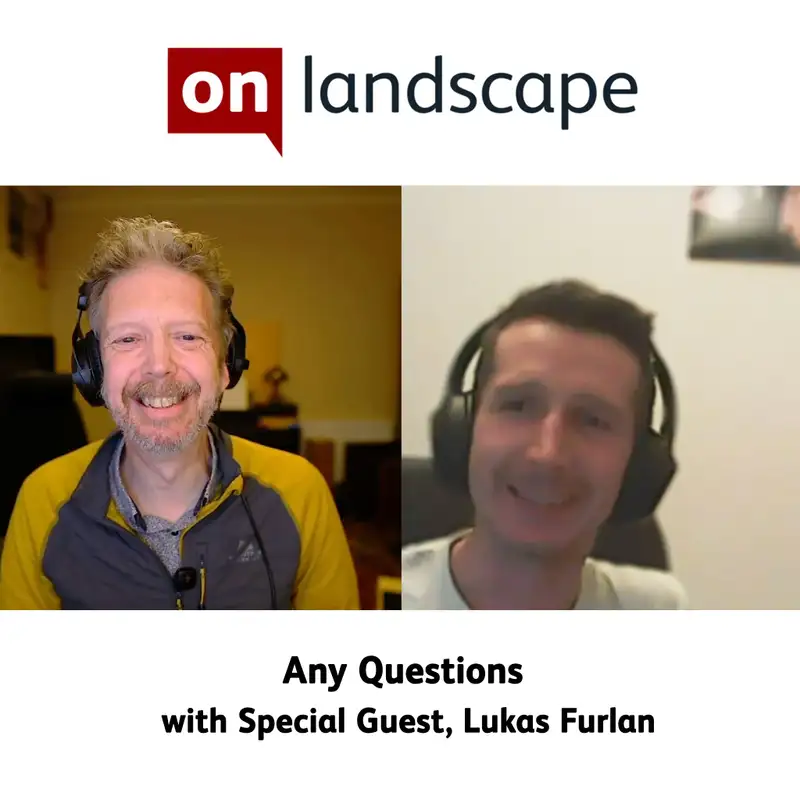
Lukas Furlan
Tim Parkin (00:01)
Hello and welcome to On A Landscape. I'm here with the Natural Landscape Awards ⁓ Photographer of the Year for 2026, as we recently found out, and great photographer Lucas Furlan. Hello, Lucas.
Lukas Furlan (00:15)
Hi Tim, thank you so much. And that sounds crazy, yeah. How you introduced me.
Tim Parkin (00:20)
Yeah, especially being as last year you came with a runner up and did you come second in the project? I can't remember what you placed with the project. Yeah, I'll be asking about that later because that was really interesting. But yeah, I'm going to pretend I don't know as much about you as I did. So if you can let us know where you're from and how long you've been a photographer.
Lukas Furlan (00:31)
⁓ it was highly recommended, I think. Yeah.
Yeah, easy questi questions to start with. Yeah. ⁓ yeah, my name is Lukas Folan. ⁓ I currently live in Vienna. I moved here, I don't know, maybe fifteen years ago, ⁓ for university and then I started my first job here. And yeah, originally I'm from South Tyrol, that's the northern part of Italy. ⁓
More famously, you know the region because of the dolomites and yeah, I still visit as often as I can ⁓ this beautiful area. And yeah, it's not it's a a big contrast for me to live in a city, in a big city, because ⁓ yeah, I come from a mountain region. ⁓ you don't have the flat land, you have mountains and
Tim Parkin (01:35)
Yeah.
How close were you to the mountains?
Lukas Furlan (01:43)
in the winter I took the bus for fifteen minutes and then I'm in the first she region. So I could ⁓ go for snowboarding or so in less than half an hour. ⁓ so I'm I'm really close to the mountains here.
Tim Parkin (01:58)
Yeah.
So how long did it take to get there now? From Vienna?
Lukas Furlan (02:08)
now the first mountains maybe one and a half hours, but I would say it's mountains because ⁓ they're not that high and impressive ⁓ as back home, but still they're mountains and you get some alpine feeling there.
Tim Parkin (02:20)
Yeah.
Do you go walking in the mountains or skiing or anything?
Lukas Furlan (02:29)
⁓ I did a lot of snowboarding back home during my yacht, but it is a bit ⁓ yeah, how you you how can I say it? you can get a lot of injuries if you go to the park and jumping around and stuff like that. And yeah, so I I I quit that with I don't know, 25, something around that. And now it's mostly hiking.
Tim Parkin (02:50)
Yeah.
Lukas Furlan (02:58)
photographing and I started also rock climbing. And that's also Vienna is also I would say a a quite okay place to do that because it takes me about one hour to be ⁓ on some rock walls and yeah that's that's quite nice.
Tim Parkin (03:03)
Okay, yeah.
Yes.
I think regular ⁓ readers of the magazine will know me and my wife go rock climbing in Scotland here. Mostly traditional climbing because we have a thing against bolts in Scotland. Not many bolts anywhere.
Lukas Furlan (03:24)
Awesome. Awesome.
Yeah, yeah, yeah. I I I saw a few videos and yeah, it's it's completely different. you are quite crazy up there. Yeah. Yeah. I can understand that.
Tim Parkin (03:37)
It makes it more interesting. And you move to a city and you do anything related to photography for your degree or?
Lukas Furlan (03:46)
⁓ when I started ⁓ with my studies I was thinking about ⁓ studying photography, but my parents ⁓ asked me if I'm pretty sure to do that because you know ⁓ the financial aspect of it and everything around that is ⁓ a different topic, and so I started with IT because that is also
Tim Parkin (04:10)
Yeah.
Lukas Furlan (04:16)
I wouldn't say a passion, but it's a big interest of mine technology. And there is also some sort of creativity behind that, behind the programming and everything around that. And yeah, so I started my IT career and photography ⁓ remains a passion and I'm quite happy with with that because at least I can
Tim Parkin (04:30)
Agreed.
It sounds
Lukas Furlan (04:46)
pursue the things I want and I don't have to struggle with ⁓ generating income. But on the other side of course ⁓ time is precious and yeah you have to manage it.
Tim Parkin (04:58)
It's really difficult, know. I know a lot of people who've ruined a good hobby by doing it for a living.
Lukas Furlan (05:06)
Yeah. Maybe I don't know, maybe in in ten years, twenty years, thirty years I I I will make a switch. ⁓ let's see. But for now I'm quite happy. I don't have to ⁓ worry about the financial aspect and can do the things I like. And yeah, that's ⁓ quite interesting.
Tim Parkin (05:25)
And how did you get into photography in the first place?
Lukas Furlan (05:31)
⁓ I have to think a bit about that. ⁓
I mean it's a slow transition I guess. ⁓ it was I I was sixteen, seventeen, something around that, and I started with ⁓ some ⁓ 3D modeling software. So I I started in the D digital place and also with ⁓ some map painting, photo compositions and such things. And then I realized okay, I need some own ⁓ footage or image.
And I took the little family camera and that I would say was the starting point. And I can remember I went out one night and did some long exposures. And for me at that time that was just crazy. ⁓ making exposures of 30 seconds and you move around with a small light and then you see all the the the the the painting the light makes and that was so fascinating and yeah.
Tim Parkin (06:08)
Yeah.
Yeah.
Lukas Furlan (06:38)
That's that was the start.
Tim Parkin (06:39)
And I presume you started photographing in the mountains quite quickly or nearby the mountains.
Lukas Furlan (06:47)
I think not that quickly. ⁓ at that point I would say I I wasn't so much interested in nature and hiking. Maybe that has to do with my childhood because we had our family ⁓ hikes every weekend and you know how child are they they don't like it ⁓ that much and so I I had to re rediscover it for myself and
Tim Parkin (07:05)
⁓ yeah, trying to, yeah.
Lukas Furlan (07:15)
Initially I started with ⁓ some portraits architecture and also some ⁓ sports photography like ⁓ downhill biking, skateboarding and such. So quite diverse and then over time I found it that nature has a lot to offer and I also like the the component of not just doing ⁓ photography but also being out in nature and doing the hikes.
experiencing the adventure and that's even more important, I would say, yeah.
Tim Parkin (07:50)
Yeah, yeah, it's a good combination. It's a good way of having a camera is a good way of making you look at the world.
Lukas Furlan (07:57)
Yeah, yeah, yeah, of course. And I I experienced things I wouldn't have without a camera. And that's that's quite ⁓ a privilege, I would say, yeah.
Tim Parkin (08:07)
So how would you say your photography's changed from when you first started going out in the landscape?
Lukas Furlan (08:14)
⁓ I would say quite a lot if I look back. ⁓
Of course you you get to know your camera, you get to know all the technical things around that, and you get better at processing, you get a a better feeling about colours and contrasts and all that. And
I would say it gets ⁓ initially I I I did everything. So that was quite fun and a lot of experimenting, and that now is a bit on the sideline, and I also would like to change that because I have the feeling that it's easy to repeat oneself over the years. So ⁓ I I made a quite big switch a few years ago from the
Grand scenic, grand landscape to the more intimate, like many others. And I am now in in in this process, but maybe I would say in a few years I'll do something different or ⁓ will try to experiment even more. ⁓ yeah, so.
Tim Parkin (09:28)
I think you learn a lot quite quickly when you start dealing with smaller subjects. It gives you more flexibility to experiment and to compose.
Lukas Furlan (09:36)
Yeah, yeah, yeah.
Yeah, and it's not so stressful because ⁓ of course you need a a good light but ⁓ often the light is is not that last sunset light and it's it's a bit ⁓ more meditative and you can focus more. Yeah.
Tim Parkin (09:51)
Yeah.
So I've noticed that with a lot of your ⁓ photographs are very well thought out compositionally, very strong ideas, but the sense of composition is consistent across. Did you put a lot of explicit thought into that or was that inspired by seeing other people's work and thinking about it?
Lukas Furlan (10:13)
I appreciate that.
I think both. But when I'm out in the field I'm I'm moving quite dynamically, so I I
I'm not stuck at one area trying to force an image. If I see something, I try, I don't know, two, three, four different perspectives and then I move on. I like this this this being in motion, being dynamic, looking around all the time. And so it's a bit intuitive for me. I have to trust myself that one of these four shots ⁓ is is well enough.
Tim Parkin (10:41)
Mm.
Yeah.
Lukas Furlan (11:00)
And I also made the also know that if I s take one hour to make one image, it doesn't get better. If it's not happening in the first ten minutes, then yeah.
Tim Parkin (11:12)
Yeah.
I was chatting with somebody about a famous experiment. It's a writing experiment. And a lecturer split the class in half and said to one half of the class, get together and write one essay you've got the whole week. And that's going be the best essay ever. And then the other half of the class, he said, you'll get points based on how many essays you write. We don't care ⁓ what they are, but they just have to be essays.
the best of the essays that came from the people who wrote the most, probably not surprisingly, turned out to be the best because they had ⁓ lots of experimentation, lots of flow, lots of practice.
Lukas Furlan (11:47)
Yeah.
I heard the the same exact thing, but not with ⁓ essays, but ⁓ with ⁓ a photography class. Yeah.
Tim Parkin (12:03)
okay, yeah, yeah. I mean, I can see the thinking about it. I know a few photographers that work handheld because they can use the camera like a sketch almost. ⁓ There were some compromises involved in that.
Lukas Furlan (12:18)
Yeah, yeah, yeah. I did yeah, I did a lot of shooting with the tripod and still do, but if the light is good enough or bright enough then I switched to handheld because of the flexibility. And a lot of ⁓ the the the last generation maybe w with film cameras they they have the tendency to shoot with ⁓ tripod and I would also
Tim Parkin (12:29)
Yeah. And then drop.
Lukas Furlan (12:47)
say that you see that in the images because it's very carefully composite.
Tim Parkin (12:52)
Yeah, yeah. I can say when I switched to large format photography, film photography for a few years, probably about eight years, and I still do it now and again, I mix both a little bit. ⁓ But the forced slowing down and stopping and preparing is a good teaching lesson to do it like that. And then once you've learned those things, you can go back and apply some of them to when you're moving faster. ⁓
Lukas Furlan (13:14)
Yeah, yeah.
That that would still be a experiment for myself to really slow down. ⁓ I mean I I'm moving quickly, dynamically, I like that, but at the same time, yeah, slowing down and ⁓ yeah, focusing on one image maybe would be a a great experiment for myself, yeah.
Tim Parkin (13:41)
I'm interested in your project from the natural landscape competition from ⁓ last year. The mistletoe on trees project, which the judges loved for the really honing in on a single subject. And ⁓ I'll try and put some pictures up as we're chatting here. it's basically, I think there was quite a few, maybe eight pictures. pictures of these.
mistletoe-clad trees in various scenarios taken sometimes with longer exposures so you get lots of movement in them. Where did that arise from? Can tell me bit more about that project?
Lukas Furlan (14:26)
I mean it it's it didn't start as a project, it's just something over time I I saw okay, I I make over and over images of these ⁓ mistletoe plants and declaring it project maybe was as soon as I I saw that NLPA has this project category.
Tim Parkin (14:53)
Yeah.
Lukas Furlan (14:53)
And so that had has something to do with that. And also because right now I just post my images on on Instagram. So I don't have a website. I I don't have this project-oriented ⁓ working, which I hope in the future will be strongly enforced. And yeah, I think the main thing I liked about that is that in the wintertime it's the only green.
Everything is quite greyish and this has still some sort of life in it. So this green, yellowish color. And in the wintertime it's also quite easy to detect. In the summer you don't see the mistletoes quite well. And so it was going or driving around ⁓ in the winter time it's it's quite easy to spot them and then of course ⁓
Tim Parkin (15:24)
Yeah.
Lukas Furlan (15:52)
It's it's a motive that presents itself quite obviously. And I was thrown t towards it and yeah.
Tim Parkin (15:59)
Yeah. Did you go back and finish, take any extra pictures to like finish the project or?
Lukas Furlan (16:06)
I made a few other ones and now this season maybe I will con still continue. I don't have any concrete ideas, but I maybe I could take some close-ups because close-ups are still missing. So there are a few as aspects ⁓ that I could still try. ⁓ and there's still a lot of experimenting. And yeah, let's see. Maybe, maybe not.
Tim Parkin (16:33)
Yeah, yeah. And do you travel much? I know you photograph nearby where you live some and back in the Dolomites.
Lukas Furlan (16:43)
yeah I I would say I make about two to three small ⁓ photo trips per year. one to two weeks at a time. And I mean the the main focus of course is ⁓ back home in in South Europe because it's I know the area, I have multiple reasons to return, to visit family, friends, then do photography, so it's a great combination.
And around Vienna, of course, it's a bit difficult, but that's that's also a great challenge. And then of course, with the photo trips, I try to cover things I don't get to experience otherwise, like ⁓ seascapes or ⁓ I don't know, some sand dunes. And yeah, this year I was one week in North Spain. Really awesome. I still have to look
Tim Parkin (17:31)
Yeah.
Lukas Furlan (17:40)
⁓ at all the images and I was one week in Greece. ⁓ I didn't saw many on nearly any image from from Greece. So I was curious what Greece has to offer. Okay.
Tim Parkin (17:55)
I've got one friend who goes and they've come back with very interesting work.
Lukas Furlan (18:01)
Yeah, yeah, yeah. And I think most of the photographers go to the little islands. I was on the the main part of Greece and no preparation, nothing. It was yeah, a bit diff difficult to find the subjects. ⁓ I mean quite interesting. Come again. ⁓ with a friend, photographer friend, yeah. ⁓
Tim Parkin (18:18)
Were you on your own?
Were you on your own? Yeah.
I think very dry places like that ⁓ don't exude subject matter.
Lukas Furlan (18:35)
Yeah. ⁓ it it was it was difficult. I don't think I have a lot of images, but it was a great experience, great adventure, and that's the most important thing. And yeah. Maybe in in a few weeks I will head ⁓ to England and no no plans, just some coast, maybe Cornwall, that area. Yeah. Maybe you have some something ⁓ you can add to
Tim Parkin (18:46)
Have you got any?
Okay.
Mm-hmm. Yep.
Lukas Furlan (19:04)
to England and November photography. Yeah. Yeah, of course.
Tim Parkin (19:07)
I can make some suggestions if you're interested, yeah? I've got a few friends down there. yeah. Any other plans for trips?
Lukas Furlan (19:18)
⁓ no, let's see, maybe next year something a little bit bigger, let two weeks, maybe three weeks, but it's still open. I have a few photography friends and I really appreciate that I have this possibility to not be forced to do it on my own because it's so much fun if you can share it. And so it's al always a bit a bit of compromise. ⁓
regarding timing, location, but ⁓ in the end the it's it's a big advantage to have this this ⁓ these are few people that are as interested, yeah.
Tim Parkin (19:59)
And you said you don't have a website, which is probably quite unusual for ⁓ a lot of photographers playing around.
Lukas Furlan (20:07)
maybe. I I since two years I I'm I'm playing with the thought to build one. But at the same time today, who visits a website? I mean it
Tim Parkin (20:21)
I've thought about this before, yeah. ⁓ It's gone back to being just a business card almost, hasn't it?
Lukas Furlan (20:27)
Yeah, yeah, yeah. I mean the I would do it for myself to be forced a bit to ⁓ make ⁓ a selection a portfolio because now I just dump it on Instagram and and yeah, then it goes and ⁓ I I don't have yeah, the feeling of having ⁓ a small selection of my ⁓ best work and it it's also a bit
for the mind to think about big why I would choose that image over another one. And it's also maybe that I could learn something. So that is the the reason I would make a website, even if maybe two people visit the website per month and one of them is a bot. I don't know.
Tim Parkin (21:01)
Yeah.
Yeah.
I'll go, I'll be the other person.
There is something about, I like to say, curating a set of work, ⁓ whether it be to submit to a competition or to have an exhibition or to create a book. But I get the feeling that you're as much interested in just taking pictures and being out as much as sharing them and putting them on social media.
Lukas Furlan (21:45)
Yeah. I sometimes when I have time to ⁓ look at my images and to process a few, most of the time I go outside and make new ones. So it's it's that that that intrigues me. ⁓ everything else comes secondary. And yeah, I mean it it's it's a bit
Tim Parkin (22:05)
Yeah.
Lukas Furlan (22:14)
I don't know. It's y it's the discovery, the the you you always ⁓ find something new, you discover something you haven't discovered yet, and yeah. This this n never ends.
Tim Parkin (22:25)
I like it force forces you to learn about what you're looking at sometimes as well. I quite like I quite like the intrigue when I see something I don't recognize and go, what's that?
Lukas Furlan (22:29)
Yeah.
Yeah, yeah, it it it can get quite addictive, I would say.
Tim Parkin (22:42)
So who would you say inspired your photography when you were starting up? Does anybody inspire you these days?
Lukas Furlan (22:54)
⁓ when I started up, it it was the time before social media and everything. So for me at that point it was hard to stumble upon inspiration. It was I was completely new to this ⁓ photography thing. So there were I think one or two German ⁓ forum online websites where people meet and discuss things.
Tim Parkin (23:19)
Yeah.
Lukas Furlan (23:24)
So the the inspiration was quite limited, but at the same time you can do the things that you want without having in your back the images you already saw. So it was quite a lot of experimentation and ⁓ discovery from that perspective. And then with social media, yeah, things changed. You you saw too much, I would say.
Tim Parkin (23:39)
Yeah.
Lukas Furlan (23:55)
And you also maybe consciously but also unconsciously ⁓ yeah made the same thing everyone else does.
Tim Parkin (24:07)
We see it lot in the competition that there's definitely patterns of photography, styles of picture that get repeated.
Lukas Furlan (24:15)
Yeah. I mean I'm also part of it. Of course. it's it's it's not easy to ⁓ to don't have it in your mind all the images ⁓ you see.
Tim Parkin (24:25)
And originality is, being original isn't the most important thing. Doing something interesting with what's in front of you is more important.
Lukas Furlan (24:32)
Yeah.
Maybe it helps if you don't live ⁓ somewhere where everyone goes around to shoot. Maybe if you live some somewhere an area where you are the only photographer, you have ⁓ to think more, to look more, and then maybe you can be quite original. ⁓
Tim Parkin (24:57)
We do see in the competition different cultures having different aesthetics. I think we had a couple of Japanese photographers win about three years ago ⁓ and did very well. And all of a sudden we had lots of entries the following year and now we get quite a few Japanese photographers entering. And it's interesting to see this. And it's interesting to see how they work differently. we've had this year, we've had Taiwanese photographers enter.
Lukas Furlan (25:17)
Yeah, yeah, yeah, I I saw that, yeah.
Tim Parkin (25:27)
Indian photographers, and South American photographers. So it's interesting to see some of the aesthetics there. I used to do a competition for the environmental photographer of the year, which was free to enter. And because it was free, people in countries like Iran were able to enter. And a quarter of the entries to the whole competition were from Iran, because there was nothing else they could enter.
Lukas Furlan (25:30)
Awesome.
Yeah.
⁓ Okay.
Tim Parkin (25:56)
And so they had, and it was, that was incredible to see an environment where, you know, they couldn't use the internet really to look at a lot of pictures from other people. And they were developing in their own ⁓ habitat as it were. think they still got access to a lot, they still got access to books and some internet, et cetera, but.
Lukas Furlan (26:11)
Hm, okay, awesome.
Was this quite some time ago or recently?
Tim Parkin (26:21)
No, this was eight years ago, maybe 10 years ago.
Lukas Furlan (26:28)
If you still have ⁓ some resources or links to this competition, I would be quite curious to see what they produced.
Tim Parkin (26:34)
Yeah, I'll pick it out. The competition is still running, so it's quite good. ⁓ Yeah, and...
Lukas Furlan (26:39)
Okay, awesome.
Tim Parkin (26:46)
From your experience looking at an entering a competition, how did you feel apart from winning because there's no guarantee you'll win a competition? What was your objective in entering? you think about it as a way of putting your pictures together or seeing how they potentially stood up against other people's pictures or any other motives?
Lukas Furlan (27:08)
⁓ I wanted to get the free book. That was one of the reasons. ⁓ no. Yeah, maybe just to see what other people think about it because ⁓ on on on social media or so you you don't get any feedback. you can forget ⁓ getting constructive or any feedback at all. And
Tim Parkin (27:11)
Yeah.
Yeah.
Lukas Furlan (27:36)
Yeah, of course I I have a few photography friends who I'm talking to about ⁓ image style and if image is good or not. But this is something different, something new to me. I entered a few ⁓ competitions a long time ago and then nothing. And this NLPA was the first recently. ⁓ so I I was just curious and also
This mistletoe project I wouldn't have done without the contest. So it was also a bit of how you say ⁓ motivation to do it and to pursue it. Yeah.
Tim Parkin (28:12)
Yeah.
An opportunity to create a project together. I know the book, it's interesting you say that the book is a prompt. I think books are fantastic resource. think photography books are underrated and the ability to share images in a way and making a book of some sort is great. So I think for me, the competition is about the book.
Lukas Furlan (28:23)
And
Tim Parkin (28:47)
as much as is about winners and seeing a variety of pictures. I'm just organizing the new book at the moment and it's great to go through all the entries and curate a set of pictures.
Lukas Furlan (28:47)
Yeah, yeah, yeah, yeah.
I bet that. I'm s looking forward. I have all other books and each one of them is so awesome and the variety. Yeah. Just great to to take I don't know half an hour, an hour to to go through the book. Yeah.
Tim Parkin (29:15)
Do you have many other photography books?
Lukas Furlan (29:17)
I started collecting a few years ago. I think the first one came in three years ago. And then it was yeah, it go it went up like nothing. ⁓
Tim Parkin (29:30)
There's a lot of photography books published recently. I think in the last probably about five years, I'm not sure whether printing has become more accessible to people or the software to create books, but it's within reach for a lot of people now to make a book. It's not cheap, but it's accessible.
Lukas Furlan (29:33)
Yeah.
Yeah.
Yeah. I I also ⁓ try to find old ones like from the I don't know 70s, eighties, from the Grandmasters, ⁓ because you can get them quite cheap and you can relearn a lot. And it's interesting, a few images, they of course the quality of the printing also of the camera is something different, but it it you you
Tim Parkin (30:00)
Yeah, absolutely.
Lukas Furlan (30:14)
I thought, okay, it's the same thing I would make today from from the composition or also from the motive. So it's quite interesting that they already at that time had that ⁓ way of thinking.
Tim Parkin (30:30)
Yeah, from from Elliot Porter and one of my favorite photographers, Brett Weston, Edward Weston's son, and did some amazing black and white photography. It's really contemporary looking. But I've got quite a few old books, I should probably make a list of them to stick on the website to share, share what we've got. Have you got any recommendations for interesting books you've found?
Lukas Furlan (30:33)
Exactly, yeah.
Yeah. Yeah.
I I ordered today the new from Joe Cornish, which I'm looking really forward because he's a yeah a big inspiration and I yeah. I I don't have any ⁓ books from him. I don't know. I I think he has one or two or maybe more.
Tim Parkin (31:07)
That's brilliant. He will be very grateful.
He's done about six or seven, this, I would say there's probably three that are really, really good and worth grabbing hold of. there's First Light, which is his first book, which is favorite. And then he did two books on Scotland, which are well worth getting, I think. But this latest book's going to be the same, ⁓ it's printed by the same people who do the natural landscape book. And it'll be about the same size and length.
Lukas Furlan (31:23)
⁓ okay.
Okay.
Tim Parkin (31:50)
I think quite a bit of writing.
Lukas Furlan (31:51)
Awesome. Yeah, really looking forward. ⁓ any other I have to think about it. ⁓ yeah I have it here, one from ⁓ Agit Porta. I like it because it's so old. That's the main reason. Porta. Yeah. I just have to take a quick look.
Tim Parkin (31:54)
Any other any other things here you go back to?
Who? Who's it from? yes, yeah.
Yeah.
Lukas Furlan (32:21)
It's called Nature's Chaos. Yeah, it's it's yeah, awesome.
Tim Parkin (32:25)
Another one.
It's quite satisfying when you get some of these old books that you can buy for, you know, four pounds or something. And they come through and they're really good quality. There's a lot of old Sierra Club books that you can get like that. Because books aren't cheap these days ⁓ to print or to buy. I 50 pound, 60 pound for a lot of books. Have you thought about that potentially?
Lukas Furlan (32:37)
Yeah, yeah, yeah, yeah.
Yeah.
Yeah, yeah, yeah, yeah.
⁓ potentially yes. ⁓ but it's it's yeah, it's it's a lot of work and how I said earlier I I I'm more willing to go outside taking new images. yeah.
Tim Parkin (33:10)
Take more pictures. I'm impressed that you can come back from a holiday and not immediately sit down and go through the images to process.
Lukas Furlan (33:18)
I did that a few years ago and now my my work changed a bit to how I I I do the organizing. I think it had a has a lot to do with ⁓ previously I did mostly grand landscape and nowadays I have a lot of focus decking and such and this makes things so much more complicated to organize and that's a bit of ⁓ yeah ⁓
Tim Parkin (33:39)
so you need to address them. Yeah.
Yeah.
Lukas Furlan (33:48)
Well, I don't want to sit down and do it. That's probably one reason why ⁓ processing gets a bit ⁓ annoying for myself.
Tim Parkin (33:56)
Yeah, and I presume if you're working in programming then you've been sat in front of computer most of the day as well.
Lukas Furlan (34:00)
Yeah, yeah, that's the the other reason, exactly. Yeah.
Tim Parkin (34:04)
That's similar. I I used to work as an engineer ⁓ and a programmer for a while and still do in Python a little bit, although it's too tempting to use Claude to write my Python code these days. He does such a good job. ⁓ But yeah, I need to get away from the computer after a while. So spend more time.
Lukas Furlan (34:16)
Yeah, yeah.
Yeah, that's of course that's that's also a big reason for myself. Yeah. Let Claude do the work and at the same time I'm outside ⁓ photographing.
Tim Parkin (34:35)
That'd be great. Just five code from the landscape.
So, happy. ⁓
Lukas Furlan (34:41)
just a a quick question for yourself because we I I mentioned the focus stacking. with the with your camera, film camera you you have the possibility to tilt. How do you experience pro or advantages and disadvantages of using digital versus the old one for focus stacking or or focusing?
Tim Parkin (34:46)
Yes.
Yes.
⁓ I've got a tilt lens for my ⁓ Sony A7R III I've got at the moment. And I've got a 24 to 35 millimeter lens that fits on it nicely and a 50 mil lens. quite often I will try and if I'm sitting up and taking a while over a picture, I'll quite often try and take it with tilt. It's a compromise.
because obviously if you've got a very three-dimensional picture, this single plane of focus isn't gonna fit through everything. But there is something organic about taking a picture with a foreground quite close and a background, this sort of near far composition. You'll see on Joe Cornish or who else would we say it'd be? David Munch maybe where...
Lukas Furlan (35:39)
Yeah. Yeah.
Tim Parkin (36:03)
you can see the subject, say if you've got some grass on a rock, the blades of grass will be in focus, but the bottom of the blades of grass will be out of focus. The top of the rock will be in focus, but the bottom around it will be out of focus. So you get this strange sense of drop focus in another direction. And you get this light softening effect. it's like using a fast lens.
Lukas Furlan (36:20)
Yeah. Yeah.
Tim Parkin (36:33)
but positioning the planar focus slightly differently. So you do get this ⁓ selective focus, whereas when you stitch it with a focus stack, everything's perfect. I often wonder whether it be possible to...
Lukas Furlan (36:34)
Yeah, yeah.
Yeah. Or if you ⁓ do a water reflection, then the water is sharp and the reflected prease are evenly unsharp. Yeah.
Tim Parkin (36:52)
Out of foc... Yes, yeah, exactly. Which is really intriguing. I always wondered whether you could be able to do that with focus stacking and decide not just stack them all together, but pick which parts you want to have in focus and out of focus at the same time. I'm not sure. You might have to end up taking ⁓ each focus layer as an aperture stack as well. I have done...
Lukas Furlan (36:57)
Yeah.
Yeah.
Yeah. Yeah, but but that was a bit a way I I I would appreciate this compromise because it's the more puristic way of shooting because even no not even ⁓ each time I I do a focus deck it's it's even more digitally altered.
Tim Parkin (37:40)
Yeah.
Lukas Furlan (37:40)
⁓ of course the sensor everything is already digital but you can still argument okay it's one exposure but with the focus stack ⁓ you have this technical flaws if you stack of course. So yeah maybe I'm I'm I I would try ⁓ tilt lens because yeah it gets easier to organize and it it's more puristic I would say.
Tim Parkin (38:02)
That's it.
Yeah. One thing I do do with the tilt lens sometimes because my tilt lens goes to F16. Obviously you're losing a little bit of sharpness to F16. But I'll take a photograph. I'll get the plane of focus where I want it and then take a photograph at F11 or F8 and then a photograph at F16 and do an aperture blend rather than a focus stack. you get the depth of field.
Lukas Furlan (38:28)
okay, awesome.
Tim Parkin (38:32)
as well as the planar focus from the F16, but you get the sharpness from the areas that are at F8, which then looks quite organic. So it's fiddly, but I think it is quite fun to do. I've done it with a Mirex adapter. I'm using Nikon AIS lenses where you can get an lever to set the aperture.
Lukas Furlan (38:34)
Yeah.
Awesome.
⁓ okay. Yeah.
Tim Parkin (39:01)
So it's nice and manual, you even have to set the aperture by hand as well. But yeah, it's doable. And then you get sucked into starting using film as well.
Lukas Furlan (39:06)
Awesome.
Yeah, yeah. Maybe in the future, yeah, yeah, yeah, yeah. It's intriguing.
Tim Parkin (39:14)
Maybe one day.
So would you recommend other many landscape photographers in Vienna where you are?
Lukas Furlan (39:23)
⁓ that's ⁓ an ongoing project of myself to find anybody up to now, not really. It's it's a a bit of a community I would say, but it's more on ⁓ wildlife. ⁓ there are a lot of birds and yeah, other smaller animals around, so yeah, it's a great place for that. But
Tim Parkin (39:30)
Yeah.
Yeah.
Lukas Furlan (39:50)
Maybe some traditional landscape photography, yes. But the things I pursue it's it's hard to find any anyone. ⁓ maybe if a listener is out there, ⁓ write me a message if you wanna hang out sometimes. Yeah.
Tim Parkin (39:58)
Yeah.
What about in the, you're at home, Terrell?
Lukas Furlan (40:13)
In can ⁓ there are more. ⁓ I have ⁓ some friends, some close friends ⁓ that do also some photography. Of course ⁓ it's a bit difficult to head out together all the time because I'm away. ⁓ some other
Friends are also living abroad. ⁓ but there is more going on. There are also some ⁓ local photoclubs that are centered around nature, also wildlife but also ⁓ yeah, plains and mountains and such. So it's a bit more yeah, vivid there.
Tim Parkin (40:47)
Yeah.
But I'm intrigued in visiting one day, both for climbing and photography. I think it'll be quite interesting.
Lukas Furlan (41:03)
Yeah, it would be a great combination. And ⁓ you can I think there is a lot of tread climbing ⁓ you can do in the l the Lomites.
Tim Parkin (41:13)
Yeah. Have you taken the camera out while climbing and combined the two?
Lukas Furlan (41:18)
I was thinking about it but it's it's too much I would say. ⁓ I I can't focus on both things. So I I keep this thing separate there.
Tim Parkin (41:26)
I can understand that. Well, thank you very much for your time, Lucas. It's really appreciated it. ⁓ And we'll include some links to your Instagram. I think you can have a be hands as well. And hopefully we'll show some of the photographs as we've been chatting.
Lukas Furlan (41:33)
Yeah, it was awesome talking to you.
Yeah, I I I will make more if I can show more, let's see.
Tim Parkin (41:53)
I'll send some links to ⁓ potential places in England for your next trip.
Lukas Furlan (41:58)
Yeah, that would be awesome. Much appreciated. Thank you, Tim.
Tim Parkin (42:02)
Thank you Lucas.