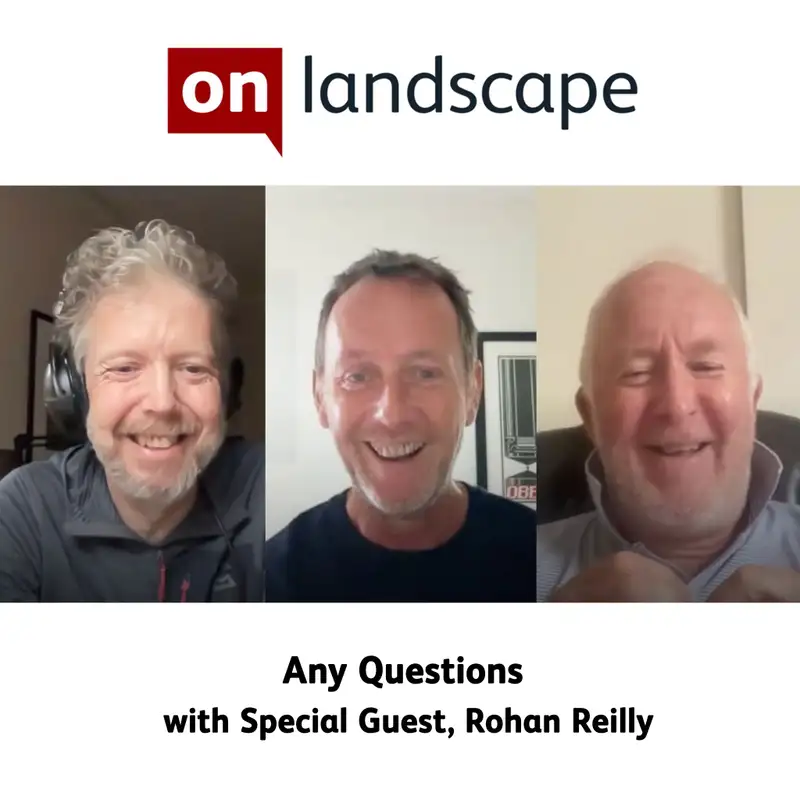
Rohan Reilly
Tim Parkin (00:00)
Hello and welcome to On Landscape with another episode of Any Questions. I'm here with Mark Littlejohn and our guest Rohan Riley. Hello, Rohan.
rohan (00:10)
Bye, how you all do?
Mark LJ (00:12)
I'm doing fine, thank you.
Tim Parkin (00:12)
very good here, yeah.
rohan (00:14)
Nice to meet you.
Mark LJ (00:16)
Yeah, it it it it's very nice to meet you. I I've I've followed your work for a long, long time. I wouldn't like to say how long actually, but but it's been quite
rohan (00:24)
Yeah,
Mark LJ (00:24)
a while.
rohan (00:25)
could be 16 years. 15 years, something like that,
Mark LJ (00:27)
Yeah, yeah, yeah, yeah.
rohan (00:29)
I think. Yeah.
Tim Parkin (00:30)
I think I've s I've
Mark LJ (00:30)
Yeah, I mean that
Tim Parkin (00:31)
I think I've seen your work around the twenty tens ish.
rohan (00:34)
Yeah, yeah, that would have been when I came back to Ireland from Barcelona. And that's when I started getting seriously into photography. So yeah, from Flickr, you know, that's where we all were.
Tim Parkin (00:46)
Those days.
rohan (00:47)
Yeah.
Mark LJ (00:47)
Yeah, yeah, no tw tw twenty ten, yeah, that's exact that's when I bought the camera and and I think sort of fell into watching or looking at a few individuals that I still look at today, to be honest.
rohan (01:00)
Yeah, yeah, there was a great community on Flickr back then, very supportive.
Mark LJ (01:05)
Yeah.
rohan (01:06)
The critique was very good as well. Everyone just said that's brilliant. You know, it was a different kind of group. Yeah.
Mark LJ (01:11)
Awesome. Awesome.
Tim Parkin (01:15)
I was I was quite surprised how
it all changed with Flickr 'cause it it Flickr Flickr was just like you say the one of the best platforms for feedback. People would give you proper critiques if you wanted. And there was a sort of round robin sort of network of people who talked to to each other.
Mark LJ (01:28)
And there were nice
nice little groups as well. I mean on landscape had its own little group. But yeah, it was it was it was good. It was a little community. and if you I mean I still host pictures in there occasionally because I I I I'm into my music so I I'm I'm still on a couple of hi fi forums and that's where if I'm gonna put up a picture up in there then that's which is usually a bottle of whiskey these days to be honest on the whiskey side.
But yeah, so it's still it's still going, still people that have just used it and nothing else for the last fifteen years.
Tim Parkin (02:03)
Not nothing seemed to replace them and it lost its it lost its momentum when when it was taken over and they sacked everybody. I had a few friends that were sacked.
rohan (02:09)
Yes. And I think there was a,
Mark LJ (02:11)
Yeah.
rohan (02:15)
really? There was a period when Google plus was very good. And just that first splinter kind of
Mark LJ (02:19)
Mm.
rohan (02:23)
led to another splinter then with Instagram. then, you know, it just all lost its community
Tim Parkin (02:27)
Yeah.
rohan (02:28)
vibes.
Tim Parkin (02:30)
There was a there was not knowing what you're gonna see. I think it was an a tactical decision by the social media companies. But how d how how did you go from from being 'cause we were just chatting earlier before about the fact you were a you were in the music industry managing a couple of venues down in London. and y you carried on in the music industry as
a record label owner in Dublin?
rohan (02:50)
In Dublin.
Yeah, I owned a record label and a record shop and I also promoted nights as well and DJ'd, I DJ'd quite extensively around the world. And it was around 2005, 2006, the internet came along in a different way in that people could buy MP3s and also people could buy vinyl on the internet and that
Both of those attacks, both the record label and the record shop. so I closed
Tim Parkin (03:23)
Yeah.
rohan (03:24)
the record shop and moved to Barcelona and the, the,
Tim Parkin (03:27)
Fly.
rohan (03:28)
the advent of digital technology killed one, but also brought cameras to a much cheaper, you know, audience, you know, like I
Mark LJ (03:37)
Yeah.
rohan (03:37)
bought a Canon EOS 350 or 400 D and it wasn't that expensive. Whereas we previously, they were much more
Tim Parkin (03:44)
Yeah.
rohan (03:45)
expensive. So one kill the digital evolution killed one.
career beside another so yeah it's quite interesting.
Tim Parkin (03:53)
That ha ha what why a camera? Was that inspired by any particular photographers or any moments of
rohan (03:59)
At that point, no, not photographers. I had been DJing around the world and I had a Polaroid camera and a Casio camera and I'd started messing around wanting to record not only the people that I was meeting but also some of the scenes. And I remember I was in North America during fall or autumn and the colors were absolutely amazing and I couldn't capture that. I couldn't record what my eyes could see and I got really frustrated.
Tim Parkin (04:28)
Yeah.
rohan (04:29)
that the photographs on my phone or my Polaroid or whatever just weren't good enough like when I showed them to other people because they're just like, all right, yeah, you know, that's
Tim Parkin (04:39)
Yeah.
rohan (04:39)
not good.
Mark LJ (04:40)
It it's not
a it's quite a big thing to leave and I suppose in Dublin. It's a very musical city.
rohan (04:48)
Yes.
Mark LJ (04:48)
and it's a very vibrant musical city. I went last year with my boy, we went to see Nick Cave, which which was a fab night, but we went to the rock and roll museum, which was great going downstairs and seeing all the b y you really got the impression that music meant an awful lot to the city. So it's a it's a big sort of change, I suppose, really. You know, you're
completely changing the different community, different people.
rohan (05:13)
Yeah, I kind of had come to an end of an era. I knew that closing the record shop and the record label was turning into an MP3 label, which I didn't want to do. I love vinyl. I love records. It's a tangible product. At that time, I was very anti-MP3s. And now we listen to music on our phones in the cars and we don't have that product. So I just thought I'd go with that.
Mark LJ (05:36)
The mix the mix room for all the
all the vinyl in
rohan (05:40)
Yeah, exactly. Like I've still got thousands. I've moved them again recently and it's heartbreaking and backbreaking, but I can't get rid of them. yeah,
Tim Parkin (05:48)
It's especially the dance scene, isn't it, as well, yeah.
rohan (05:50)
yeah, yeah, there's thousands, but I've actually just bought a new MP3 digital player, which, you know, I've come around now that the music isn't coming on vinyl. So I want the music and I want to be able to still DJ. So I thought I've kind of turned the cord on that point.
But
I went to Barcelona to just to reinvent myself and have a little think about what I wanted to do next. And it was the architecture of Anthony Gaudi that just blew me away. And I just started photographing the architecture and through the record label, I'd already been using Photoshop. So I knew how to create layers and masks. So as soon as I was taking any photograph that looked kind of okay, I could do something with it and make it look a little bit better. So I was uploading to FlipBars straight away with some, you know,
Some photographs I look back on now and I still go, yeah, they're not too bad, you know, even though I'd only had a camera two months, like a proper camera two months. So that's how it all stops from using these to these, you know.
Tim Parkin (06:52)
And that's archite architecture,
Mark LJ (06:52)
But it needs.
Tim Parkin (06:53)
not landscape, which is a big a
rohan (06:55)
Yeah.
Tim Parkin (06:56)
big change as well. I know you still do a fair bit of landscape. I've seen the some of the Spanish rooftops and things.
Mark LJ (07:03)
But is that as much
rohan (07:03)
Yeah.
Mark LJ (07:03)
to do with what w you were actually surrounded by? If you're in a city, it's the buildings that you're surrounded by. Wh whereas when I picked up my first camera, within no time at all, I'm sailing up and down Osworth all day. So it's like you take a picture of what's close to you and what you see and what strikes your heart, I suppose.
rohan (07:20)
Absolutely.
And then when we came back to Ireland, the architecture was gone because we don't have that much modern architecture. And so then it was the landscape that was around me. And that's what I photographed, you know.
Tim Parkin (07:34)
How long were you in Spain for?
rohan (07:36)
Three years. Yeah, three years exactly. We came home to start a family and my wife brought me back to a tiny fishing village in Ireland called Baltimore. I was just like...
Tim Parkin (07:48)
Quite a shock from moving
from from London, and then yeah, and then to Barcelona,
rohan (07:51)
to cover them and let us know.
Tim Parkin (07:54)
which is I mean Barcelona and Manchester where I was from, got massive links. And
rohan (07:58)
yeah
to a fishing village of 400 people and I was like what am I gonna do there and she said you're gonna be a photographer and I was just you can't be
Mark LJ (08:06)
It wouldn't.
rohan (08:08)
photographer.
Mark LJ (08:10)
A few years old, what do you what do you of living in a little village? How have you enjoyed it?
rohan (08:15)
I love
it. love it. we, my gallery is in Kinsale which is narrow and a half way or narrow 15 in wintertime when there's tractors and tourists. But it's lovely. It's great for the kids. We've got a lovely setup here with the families around
Tim Parkin (08:30)
Mm. Yeah.
rohan (08:31)
us. Yeah. It's really nice. Really nice.
Mark LJ (08:35)
You almost you almost have like I mean it's like our little lane here 'cause we've got a very small community, but y it's almost like a support group. If anything's
rohan (08:42)
Yes.
Mark LJ (08:43)
gone on when Rachel was in the hospital for a couple of weeks there, it was like everybody was looking after the dog and everybody's doing this and do you need anything else and do you need that? And it's it's different. You go to the
rohan (08:53)
Yeah, no.
Mark LJ (08:53)
city and don't know who's on the inside.
rohan (08:56)
Yeah, you don't know who's next door and you know, there's the,
you
Mark LJ (08:59)
Yeah.
rohan (08:59)
look up the dog for a week? There's no issue, you know, there's someone who will do it. And also people are very supportive of emerging artists and, you know, helping encourage them. if you're in a city, I would imagine it's much more difficult.
Mark LJ (09:14)
I I I found
Tim Parkin (09:14)
Yeah.
Mark LJ (09:15)
that when I moved here, my next door neighbour is Alison Dunlop, who's a fantastic she's you can't call them sketches, but she does the most amazing work with with pencil, but also watercolor. and we've got writers down the way, then we've got another lass who does ceramics and things and it's it's come here and it's like incre you know, art being an artist or or in that sort of field, you feel very much at home.
rohan (09:41)
Yes.
Mark LJ (09:42)
feel supported.
rohan (09:43)
Yeah, absolutely.
Mark LJ (09:44)
as as opposed to when I lived in, you know, Cumbria and it was like, What you taking a picture of? And it was
rohan (09:49)
Yeah.
Mark LJ (09:52)
a totally diff totally different attitude. Totally different attitude.
Tim Parkin (09:55)
How d how did you transition from as I say if you're in Barcelona taking pictures of the buildings to to trying to develop a business having been told you're going to be a photographer?
rohan (10:08)
I was very lucky at the time my wife had a family business which was a restaurant which is actually now just our home. We renovated it last year but I was working in the kitchen and this her and her sisters convinced my father-in-law who was a painter and who normally had his paintings on the wall in the restaurant for the summer to let me have my photographs just to try and kind of like growl at me and like show encouragement and
Immediately I was selling photographs very, quickly, you know, and then another photographer approached me about setting up a small photography gallery the next year. And I was the one who was going to run it when there was five photographers. And then I was working in the kitchen at nighttime because at this point I needed to be doing two jobs because obviously, you know, one isn't enough. And it kind of developed from there, you know, and then it's I started doing workshops as well as
working in the kitchen and selling in the gallery and, you know, eventually, you know, I transitioned to just photography work with workshops and selling photographs. And now it's predominantly just selling photographs and a couple of workshops here and there.
Tim Parkin (11:23)
Is it the same gallery? Or is that a different was it a different one you started with?
rohan (11:26)
No, moved.
had one in Baltimore, which is the village that I'm in. the season really is only six weeks, whereas Conceal, it's much
Tim Parkin (11:34)
All right. Yeah.
rohan (11:35)
longer.
Mark LJ (11:38)
Yeah.
Tim Parkin (11:39)
How long that process
take then from from getting contacted by another photographer about a gallery to to being able to stop cleaning dishes?
rohan (11:50)
What I did, I did dishes for two years, maybe three years,
and then
Tim Parkin (11:55)
Okay. Yeah. That's
rohan (11:57)
I opened my own space 12 years ago. yeah, it's all...
Mark LJ (12:02)
it's a decent length of time. Is is is that
influenced you at all in in in what you photograph thinking about I've got to to to sell?
rohan (12:12)
Yeah, like there was always a panic. Like I do limited editions and the total amount of prints for any photograph is just 30. And
Mark LJ (12:21)
Yeah.
rohan (12:22)
I would panic every January, February, wondering if I would have that photograph that would sell that year.
Mark LJ (12:27)
Yeah.
Tim Parkin (12:27)
Yeah.
rohan (12:28)
And then in 2020, during lockdown, I took a photograph of a local lighthouse called the Fastnet. It's 15 kilometers out in the ocean. It's made from granite from the Cornwall coast.
It's just the most amazing structure. And I took it to sunrise in a different way to what most people had before. And I made the decision not to limit that one because not only did I know what was going on with lockdown, like it was a worrying time for everybody, none of us knew what was going on. And that gave me a situation where I could relax knowing that I had the fast night. wasn't going to sell out that year. And so for subsequent years up until
maybe the last year or so where it's not, or the last two years it hasn't been the biggest seller, but it just, you're relaxed, I could do what I want to do. And that's
Tim Parkin (13:15)
Yeah.
rohan (13:15)
where I can do whatever I want with it. Not I can do whatever I want, but I don't feel the pressure to make photographs to sell.
Mark LJ (13:22)
So is is it mostly from footfall or is it or people 'cause obviously you've you've probably got a fair bit more publicity recently with the Hasselblad Masters. Is is that has that made any difference, the Hasselblad Masters to sales or visits?
rohan (13:35)
Not
to sales, no. To things like this, know, and just being contacted by various different photographers and what have you. It's, I've gained quite a few followers on Instagram as well. And I have a little sign in the window, you know, saying, you know, and I have the photographs in the window.
But no, I think it's not a huge thing for sales in the gallery in any way, but it's just a little bit of reinforcement for people to go, okay, this seems like something serious. But I had the Sony Awards in 2019 as well. I came second
Tim Parkin (14:23)
Mm.
rohan (14:23)
at that one and that was huge for me back then. It's just...
Tim Parkin (14:26)
Wh which project w
which project was the Sony Awards one?
rohan (14:31)
That was for the fishing huts in Palestrina.
Tim Parkin (14:34)
Yeah. Yeah.
Mark LJ (14:36)
Yeah, remember that. That was six year ago. Seven year ago. I can't I can't even claim it
rohan (14:40)
Yeah, everywhere goes.
Tim Parkin (14:41)
Flies.
Mark LJ (14:44)
that quickly.
rohan (14:46)
Yeah, that's it.
Tim Parkin (14:46)
And you've got a quite
quite a broad range of countries that you've done work in. Is it is has that been part of an exploration of just research or have you been influenced by what you've seen or contacts you've made around the world?
rohan (15:02)
Well,
like my photographs are predominantly from Ireland, Italy, Japan, Spain. Spain is where I started and
Tim Parkin (15:08)
Okay, yeah. Yeah.
rohan (15:11)
Italy, I went to Venice quite early on, maybe 2013 or 2014 and then went to Tuscany and then I started exploring the places that aren't so much photographed and I just love Italy. I love the food.
Tim Parkin (15:26)
I r I remember
I remember some of the Italy works. I remember I'm a big fan of Alga Essa, and his he's one of the one of the students of the Beckers in Germany. And
rohan (15:36)
Okay.
Tim Parkin (15:37)
he'd he'd he did quite a bit work around the the entrance way to Venice. Quite simplistic ten eight colour negative shots in very warm tones.
rohan (15:50)
Mm-hmm.
Tim Parkin (15:51)
and I think I think he
they were obvious obviously an influence on quite a few photographers, but I remember seeing your work around the same same time as that, I think it was.
rohan (16:00)
Okay.
Tim Parkin (16:01)
fantastic. I love I love the I love the long exposure minimalism of those classic buildings over water.
rohan (16:09)
Yeah, yeah, it's like it is a wonderful place and I spent two months there every year for a considerable number of years. I was chasing the flooding, the aqua altar, as
Tim Parkin (16:21)
Mm-hmm.
rohan (16:21)
well as various other things, you know, so yeah.
Mark LJ (16:25)
That's a fair
so so that's two two two months away from family? Just dedicated to the craft?
rohan (16:32)
Yeah, They were my family were quite young then. That's one of the reasons I stopped doing workshops
Mark LJ (16:38)
Okay.
rohan (16:39)
because they're at an age now where I'd like to be here to help them with the homework and just to be around have a laugh as well. But like,
Mark LJ (16:49)
Well 'cause it it doesn't it doesn't last long.
Tim Parkin (16:50)
Yeah.
rohan (16:52)
no, no, there was was one occasion, I think it was it wasn't last year was the year before I was it was 430 in the morning in Japan and my daughter rang me to help her with her maths.
And you know, I was
Mark LJ (17:04)
Yeah.
rohan (17:04)
just like, what, really? Okay, come on, let's do this. Let's do this. But yeah, you know, I'd rather be I'd rather be here rather than waking up in a foreign country trying to help them with that.
Mark LJ (17:12)
Yeah. Yeah, it it
it's crazy. It seems like five minutes ago, but my kids are now twenty nine and twenty seven and it's like you know, it just vanishes and it and it and being in that position where they're coming to you for help and assistance and everything else is it's lovely. It's not it's not
rohan (17:27)
Yeah, I don't have regrets for
that. So that's why I've cut down. I used to do nine or 10 workshops a year and now it's pretty much three or four.
Mark LJ (17:39)
Is is are those
for yourself or is that ocean capture or is it
rohan (17:43)
I'm only doing photographs of trips with ocean capture and I might do one just with a couple of people that I know very well if I'm doing exploratory trips or what have you. They're not official workshops or anything like that. Yeah, I don't do it. Anything else?
Mark LJ (18:00)
Tim was saying before
Tim Parkin (18:01)
How old are the kids? Sorry.
Mark LJ (18:02)
the the th the thing I noticed from obviously following you from years and years back, and it was the impression I got was like going from the black and white because a lot the guys were you know, I mean you're the very to things of style, but it's the the desaturated look. and it's a particular colour palette that you have. And and it's noticeable with that we we discussed this with Theo Bosboom.
And he's got a very distinctive colour palette. And I and I look at yours and you can tell the colour palette. There's a picture I actually made a note of the the time 'cause I've forgotten what it was, Matera. and you're looking down and it's just and it just makes me think of a Lowry it somehow. but it but it but it's
rohan (18:40)
Yeah, I've been trying
Mark LJ (18:42)
how you how you kind of a a view of a lot of like little tenement buildings and yet it looks imagined and nostalgic and painterly I think's I thought it was fantastic.
rohan (18:55)
I've been like
I study. I try to study painters and other forms of art to get my inspiration rather than
Mark LJ (19:04)
Mm.
rohan (19:04)
studying contemporary photographers. If we all look at each other and get influenced by each other, it will become quite generic. Whereas if
Mark LJ (19:11)
Yeah.
rohan (19:11)
you study older photographers or different artists and Larry is one and I'm trying to do now. I didn't realize the one with Matera, but now that you mention it, there could be a little bit of influence, but I'm trying to do something.
with Hokkaido because he did some paintings in the snow and they just look fantastic. And I want to do something in Hokkaido that's inspired by him.
Mark LJ (19:34)
It it yeah, when when you say that I think one of my favorite books is and I've mentioned it before, is is Heaton Cooper, portrait of a mountain painter. and it's a tonality in that. And and like you say there, I don't if I go to an exhibition it's usually in support of somebody. Paul Kenny or or whatever else has got an exhibition and I'll try and go and just, you know, and put and put a footfall through.
But for sheer sheer enjoyment. I like, you know, the the National Gallery in Scotland has a Scottish section and you've got Alexander Naismith William Crozier and and whatever else. and if you say I mean that's I think is is for for some photographers is more of an inspiration than perhaps Joe Cornish and and and people of that nature.
rohan (20:22)
Yeah, no,
Mark LJ (20:23)
work.
rohan (20:25)
like with Venice, I went to get the William Turner, you know, books to try and take his tones rather than and his mood, because I love them, but also how to interpret that into the tones in my photographs. And I do try and go to exhibitions whenever I'm away as well. The last one was Edward Patinski, which was fantastic.
Tim Parkin (20:50)
Photographers got the
right one. Yeah.
rohan (20:51)
Yeah, yeah. That was I saw that one in Spain actually, and Salgado, when I went to that, that was I was blown away because I'm always I'm always not trying to have any grain or noise in my photographs. And he's the complete opposite.
Tim Parkin (21:04)
Some of these big prints
with grain like that.
rohan (21:07)
It's absolutely amazing, you know, but it's totally not what I do. So now I've relaxed a little bit again. Actually that felt good. So yeah, it's enjoyable.
Tim Parkin (21:17)
How long ago did you move over to to the Hasplast system then and colour?
rohan (21:24)
I've never used a Hasselblad before winning the awards. You don't need a Hasselblad camera to enter.
Tim Parkin (21:32)
do they not? I I didn't I didn't realise. I always thought it was just people who use it 'cause 'cause a friend of mine's friend
Mark LJ (21:36)
No.
Tim Parkin (21:38)
of mine's
Mark LJ (21:39)
You
can use one after you've won it.
rohan (21:41)
Yes, yeah,
Tim Parkin (21:41)
Yeah.
rohan (21:43)
you have to if you want to do the book.
Mark LJ (21:45)
So what
did what what what camera did you win? 'Cause I I I looked up before 'cause I thought, what did the bugger win anyway? And it was like medium format, two X C D lenses and I'm thinking, might enter that next year. But I I just haven't entered the competition for years. But so you've got a camera?
rohan (21:59)
Yeah, I haven't
Tim Parkin (22:00)
To get the
rohan (22:02)
entered the competition for maybe six or seven years, when I had taken those photographs I went, on, that's one that... It's free, first off, and they also... The competition actually does try and do something for the photographer, so I thought, okay, we'll go with that one. But I won the X2D100C II, and it's one of two of my lenses, so...
Tim Parkin (22:27)
Is that the back
that you can take off and use as a a camera back? Okay, it's it's the camera. Yeah. Yeah.
rohan (22:30)
No, no, it's a really good show. Yeah,
they don't offer you that one, you know, but I'm not sure if I would have picked the other one anyway. I do love the look of it, but I'm not sure.
Tim Parkin (22:40)
Yeah.
rohan (22:41)
I'm trying to learn that in addition. Like I have to, I have to have all of the images ready, but all the photographs ready by the end of October for publication before Christmas. So it's a very short turnaround.
Mark LJ (22:52)
What what
do you use yourself? What what have you been using? I know you started off with a canon. Are you still with canon or?
rohan (22:58)
Yeah,
no, I switched to Sony when it was the Sony one and I used that I upgraded to three and then the five but I've always kept the Canon tilt shift lenses. So I have the 17, 24, 50, 90 and 135 and I just love those lenses.
Tim Parkin (23:18)
Yeah.
Mark LJ (23:21)
Yeah, I mean it's the
Tim Parkin (23:21)
And they adapt well.
Mark LJ (23:25)
It it's it's the glass, to be honest. I mean, camera bodies are camera bodies, but it's the glass. I mean, I've always been well not always been Nikon. but it's like a my favorite lenses are still the old AIS manufocus lenses. I've never quite the tilt shift, that's just a little bit too methodical for me. But I mean you're a love for precision in your work. even
rohan (23:46)
Yes.
Mark LJ (23:46)
the drone pictures are precise. I mean the FMRL god, what's that? There's a picture looking down the canal.
And and the precision of that is just beautiful. it's
just such a good Yeah.
rohan (23:57)
Yeah, that's it. filters do help with that. And
also I was stitched. I stitched and I developed a technique where I would stitch 13 photographs together.
Mark LJ (24:08)
Okay.
rohan (24:09)
So a tilt shift lens is designed to be shifted upwards so you correct any kind of parallax and, you know, distortion. But you can shift in 13 in 12 directions and then keep the one in the center and then stitch them all together. You can turn the 60 megapixel.
camera and make 150 megapixel files and then crop in between below that and still have more resolution than you know some of the cameras at the moment.
Mark LJ (24:37)
But the original
vision of what you're but the original vision of what you're photographing's already in your head before you're even doing it.
rohan (24:42)
yeah, that's not good. There's no reason to do it unless you want to print big regularly, you know.
Mark LJ (24:47)
Yeah.
rohan (24:48)
Or you're just a narcissist who just wants to give yourself a hard time.
Tim Parkin (24:52)
How how often do you get
Mark LJ (24:52)
Yeah.
Tim Parkin (24:53)
the chance to print really big?
rohan (24:56)
Quite regularly. Well, it depends what really big is, like I have, yeah, yeah, no, have
Tim Parkin (24:57)
Yeah. Yeah. Fifty by forty inch sort of thing.
rohan (25:03)
in the gallery at the moment, I have four photographs that size and they sell and I have a 44 inch printer in my studio. So I'm printing a 120 by 80 centimeter one later. So yeah, it's quite, it's lovely. Yeah.
Tim Parkin (25:17)
Fantastic. Yeah. Yeah.
Mark LJ (25:18)
It's
it's transport and stuff like that. I remember the Masters of Vision, I you gave me a hand to to put it up, Tim. And I had one picture of the woodland scene that was about sixteen inches across. And I didn't think
Tim Parkin (25:30)
Yeah.
Mark LJ (25:30)
it 'cause it was all frame 'cause it had to go down and be hung on the the walls. And it was like, shit, I couldn't get into Land Cruiser. I had to hire a van 'cause of one fucking picture. And then hire a van to bring it back.
rohan (25:40)
Yeah, it's the biggest thing.
The biggest thing I can put in my cup.
Mark LJ (25:44)
Well, the thing is it sol it sold
the last night but the guy forgot to to say anything. So it came back and then I had guy had to come up in a minute in a a campervan from Dorset or something
rohan (25:55)
Hahaha
Mark LJ (25:56)
to come with the bloody picture up.
Yeah, but it is lovely seeing a a large print. A large print.
rohan (26:05)
Yeah.
Tim Parkin (26:06)
I went I went
to an exhibition at Somerset House. I'm not sure if you mean basically it was the landscape exhibition that was on god how long ago now? That might have been a decade ago. but they had Simon Roberts, like hundred plus inch prints, and Olaf Otto Becker, those sorts things. And it was great to see. It's very rare you get a chance to see so many landscape photographers displayed like that in a in a large venue.
rohan (26:35)
Yes.
Tim Parkin (26:36)
It's always a pleasure.
So when when people are visiting your gallery, h what proportion of sales would you say come from footfall in the gallery or from online commissions or purchases?
rohan (26:53)
I'd say 90 % from the gallery.
Tim Parkin (26:55)
Yeah. So you must have quite a a good footfall in the in the the gallery and
rohan (26:59)
Yeah.
Tim Parkin (27:00)
and and the the village or the the city where it is.
rohan (27:04)
Yeah, the footfall is huge. And whilst they might not all buy when they're in there, I'm not a pushy salesperson. I'm very relaxed and, you know, go away, have a think about it. it's still bugging you in five days that you didn't buy it, then buy the photograph on the
Tim Parkin (27:22)
Yeah.
rohan (27:22)
internet. know, and that happens quite regularly as people go away, think about it, study my website and then make a choice. Once someone's been in the gallery space and
seeing the quality of the photographs, they know how they felt. And it's very hard to judge photographs online, you know, or on your phone. You
Tim Parkin (27:41)
Yeah, yeah.
rohan (27:42)
can't, you don't know the quality of what you're actually dealing with, so small. Yeah,
Tim Parkin (27:44)
Yeah. And the way it's printed, etcetera, yeah.
rohan (27:47)
exactly. yeah, whilst I do sell photographs on the website, I know they're driven from the gallery space. And if I close the gallery space now, sales would drop. Yeah, absolutely.
Tim Parkin (27:56)
Yeah.
d do you do people come and pick them up or do you tend to deliver t are they t tr foreign tourists quite often?
rohan (28:05)
It's a combination of both. It's a combination of both. We ship worldwide and some people take them away on the day, you know, it all depends.
Tim Parkin (28:18)
Okay, yeah.
rohan (28:19)
Sometimes, you know, there'll be a small family and they'll be down from Dublin and they don't have room in the car to go back so I
Tim Parkin (28:25)
Yeah, yeah.
rohan (28:25)
help with shipping and we ship it to them. So it's a combination.
Tim Parkin (28:28)
Yeah.
And do you spend a lot of time in the gallery?
Yeah.
rohan (28:32)
Yes,
from, well usually from May to September I'm there five days a week. But we were
Mark LJ (28:42)
Okay.
rohan (28:42)
renovating a house this year so I was a little bit more lax with the gallery, you know, and even
Tim Parkin (28:49)
Does it do you think it makes a difference
for sales when you're there to talk about it?
rohan (28:55)
Sometimes, absolutely. Especially on the bigger pieces, but I have two lovely ladies who work with me and they're both very good. people, I think the most important thing is that some people to pay for a photograph but leave with nothing, there has to be a certain amount of trust. So that's
Tim Parkin (29:12)
Yeah.
rohan (29:12)
the first thing that they have to feel comfortable with the person that's there that, they're not hurting over two, five, seven thousand euros or whatever.
Mark LJ (29:21)
It's it's funny I was
I was away, you know, when you send the lovely ladies there. I was away with Stuart McGlennon, who's a lovely guy, lovely photographer, he's got a gallery in Keswick. And I think his best week was when he was away with me and his mum was in the shop. She was just one over there. I've
Tim Parkin (29:36)
Fantastic.
rohan (29:35)
Yeah.
Mark LJ (29:37)
just sold this, I've just sold that, I've just sold this one, I've just sold that one. Lovely little old lady chatting away, smiling away, no pressure, no strain, bang, sales. I was gonna ask the
rohan (29:46)
Yeah, he's lovely little boy.
Mark LJ (29:48)
Yeah, with the music,
It was a dafthing went through my head thinking about if it was music, what would your pictures be? You know, you I mean I mean I sometimes think, you know, if I'm if it's like I'll be listening to Leonard Cohen or a bit of Americana or whatever else. And is is there any sort of like genre that you think your pictures would be most like when you're
when you
rohan (30:13)
There's this,
like my playlists for when I'm away taking photographs would be represented of the photographs that I make, you know? But the
Mark LJ (30:25)
Yeah.
rohan (30:26)
music that I might want to play if I was DJing would be totally different because I want people to do different things. With my photographs, I generally, not always, but I like a feeling of calm.
Mark LJ (30:38)
Yeah.
rohan (30:39)
Sometimes it's melancholic, sometimes it's little bit sad.
Some of the architecture can be a little bit more strong and powerful. So the music, you know, could be classical, modern classical music. It could be reggae, could be soul. It could be Lena Cohen, you know. There is my playlist for when I'm in, say, in Hokkaido for eight days will be reflective of the photographs I want to take. And I think they do work hand in hand together and they get you in the right mood.
Mark LJ (31:07)
I I think it's intriguing when you said melancholic. because if I you know, when I was doing more dawns down in in in the lakes, whatever it's been different up here, but I would be listening to like said Natalie Merchant or whatever else when I travelled out. So it it sort of like calmed me down. It just sort of put me into quite a an introspective sort of a mood so that you'd see more, I suppose, as opposed to like going around like and get I would never listen to the Ramones on the way to to taking a photo.
Tim Parkin (31:35)
Not not the way you drive, no.
rohan (31:37)
Maybe on the way home. Maybe on the way home. But there was
Tim Parkin (31:39)
Yeah.
Mark LJ (31:40)
Yeah. Yeah.
rohan (31:44)
a Max Richter album, Blue Notebooks, and that's been a favourite of the people who've been on trips with me to Hokkaido. And it's like a modern classical piece of work. And that's the album, I'll put that on again. That's just got us in the mood for the thing. And I also
Mark LJ (32:01)
What but
rohan (32:01)
have those records in the gallery now, so.
Mark LJ (32:04)
Which album?
rohan (32:05)
Max Richter, Blue Notebooks.
Mark LJ (32:07)
Yeah.
rohan (32:08)
Yeah, it's a fantastic album. It's perfect for... When I do Hokkaido and you bring three people with me, so we're four people in one car, and I try to match people of personality and quality and level of photography and people who I think would get on, and then we all have days of playing music. So we're learning about
Tim Parkin (32:28)
Yeah.
rohan (32:29)
music, about photography and from each other.
Tim Parkin (32:31)
It's amazing how music
can connect with experience as well to take you back to places. Yeah.
Mark LJ (32:37)
But but it's a it's amazing how many people you know, said Nick Cave before w had I do a tour with Joe Cornish. And there was three people on on the group, we're all going to see Nick Cave at different spots. And everybody was like and we're sitting there discussing gigs and everything else and and it's amazing, like the love of music, just a love of the arts, obviously. It's just a love of, you know, enjoying our senses, if you like.
rohan (32:58)
It's just another sense and Nick Kavis is a regular on the playlists as well.
Mark LJ (33:05)
He
was he was fantastic live in Dublin. Absolutely brilliant. Absolutely brilliant. But I mean it it it's
Tim Parkin (33:10)
And you'll meet.
Mark LJ (33:11)
if you say that when when you've got a car, it it's important that people are, I suppose, like minded, similar,
rohan (33:17)
Mm-hmm. Yeah.
Mark LJ (33:19)
laugh easily. that I always think that if if you're laughing, if you're smiling, then you're far more likely to see something anyway. But it just makes more
rohan (33:26)
Yeah.
Mark LJ (33:27)
pleasant day. Especially if you've travelled halfway around the world.
rohan (33:31)
Yeah. Yeah. Yeah.
Mark LJ (33:33)
What what's
your favourite? 'Cause I I obviously when when Tim was saying before, but I was aware of of of your your your your four places, if you like. But w if you had to decide on one above the other, 'cause you've all got very different senses. Different sort of
rohan (33:50)
I
probably say Italy. Like I know I know I should say Ireland, but there's because you know, I live here and I grew up here and but Ireland's a bit wild, like the weather around I like calm weather. I you
Mark LJ (34:04)
Yeah.
rohan (34:05)
can't make a serene photograph in a storm. It just can't be done. I
Mark LJ (34:09)
Yeah.
rohan (34:10)
don't don't want to Photoshop. I want what I do what I do with when I
taking a photograph that I think is going to make it on the wall. I get my iPhone, I make a video of the scene so I can show the people come into the gallery. This is what it's like. Now you can judge how much, you know, I've done to it or not done to it. Because I say, like I tried to, with my photographs, I tried to add a little bit of makeup, not plastic surgery. It is the real thing. I'm just making, you know, it has the beauty already. I'm just trying to make it a little bit more presentable and just increase, you know, contrast or tones or soften things.
but it's very much real. And in Italy, the weather there is much more reliable. It gets foggy,
Tim Parkin (34:59)
Yeah.
rohan (35:00)
it's calm, it gets reflections, and the subject matter is amazing. But also, there's the coffee, the food, the people. When they do things, they do it well. apart from that.
Tim Parkin (35:09)
Italy covers covers
quite a long range, so which part of Italy are we talking about? All of it, yeah. Quite a variety then,
rohan (35:13)
All of it, all of it from, yeah, the North,
Tim Parkin (35:16)
yeah.
rohan (35:17)
yeah, from the Dolomites to Sicily, you know, there's subject matter everywhere. I haven't done the North West Coast, but that's where I've done. went to Cinque Terre for a day, but it was far too busy. But I'm going up there. haven't I haven't hit that area yet. But most of it I've been before and there's so much more I keep discovering. So I'll go with Italy. Japan's a little bit far away.
It is a bit of a commitment, whereas Italy, I could see there's a snowstorm tomorrow and I could be there without upending all plans.
Tim Parkin (35:51)
You go you get to go to the Dolomites as well?
Mark LJ (35:52)
she's saying it's also being
it's also being comfortable between photographs.
Tim Parkin (35:56)
Sorry. Cole, Ralph, Johnny. What about that?
Mark LJ (35:59)
And with
the
rohan (36:00)
You
Mark LJ (36:01)
and like with gorgeous coffee, fantastic food. And it's
rohan (36:05)
Yeah.
Mark LJ (36:05)
like afterwards. Okay, the beer's crap, but apart from that it's fine.
rohan (36:08)
No,
they have to. You can find good beer. You can't find good whiskey. They don't do whiskey. But apart from that, have wine, ice cream, know, food.
Mark LJ (36:16)
Well, I funnel funnel
enough, yeah, the Japanese are fantastic with them. I mean, I've had quite a few. Tim bought me one
Tim Parkin (36:20)
yeah. Yeah. That's because the
Mark LJ (36:23)
was it the cheetah you bought me a while back actually. That was
Tim Parkin (36:25)
They
they pinched all the Scottish distillers when the Scottish industry was collapsing.
Mark LJ (36:28)
Yeah.
Yes.
rohan (36:31)
Yeah, two different Japanese people worked in the Scottish distilleries and went back and one formed Nika and the other one formed Sontori. And
Tim Parkin (36:43)
Yeah, yeah.
rohan (36:44)
that's why they're so good. They brought the barrels back
Mark LJ (36:46)
Yeah.
rohan (36:46)
with them as well.
Mark LJ (36:47)
Yeah, no I've I've I've never been snobbish if it doesn't matter where the whiskey's from. A lot of my favourite whiskey is Irish. You know, from
rohan (36:54)
Okay.
Mark LJ (36:55)
you know Green Spot, Yellow Spot,
rohan (36:57)
Yeah.
Mark LJ (36:58)
Redbreast. I mean Redbreast, fantastic stuff. Middleton, Method and Madness, Tealing, yeah. It's pretty much stuff.
rohan (37:03)
Yeah, we do this
as well, but I do bring a bottle of Japanese and a different bottle every time.
Mark LJ (37:13)
Yeah.
So you you had I know w right at the very start when you talk about Flickr and you bought the EOS three fifty or the US four hundred and you're saying you were o f au fe with with with Photoshop so you knew how to to improve it. So obviously had a fairly set idea of what you were gonna show or or you envisaged in your head right when you started from from the very get get go.
rohan (37:39)
I
suppose I was influenced quite dramatically by photographers on Flickr, but I had been taking architectural photographs and I went to Venice before Flickr, before I knew Michael Kenner and I was doing things that people were doing already even though I wasn't buying the photography magazines. So there was a little bit of a natural kind of element to it but
There was a group of photographers on Flickr like Keith Agate, Charles McGarry, Noel Clegg, Nathan Worth, Steve Landross,
Mark LJ (38:14)
Yeah.
rohan (38:15)
and Joel Tintore himself. they not only encouraged you, but critiqued. And it was a very quick step up the ladder, just watching these guys. And then I learned about Michael Kenner and Michael Levin, and I was just hungry.
I learned very quickly, you know, how to do it my way. know, because there were, there weren't tutorials back then. Obviously Joel started doing tutorials and people started doing the workshops. When I, when I did my first workshop, it was only because people were asking me and I've never done a workshop with anybody or done a tutorial workshop or anything. hadn't learned processing from anyone. So yeah, it was just hungry, hungry for it really. And living in the village,
Mark LJ (38:59)
What's it?
rohan (39:00)
there's a lot of time to do things, you know, I had a lot of downtime, you know, in the winter.
So.
Mark LJ (39:07)
There was a lot of sharing. I remember a great pal of mine, Billy Curry, speaking to Joel Tintila and discussing 'cause Billy's Billy's an absolute wizard with computers. So I mean he was actually telling Joel, Well, when you do that, you can actually do that a lot quicker by doing this. And it was like a complete sharing of but Keith Agate, what happened to Keith?
rohan (39:26)
No, I know. I-
Mark LJ (39:27)
He was
absolutely fabulous. Absolutely
rohan (39:30)
and he took risks.
Mark LJ (39:31)
based off the early days of Flickr. Then you I think he was a friend on Facebook because we chatted a fair bit. And then it must be it must be over ten years ago that you just vanished. Gone.
rohan (39:40)
But he,
like a lot of people were doing the same things, but he was doing different things and approaching the things different. Yeah, yeah, yeah. Like he was using Photoshop, but he was
Mark LJ (39:46)
Yeah, right. Very dissentive. Yeah.
rohan (39:52)
just like, wow, that's Keith. That has to be Keith. be anyone else. You know, yeah, fantastic.
Mark LJ (39:56)
Yeah. Yeah.
No, it was great. But it it was a really you when you're saying all the names there, I think Noel and everybody else and it was like there was a really good crowd. Really
rohan (40:05)
Yeah.
Mark LJ (40:06)
good crowd. And it
Tim Parkin (40:07)
I think when people like
Joel Joel Tintlar and was do start doing tutorials, there were lot of people doing that style of work and it became it became very popular. Yeah. And
rohan (40:14)
Hmm.
Mark LJ (40:14)
Yeah. Well that Julia Julia Gosp Gosperado? Is it Julia Gosperado? Yeah.
rohan (40:19)
Yeah.
Tim Parkin (40:20)
and and Levin and Bedini and it became it became a a style, as it were, for a while. How
Mark LJ (40:26)
Yeah.
Tim Parkin (40:27)
did you how did you escape from that or did you develop your own style around it? Or did it bother
rohan (40:34)
I suppose,
Tim Parkin (40:34)
you at all?
rohan (40:36)
well, the reason I switched to color was because we have a lot of American tourists in Ireland and they know some of the photographers that are little bit more clued up than say people from other countries in Europe and Ireland. so even though I hadn't been to any of the locations that Michael Kenna had at that point, I was making photographs in square formats and they were minimal black and white and they were commenting, you're a fan of Michael Kenna.
And I was, but at the same time, didn't
Tim Parkin (41:04)
Yeah, yeah.
rohan (41:05)
want to just be recognized as a fan of Michael Kenna. So I switched to color.
Tim Parkin (41:09)
Not the first reaction, yeah. Yeah.
rohan (41:11)
Yeah. Yeah. So I switched to color and I started, broadening my aspect ratios to include five fours, two, three, 16 nines, and, and also then try and find other inspiration. So there's no doubt that Michael Kenna was a huge inspiration and I have many of his books, but I wanted to
Tim Parkin (41:30)
Mm.
rohan (41:30)
step away from that. that was a,
something that I wanted to do quite early. I switched quite, like I was quite nervous. I remember putting the first colour photograph up in the gallery and I put it in
Tim Parkin (41:41)
Yeah.
rohan (41:41)
the most prominent place rather than hiding it in the corner. I put it right bang in the middle and it did really well and it gave me the encouragement to carry on. So yeah.
Mark LJ (41:50)
I think
I think it works fantastic because you don't but it but it adds to the sense of tranquility because the colours are never the colours are always matching. I mean I th one of my things I always look at is is like how colours match. and I think the the your tonality works really well in achieving what the thing that I always think about your pictures is which is that sense of tranquility.
Whether it's that Jap the Japanese influence or whatever else or your own influence, but I always feel they're peaceful.
rohan (42:24)
When I take photographs and when I process photographs, it's probably the only time I am peaceful. You know?
Mark LJ (42:31)
Serenity.
rohan (42:32)
Yeah. And I
Tim Parkin (42:33)
Yeah.
rohan (42:33)
mean, I need those moments. You know, just like my brain is crazy and like two young children and, you know, all
Mark LJ (42:42)
Yeah.
rohan (42:42)
things like that. It's wonderful. like life is hectic. Life is busy. So when I go away with the camera and I get on a plane, can just, that's it.
This is my time, you know, and it's just, it's wonderful, you know? Yeah, it's very calming.
Tim Parkin (42:55)
Yeah. Photography is good for that, definitely. Yeah.
Mark LJ (42:59)
Yeah, I mean
that that's exactly it. The the first time I ever spoke to Tim, which I I I've no idea when it would be, probably about twenty thirteen or something like that. And he said, you know, I want I want to come and interview you and he says, What the feck do you want to come and interview me for? and he said, Well just to get your thoughts and I Well it'd be a feckin' short interview then because I don't think a bugger all. because it it's that thing, isn't it? It's it's it you know, I suppose if you're feeling tranquil when you're out and you're you're
seen things near peace, then I suppose the likelihood is that the image you produce is going to be peaceful. but even even your your city images, you know, the the one that I mentioned before, it's a multitude of houses, but it's peaceful. if that's possible.
rohan (43:42)
Yeah,
that is down to tonality. And what I do is I just keep, you know, playing with the saturation, like the global saturation, just kind of until I just go, okay, that's it. Nothing's distracting me now. Nothing's annoying me now. You know,
Mark LJ (43:58)
Yeah.
rohan (43:59)
I don't listen. They're not collages. are just like that. That's what you if you stood in the same place that I stood, that's what you'd see. But then it's just a little bit of, you know, take the blues down or, you know, push the reds a little bit or, you know,
Mark LJ (44:11)
And and that's your and that's your own little bit of artistic license. That's your production, your
rohan (44:14)
Yeah, I want to put something in the end.
Mark LJ (44:17)
it vision when you see it and you just sigh and you think.
rohan (44:22)
Yeah, that's it. But as soon as I can go, okay, there's nothing annoying me anymore, then I'm happy.
Tim Parkin (44:28)
Have you
Mark LJ (44:28)
Yeah.
Tim Parkin (44:29)
have you produced any books? Or have you attempted to create a book?
rohan (44:31)
No, no, no,
that's it. That's next year. I'm looking forward to working
Tim Parkin (44:36)
come.
rohan (44:37)
with Hasselblad on their book. one of the big things that I want to see is what the difference is in the colours of what I present to them and what comes back.
Tim Parkin (44:47)
yeah, yeah.
rohan (44:48)
And
Mark LJ (44:48)
Yeah.
rohan (44:49)
that's what I'm most interested from. Well, not it's one of the most things I'm most interested about the Hasselblad book. But I've started programming the order of my book and it's going to be
a look back at the last, you know, 15 years of my photography, a retrospective.
Tim Parkin (45:05)
Excellent. Yeah. I th I think
I think books are an amazing way to experience photography because n not everybody can come over and visit the exhibition or go and find the prints to look at.
rohan (45:16)
Yes,
a lot of people don't have enough space on their wall anymore for photographs. It also bridges the gap between, a greeting card and, you know, a small print and people get to, you know, lift it up. And I love I love lifting up a book and just going through an artist's work, you know, closing the computer and just sitting back and just flicking things by page.
Mark LJ (45:39)
Yeah,
I've got I've
Tim Parkin (45:39)
There's mine.
Mark LJ (45:40)
I've got I've got a hundred and three, I think I counted up the other day in the hallway there.
Tim Parkin (45:43)
As my
l as my last month's books.
rohan (45:45)
wow. Okay.
Mark LJ (45:47)
No, he's just ridiculous.
He's ridiculous.
Tim Parkin (45:50)
I've got a few Billy bookshelfs in the in the shed outside. Yeah, expensive wallpaper.
rohan (45:51)
Yeah, thought it was too close.
Mark LJ (45:55)
Well you you need an extra shed to be honest, Tim. I think you've only got four sheds, you need more. So yeah, 'cause
Tim Parkin (45:59)
I really do. I really do.
rohan (46:00)
Wow.
Mark LJ (46:03)
I think we spoke to we spoke to Norman, didn't we? and he had obviously
rohan (46:07)
Thank
Mark LJ (46:08)
very, very big into books. So do you know not is that something you've discussed with other people that have done books, right? 'Cause it's one thing designing the book, it's one thing deciding what goes in it, what gets said in it, but it's actually getting the the the thing printed. And where so is that going to be done by yourself?
rohan (46:27)
The printing I'm going to go to the north of Italy and go to
Mark LJ (46:32)
Okay.
rohan (46:32)
a trade fair. I want
Tim Parkin (46:34)
Yeah.
rohan (46:34)
the best quality and the pricing is more expensive but you know there's no point in going to that point.
Tim Parkin (46:41)
Is it is it PBS or something
Mark LJ (46:42)
I think Ian
Tim Parkin (46:43)
like that, isn't it?
Mark LJ (46:44)
Ian Ian Lawson, I think, went to the north of Italy. you know,
rohan (46:47)
Okay.
Mark LJ (46:48)
from Land Comes the Cloth, he did one on the Herdwick but I mean his books were absolutely beautiful. I mean there was no expense spared, but they are absolutely superb, superb quality.
rohan (46:59)
Yeah, yeah, no, I'm playing.
Tim Parkin (47:00)
We do, we
Mark LJ (47:00)
No.
Tim Parkin (47:01)
we we run a a landscape photography competition as well, which which marks judging at the moment. and we get a book done every year printed in the UK. And I'm always amazed at how how good books can print colour wise these days.
rohan (47:16)
Okay.
Tim Parkin (47:17)
the only the only pictures that have real problems are ones that are the slightly oversaturated or aurora or Antarctic ice.
those sort of really pure colours that sometimes has problems with. But generally it they're they are very, very good. Then they're never an ink jet print. But
rohan (47:39)
Yeah. Yeah.
Tim Parkin (47:41)
they they're enough to be able to go without putting them side by side you wouldn't tell the difference. If you put them if you put
rohan (47:48)
Okay.
Tim Parkin (47:49)
them side by side, you can see the difference. But if you go from one room to another and look at them, then your brain says, Yeah, they're the same. Which is which is always good.
rohan (47:57)
If you could please.
Mark LJ (47:57)
So is it is it gonna
be purely purely images or a a little bit of the Rowan Rayleigh life and whatever else or as Carol's I 'cause
there's one thing you've said there be and I can't f I can't remember now. You did you did have a little phrase before and I I said remember that. I nodded my head but I can't remember what it was. memorable. I'm just
rohan (48:19)
Sorry,
I've forgotten so quickly. I'm not sure. I haven't thought too much about what I'm going to say in it really. it's more like, I've often thought I've been a photographer and a DJ and they're the two places where you're not behind the camera. You're behind the camera or behind the decks. like, it's not so much about what I say is what I can show you from, you know, through music or photography, you know.
Tim Parkin (48:46)
Perhaps it perhaps it needs an associated soundtrack.
rohan (48:50)
That could be, that could be.
Mark LJ (48:52)
I'm just
Tim Parkin (48:52)
Ha ha
Mark LJ (48:53)
saying like when you open up a birthday card and it starts playing the tune. What do that? Max Rixler
rohan (48:56)
Yeah.
Mark LJ (48:59)
comes out when you open up a page.
rohan (49:01)
Yeah, that's what I'm
Tim Parkin (49:01)
I like I like
the idea of music and pictures like that when you're experiencing You do the same thing at home when you're looking through books, have a have it on in the background. Yeah.
rohan (49:08)
Yeah, if you put it on a record, I'll put it on a record and you know,
music and start going through a book. yeah, I could,
Tim Parkin (49:14)
Maybe not draw and bass, but
rohan (49:16)
I could. No, no, no, there are some, but not probably not. No, you could have a little
Tim Parkin (49:20)
Yeah.
rohan (49:20)
QR code and when you press that and now it starts, that might be an
idea. Yeah. Don't tell anyone.
Tim Parkin (49:24)
But I like that idea. Yeah.
Mark LJ (49:24)
That's a good idea. Yeah. No,
do me can I
Tim Parkin (49:29)
Shan't say what. Yeah. So what s
apart from the book, what's next? Have you got any trips coming up or are you mostly staying around Ireland for the for the for the next few years?
rohan (49:41)
I'm going back to Italy and Japan twice, three times this year, three times to Italy and once to Japan and then next year I've got a trip to Japan and Italy as well in the beginning of the year and then I'm going to start looking at new locations. Yeah, yeah.
Tim Parkin (49:59)
Okay. Thought
thoughts on those urban or wild?
rohan (50:05)
I'm tending to more urban these days. I'm really
Tim Parkin (50:09)
Yeah.
rohan (50:10)
enjoying trying to do some more abstract work through architecture and with my drone as well. I've been photographing a lot with my drone and stitching with the drone as well, creating crazy big files because you can
Tim Parkin (50:30)
Mm.
rohan (50:30)
only get so high with the drone and
your field of view isn't wide enough. I've been stitching salmon farms and mussel farms and things like that. So you do end up getting crazy detail, but you also get the actual composition that you can see on Google Maps, which is great.
Tim Parkin (50:52)
Which which drone are you
using? Are you are you using one of the Mavics or?
rohan (50:55)
The Mavic 4 Pro, the new one, it's
Tim Parkin (50:57)
Yeah. Yeah.
rohan (51:00)
100 megapixels, not quite really. But they're
Tim Parkin (51:02)
Yeah.
rohan (51:03)
large files and they're not too bad, they're not too bad at all.
Tim Parkin (51:06)
No, I've I've got one and
Mark LJ (51:07)
Yeah.
Tim Parkin (51:07)
w if you start stitching a few together it's it is kind it's a lot.
rohan (51:11)
Yeah, it is. they do become big files and I enjoy that. So I haven't published enough of my drawing work, but that will be coming over the winter months, I would imagine.
Mark LJ (51:22)
No, it it
Tim Parkin (51:23)
Have
Mark LJ (51:23)
wasn't something that that's usually, but I did like the it
Tim Parkin (51:23)
you got some on the website already? Sorry.
Mark LJ (51:25)
it was at Hokkaido and it was defenses and everything else and obviously the drone shots and it did work really well for for abstract type because you've no idea the scale or anything else or even how you see in the image, so
rohan (51:39)
Yeah, I have some with me in the car, which I might show as an explainer of the size of everything. But that was great fun. I'd never seen anyone do that before, I really enjoyed that. So yeah, hopefully do some more of that.
Tim Parkin (51:58)
Well, thank you very much for the chat. we'll try and
rohan (52:01)
Okay.
Tim Parkin (52:01)
w will it be all right to s to have a couple of pictures to stick on the website alongside the the vlog? That'd be fantastic. And
rohan (52:07)
Yeah, of course. Yeah, of course. Yeah, I'll send them across.
Tim Parkin (52:12)
yeah, look forward to seeing the book as well.
Mark LJ (52:14)
No, I'd look forward to seeing the book. It'll definitely be
rohan (52:14)
Yes.
Tim Parkin (52:16)
Is that due to be pr
planned to be printing next year? Is that the idea?
rohan (52:20)
I'm hoping that on my trips this year I'll start going into them and developing relations. I've sent a couple of emails, but I'm hoping to properly go in and then start working on getting some tests and getting into production. I'd like to have it in the gallery for next summer.
Tim Parkin (52:38)
Fantastic. Well, thank you very much.
rohan (52:40)
Thank you, Tim. It's lovely to
Mark LJ (52:41)
Sure.
rohan (52:42)
meet you both. Finally,
Mark LJ (52:44)
Finally, yeah.
No, I'll I'll get to Ireland. We I mean Rachel and I both love Ireland. It's just a case of w a few things out the way first and then get across, I think.
rohan (52:54)
I'm hoping to go over to Scotland to see Richard Hunter. I'll let you know if I do. I will do that.
Mark LJ (52:59)
All right, okay. Give us the show. Where's where's Rich?
Tim Parkin (53:03)
Definitely.
rohan (53:05)
Richard's in Perth.
Mark LJ (53:07)
Lots of drive through every time just about. Yeah.
rohan (53:10)
Yeah,
and taking him quite far north. So you might not know that, but you will know in a minute.
Tim Parkin (53:16)
De definitely keep it
keep a date 'cause that'd be fun to get out.
rohan (53:19)
Yeah, that sounds great. OK, great, Good night.
Mark LJ (53:21)
Okay. Cheers. How
Tim Parkin (53:21)
All right. Bye.