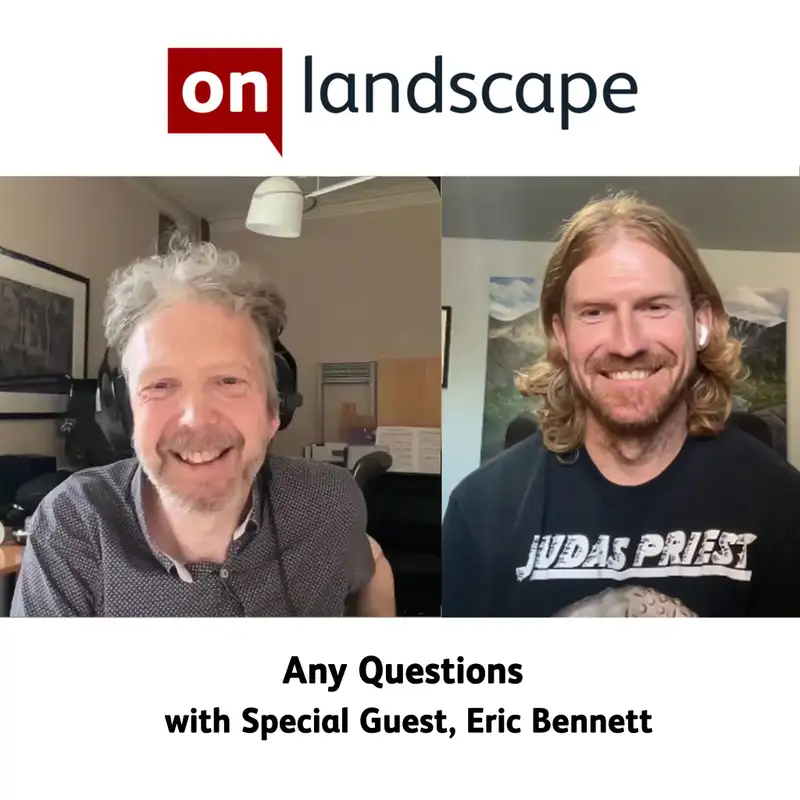
Eric Bennett
Tim Parkin (00:00)
Hello and welcome to On Landscape. I'm here with our Any Questions episode with Eric Bennett. And unfortunately, Mark Littlejohn isn't with us today, so it's just me and Eric. He'll be back in the future, I'm sure. So hello, Eric, how are you?
Eric (00:17)
Good. I don't blame Mark for missing out on this. I probably would have dropped out too.
Tim Parkin (00:22)
Have you met Matt before or chatted with him?
Eric (00:25)
No, I haven't unfortunately, but I'm familiar with his work and I'm a big fan.
Tim Parkin (00:30)
So for people who don't know much about Eric, you've started off as a skateboard photographer, I believe. That's what I read in our interview with you.
Eric (00:41)
Yeah, a videographer. Yeah, I wasn't I was doing video back then, yeah. Mm-hmm.
Tim Parkin (00:44)
So it wasn't stills, that's quite hard work.
And then after traveling around a bit, you decided the stills photography world was better. Or did you pick up a camera to do some scapegoat photography as well?
Eric (00:58)
No, I never took photos of skateboarding. I always had like a photographer with me that would do that. So I stuck to video with that.
Tim Parkin (01:07)
So was that just the pressure of doing it or it was hard work making a job out of it that stopped you?
Eric (01:15)
I made a little bit of money like I was a teenager. I thought it was pretty cool, get checks every now and then. But yeah, I never saw it as like a career. Even when I was younger, I actually wanted to like get into the film industry eventually and make like, you know, be like a cinematographer or a director and work on future films. But yeah, ended up deviating.
Tim Parkin (01:21)
Yeah.
Did you
do that as any education in terms of film or?
Eric (01:42)
No, I was gonna go to film school, but it took a while to become a resident in Utah because I'm from California. So I had to wait, I think, a year or two years because I couldn't afford the tuition otherwise. And then by the time I was eligible to get residential tuition, I was already making enough money as a photographer and doing I was actually doing freelance video back then. So it just kind of seemed like a step backwards. Like I felt like I was already
Tim Parkin (01:49)
Yeah.
Eric (02:11)
I'd kind of bypass it in a way.
Tim Parkin (02:13)
Yeah, probably a good thing these days, think. Unfortunately, degrees aren't as useful as they were. That's for certain. But you started traveling a lot for your photography. know nowadays you try and stick to a local area a lot. But it was the travel that got you inspired for the landscape.
Eric (02:17)
Yeah, for certain careers.
Nah. Yeah.
Mm-hmm.
Yeah, exactly. I actually started traveling and then I got into photography because of it. Just seeing so many amazing places and wanting to capture them in a way that I could share with friends and family to show them where I was going and stuff I was seeing. And photography was just like a better medium. I was actually doing video at first and I made like a film of like a whole year of traveling that I did. But yeah, photography gradually became
Tim Parkin (02:48)
Yeah.
Eric (03:02)
a better medium to like portray what I was seeing and I just got more into it naturally.
Tim Parkin (03:08)
You think the stills give you a bit more scope for experimenting and reacting to the landscape.
Eric (03:17)
Well, I definitely became more intentional with lighting and composition as a photographer. Cause I feel like with video, since the camera's always moving around and stuff, there's kind of some distraction to it where you're not as conscious of the composition and how things line up and stuff in shots. So
I did become like more intentional with those things, but it'd be interesting, like if I went back to cinematography now, what it would be like because I could use lighting in the same way and like be more intentional with placement and composition and perspective and everything. So I'm not sure if one is better than the other. It just started resonating with me more and felt more natural to use that medium instead.
Tim Parkin (03:43)
Yeah.
I must admit to being inspired by a lot of films and TV series. I think I was chatting with somebody about Shogun recently, which is so well filmed. Every scene is a composition and the lens choices, et cetera, are fantastic. And I like to see that in a film. It's definitely something epic. think it was a, what's it? Every battle.
Eric (04:06)
Yeah. That's a great series, yeah.
Mm-hmm.
Mm-hmm.
Yeah, definitely.
Tim Parkin (04:29)
This recent film with Leonardo DiCaprio. Yeah, another great film. Really well done, really well filmed as well. So what was inspiring you for your landscape? Were you inspired by photographers or were you just directly reacting to what was going on in the landscape?
Eric (04:29)
One battle after another. Yeah, I just watched that a few days ago. Mm-hmm.
At first it was just like intrinsically motivated. I really wasn't aware of like the landscape photography scene. So I really didn't have anything to reference. And I think it shows in the kind of work I was making, like looking back at it, it was pretty like snapshotty and like not as intentional as I later became. But once I did discover work from other photographers, I was like, you know.
ha there's a lot more potential than I had realized on my own. And so that really inspired me to pay more attention to lighting and the time of day that I'm making photographs and like be more concise with my subject matter and more picky about what I chose to include in the frame and heavily exclude things and
Tim Parkin (05:35)
What were your favorite places? I presume you traveled a lot at that point in time, so you must have gone to some, must have chosen places for their photography potential.
Eric (05:44)
Yeah, I mean I really like South America because I lived in Panama for a couple of years. So like I just really enjoyed the culture and the warm people. And there's a lot of really nice, pristine nature, like in Colombia and of course, like everybody knows Argentina and Chile. Panama is really beautiful too. So I went back there a few times. Mexico, Costa Rica, I went a bunch of times. So I really liked Central, South America, Latin America.
Tim Parkin (05:49)
Okay.
Yeah.
Eric (06:15)
Iceland I went to several times, like consecutively. later on I really liked Pathagania. Yeah, it was it's such a the first time I went was in 2014 and the entire country felt like a national park. Like it just felt vacant. Now, like the last time I went was twenty eighteen, which I'm sure it's even worse now. It was like an hour long line to get gas at the petrol station, you know, like insane.
Tim Parkin (06:20)
when it was a bit quieter.
Yeah.
Wow, okay. Yeah, I've seen Theo's
photo. Theo did a project, the Abbas boom on Iceland tourism. So he was shocked by the amount of people so he thought just photograph the tourists instead of the landscape. It's a fascinating way of looking at things but I remember we went.
Eric (06:56)
I think I remember that like
headlamp photo he had. It's like a long exposure and there's just like headlamps all over a mountainside or something. Mm-hmm.
Tim Parkin (07:01)
The volcano one, yeah.
I think we went, me and Charlotte and a couple of friends went 11 years ago, so it's probably similar to 2013, 2014. And we went in February, because we knew it was going to get busy. And even in February, it was starting to pick up, but it did feel like it was abandoned in February mostly, where we were staying. We went around the whole island. Rental car.
Eric (07:22)
Yeah. And rental cars rental cars back then
were like ten, fifteen bucks a day.
Tim Parkin (07:27)
Yeah, we got a proper high-end Hilux, which is fantastic for three weeks. No restrictions. They were like, yeah, do what you like. It's fine.
Eric (07:31)
Hmm.
That's awesome.
Tim Parkin (07:40)
I know that was, I mean it was great to see places that were completely empty. very different places get like that. I think it's getting, we see it where I live in Scotland now. Glencoe is getting very busy. Do you see the same thing in where you live in Utah now?
Eric (07:55)
Definitely. But I feel like in the last couple of years it's slowly been tapering off. places are getting quieter again. So I don't know if the trend is kind of running out, like it kind of ran its course and it's not as popular anymore. Yeah, definitely. Twenty twenty, twenty twenty one, those were like the peak. But yeah, I think a lot of people are like selling off their trailers and sprinter vans now and kinda going back to the life they had before. 'Cause just I don't know.
Tim Parkin (08:09)
That was a post-COVID thing, wasn't it? Definitely.
Eric (08:24)
Maybe it's not for everybody.
Tim Parkin (08:26)
Yeah, we were looking at buying a camper van. My camper van broke in 22, 23. And we looked at buying another camper van. was like not paying that much. It's like double normal prices. And it's still busy up here. We had Brexit as well. people used to easily travel in Europe and it's a bit harder now. So we saw more people coming into the landscape. But yeah, hopefully it'll quiet down a little.
Eric (08:34)
Mm-hmm.
Mm.
Yeah, definitely.
Tim Parkin (08:56)
But yeah, so South America is an interesting one because I've noticed in the competition, not many people take photographs of tropical jungles. We had a category in the competition last year, try and get some tropical entries. And apart from the people going to Tenerife and those areas, you rarely see that environment or maybe some parts of New Zealand.
Eric (09:22)
Mm-hmm.
Tim Parkin (09:23)
And I'm not sure why that is, because it's more difficult to photograph, I imagine.
Eric (09:27)
Yeah, absolutely. Really harsh light, super chaotic. It's either like pitch black or just like super harsh, like little pinpoints of light, you know, that mess up the exposure.
Tim Parkin (09:37)
Yeah,
yeah, it's a shame because when they do work the photographs can be incredible there.
Eric (09:46)
Yeah.
Tim Parkin (09:48)
So eventually you've decided not to travel as much. And was that a reaction to the travel itself? Was that a reaction to want to experiment around your local area?
Eric (10:00)
Yeah, it wasn't like a decision like I'm gonna stop traveling, so what should I do now? It was more just like I just fell in love with where I live and so it was always a choice between like staying here or going somewhere else and it's just I don't know, it's always like a no brainer just to go explore a new area around here or go back in a different season or go back the next year when the season might be more colorful or, you know, 'cause it's just never the same. So
Tim Parkin (10:29)
Yeah, it's really hard to do that in foreign locations for obvious reasons.
Eric (10:32)
Yeah, exactly. Yeah, like
even in the winter in the desert here, you know, typically the brush like gets colorful. It'll get like really red and orange and like there'll be nice aquas. But like one year in particular was extremely vibrant, just like insane. And so like there's just a lot of variables that keep it really interesting for me.
Tim Parkin (10:54)
And presumably you can just go out there and see what it looks like and then arrange to do something.
Eric (10:56)
Mm. Yeah.
Yeah. Between a two and five hour drive from most places around here, so really easy.
Tim Parkin (11:04)
So if you have you live
there most of your life, where you are or around where you are.
Eric (11:07)
No, I moved here th
thirteen years ago, twenty twelve. I was in San Diego before that and then Panama for two years and then here.
Tim Parkin (11:15)
How did you choose Utah?
Eric (11:17)
I actually didn't choose Utah. It was a place where my parents had a second home because my brothers were living here at the time and they had kids. So they wanted to come up and stay and see their grandkids often. And then while I was living in Panama, my parents sold their house in California. So when I came back to the US and stayed with them, I was here in Utah. And I had like a couple of friends that were living here. So I ended up moving in with them. And then I just ended up staying.
Tim Parkin (11:46)
As you continue to see in Utah then.
Eric (11:49)
Well s have I gotten used to it? Yeah. I like it a lot. Like I don't see myself living anywhere else for the time being, really. It'd be hard to picture myself anywhere besides here.
Tim Parkin (12:00)
Do you get a choice in terms of work? Do people want to go on workshops in Utah? The reason I ask this is I talk to a few people who have come to Glencoe, where I live now, and ask them about the types of places they can take people. Why do people go to the same locations? And it's quite interesting to get the answers that doing a workshop, it's really constrained on what can actually, what locations you can take people to. So a lot of the places you might want to take people, you just aren't.
Eric (12:11)
Mm-hmm.
Tim Parkin (12:30)
possible.
Eric (12:31)
Yeah, well legally you can like take people anywhere in Utah. nowhere has like a super tight group limit. It's pretty much twelve people in like any location, which is big enough for a group workshop. me, like myself personally though, just because my ethics, like I only take people to locations that can handle that amount of foot traffic. So a lot of places that I go to and make the photos in my portfolio, I don't take clients to
Unless maybe it's like a private, like just one client. I wouldn't take a group there because it's either too fragile or it's just like a really narrow slot canyon where it's just gonna kind of diminish the experience for everybody if there's too many of us. So
Tim Parkin (13:15)
That's a lot of the problems we have in the local area here. To try and find somewhere you can put a car that's not a huge drive, that has the ability to put up eight people, all taking photographs at once can get quite difficult.
Eric (13:22)
Right.
Mm-hmm. Mm-hmm.
Yeah, exactly. So that's really what it comes down to for planning my workshops and stuff.
Tim Parkin (13:36)
And do you take photographs during workshops? As much of your creative output from workshops or from your own personal work when you're at?
Eric (13:46)
I don't have a rule to not take photographs when I'm on workshops, but typically I don't get my camera out, especially if it's a location I've been to a bunch of times. Like I'd rather just be available to help my clients have the best experience possible because they'll likely never return. So that's always my priority. Sometimes I do end up finding stuff.
Tim Parkin (14:02)
Yeah.
And that's ideal if you're
local as well, because there's no pressure. If you're going to, let's say, Namibia, maybe you're only a chance to go there or your second chance to go there, it's difficult to say, I'm not going to take any pictures here.
Eric (14:21)
Well, that's another thing. Like I can't imagine teaching workshops in places I'm not deeply familiar with already. So I always choose locations that I know like the back of my hand. So yeah, I can't really picture myself being in that situation unless it was like Antarctica or something, like a place I couldn't go to unless I was sent there as a an instructor, like with all the expenses paid.
Tim Parkin (14:34)
out.
Yeah.
So do you, how do people, a lot of your work is less iconic, I would say. You've got some amazing pictures of the mountains. I don't mean iconic in that way, but there are not as many obvious compositions. One of the things I see with people who come local to Glencoe is unless you can point at something as soon as they get out the car, it's very difficult for them to get going, to find ways to photograph.
Eric (14:52)
Mm-hmm.
Tim Parkin (15:13)
got any ways around that or do you not have the problem with clients you tend to take out?
Eric (15:18)
So I when I build my itineraries for workshops, I don't select locations where there's like one obvious thing to photograph and we're all gonna line up like a firing squad and just photograph the same thing. I like to choose like more like zones that have like, you know, lots of different trees or lots of just lots of potential subject matter. So like depending on their personal interests, everybody can find something that resonates with them.
Not like, I'm gonna photograph this because Eric says I should, or cause Eric likes this, or so and so thinks it's cool. I like to take them to areas that just provide lots of different possibilities. And they can make, you know, several photographs in a single outing instead of just going, setting up, waiting for certain kind of lighting, taking the photo and heading out.
Tim Parkin (16:08)
That's great for teaching. mean, that's great for having the ability to help people find things with things, especially if things aren't obvious. It means they have to work on a composition or the way the light works on things.
Eric (16:10)
Yeah.
Mm-hmm.
Yeah, I always try to foster like an attitude and environment where you're not looking for anything. It's more about just paying attention to what naturally stands out to you and seeing what kind of photographs you can make of that.
Tim Parkin (16:34)
I was looking through some of old photographs of Glencoe when I first came here and I realised there's a certain level of, it's almost like visual blinkers you get when you go to a location that's amazing for the first time. You get shocked at what it is and you go into record mode. You go into that tourist snap mode. You know, you'll pay attention to some things to do with competition or what's in the foreground, but it doesn't matter because you've got this great big thing in front of you that's amazing.
And it's only through revisiting places or consciously being awkward with yourself to say, I'm not going to do that, that you can start to create things more interesting.
Eric (17:04)
Yeah.
Yeah.
That's definitely true. I feel like now I've kind of outgrown that. I don't mean that in like a condescending way. But like even when I went to Japan for the first time, I was completely unfamiliar with it, but I didn't just photograph the obvious stuff at the locations we went to. I'm I'm just not I don't feel like I need to make photos at this point. So like there really is no pressure. I could just go on a trip and come home with zero photos and equally enjoy it.
Tim Parkin (17:39)
Yeah.
Eric (17:47)
So yeah, I just I can definitely understand that because I feel like that happened with a lot of locations that I photograph now. Like once I got the obvious things out of the way, I wasn't as distracted and I could find the more subtle stuff and not have my attention be drawn elsewhere. But at this point, like yeah, no matter where I go, I just enjoy that spontaneous experience, you know, photographing things that you weren't anticipating anyway. So I was
Yeah, kinda lean into that.
Tim Parkin (18:19)
I'm.
One of the things I think I've noticed in your work is you've got more interest in what it is that you're photographing, not just what it looks like. And it's one of the things I have a chat with Joe Cornish when he comes around is he's discussing geology or botany or how the weather is working, what the clouds are doing, what the weather is, why things happen, what things are, rather than just, oh, that's pretty.
Eric (18:32)
Yeah.
Mm-hmm.
Yeah, no, definitely. Like what I connect with is the subject matter, not the medium. So like I'm not very interested in cameras or photography. I'm very interested in nature, and photography is just the toolkit that I use to learn about nature, study it, and share things about it that I find interesting. And like most of the books that I read are biology books and you know, they're about nature. So maybe plants that I'm familiar with through photography, I like to learn.
Tim Parkin (19:12)
Yeah.
Eric (19:18)
more about them and why they live in certain environments and what they provide and, you know, the struggles they go through and stuff and the fascinating things they've developed in order to survive. So yeah, it's really about like Yeah, exactly. Like it's it's really about using photography to express my love and interest for nature rather than just using nature to express my love for photography.
Tim Parkin (19:27)
Yeah, it gives you a story to engage with doesn't it?
Yeah, absolutely. And I a lot of what we see on Facebook, Instagram, people who have started photography, who are looking for the icons to put in their portfolio is a symptom of not having a portfolio. Quite often it's that constraint of saying, I need to get a set of pictures together to be really proud of. And if I don't add to it, it's become a wasted.
Eric (20:01)
Yeah.
Yeah.
Tim Parkin (20:11)
effort.
Eric (20:12)
Yeah, you're very eager to build something. And so what you're naturally gonna do is like go for the low hanging fruit. Like you want that assurance that you'll find a photo when you go to a location and you'll be able to accumulate more work instead of like the vague like idea that you're just gonna go out and photograph whatever you happen to find. You know, you you kinda want more security. So I feel like that's a very natural thing to do. And that's what I did in the beginning too. Like
Tim Parkin (20:42)
Mmm. Yep.
Eric (20:42)
There was kind of like a
shot list, especially back at that time on five hundred PX and stuff, that you kind of felt obligated to have before people would take you seriously, I feel like.
Tim Parkin (20:52)
your version of the classics.
Eric (20:53)
Exactly. Like to show that you could do it too and then you could branch off from there maybe or Yeah. It's kinda silly.
Tim Parkin (21:01)
Yeah, I'd like to say I can understand it and it's freeing once that disappears, once that thought of it. And I think also when I started photography, probably around 2007, that sort of time, there were so many early photographers. The number of photographers who'd been working for 10 years or more was very few in the UK. The classics who write for magazines or the Joe Cornish's or Charlie Waits.
Eric (21:07)
Mm-hmm.
Yeah.
Tim Parkin (21:30)
but everybody else was on that early first few years of experience. So it was definitely a race for something. I think, well, you can tell me what America's like, but in the UK, things have matured. There's lots of photographers that have been taking photographs for over a decade who just do what they want to do. They don't need to engage. It's just an expression of who they are.
Eric (21:30)
Mm-hmm.
Mm-hmm.
Tim Parkin (21:56)
And is America the same? Do you see the same development in the way the landscape photography population changed over time?
Eric (22:08)
For the most part, I feel like something I've noticed now that I've been doing this for like twelve years is I feel like the five year window is kind of like like if you make it past five years, you'll probably likely do this for another ten or twenty. But if you don't make it those first five years, like a lot of people that were like kind of popular and stuff and had like bigger followings than I do dropped off like at that five year mark.
And you just don't hear about him anymore.
Tim Parkin (22:40)
Do you think that's the ADHD thing? Next topic, please.
Eric (22:43)
It could be, yeah. Like they kind of get the obvious like postcard shot list out of the way and then they kind of feel like now what, you know, so they pick up another hobby or it like they don't really find meaning in it or a reason to continue to do it like indefinitely. yeah, it's just not exciting.
Tim Parkin (23:02)
dopamine hit. And there is definitely a dopamine
hit of being in the landscape when it's doing something interesting.
Eric (23:08)
Yeah.
But just like anything, you have to like continually create goals for yourself to maintain interest. And they don't need to be like goals with like very defined metrics or anything like that, but it could just be like wanting to understand a place more or wanting to explore a certain zone more. it doesn't need to be like make a certain amount of photos or anything like that. I'm not very goal-oriented in that way, but I definitely have like a lot of lifelong
Tim Parkin (23:24)
Mmm.
Eric (23:37)
ventures that I'm engaged in right now that I really don't see an endpoint to.
Tim Parkin (23:40)
Yeah,
that's interesting. It's because when you talk about painters and they talk about their periods and it's very much like, know, Monet might be his blue period or whatever. And you get this picture of them. Yeah, I've done that. Now I'm to finish that one. I'm getting onto this one. And you actually read about their lives and they're all running in parallel with each other and they're never really finished. just it's when the public becomes aware of them. That's the end of that period. And then
Eric (23:48)
Mm-hmm.
Right.
Tim Parkin (24:09)
when the public gets aware of the next one, that's the next period ending. So it's definitely an external viewpoint of it. And I see the same with photographers. And I presume you're the same there where you just, if you're interested in something or the conditions are right, you can go and work in a certain way for a while.
Eric (24:13)
Yeah.
Mm-hmm.
Tim Parkin (24:28)
See you then.
How often would you spend going out on your own trips per year, would you say?
Eric (24:38)
As much as possible. I last year I taught like six workshops, I think. This year I'm teaching eight plus like a couple conferences. so all the rest of the year any traveling I do is just for myself. And
Tim Parkin (24:54)
I'm mostly a new target with CNA.
Eric (24:56)
Yeah. So I'm a divorced dad. So I have like split parent time with my kids. I share it with their mom. And my fiance, Alexandra, is in the same situation. And we have our kids at the same time. So whenever we don't have our kids, we go out and camp. So 'cause she's into photography too. But we just like being outside in nature. So whenever we don't have our kids, like so every other week we go on a trip essentially. Yeah.
Tim Parkin (25:13)
Yeah, that's cool. Yeah.
That's brilliant. And camping
is the way to do it. Definitely. Getting embedded in the landscape.
Eric (25:24)
yeah, definitely.
Yeah. Gotta immerse yourself, so it's just yeah, the best way to get away from all this and
Tim Parkin (25:34)
I'm interested because I'm a bit of a camping geek but I'm interested in gear so what do you take out with you?
Eric (25:37)
Mm-hmm.
my I always keep it as simple as possible. So like if I'm backpacking, the only camping gear I have is my tent, sleeping pad, sleeping bag, and a pillow and then rain jacket, down jacket, one outfit for the whole time for the most part.
Tim Parkin (25:44)
Yeah.
minimal you can get.
Do you strip down your camera gear as well?
Eric (26:01)
yeah, definitely. If I'm backpacking, it's just my body and two lenses. So seventy to three hundred and I would take my sixteen to thirty-five until it broke and I just haven't replaced it. So now I'm using my twenty four to one five mainly as like my wide angle lens. But and I'm even the same way when I'm out in like with my car. I'll maybe just additionally have my one fifty to six hundred, which is pretty big, but
Tim Parkin (26:27)
Yeah, the 24-105 is just so flexible. nice to have a long reach sometimes, but for most part, it does the job. Although I did borrow, Joe Cornish has got a deal with Sigma. He's an ambassador and he gets to have two lenses here and he gets loaned bunch of lenses. And one of them was a 20 to 200 lens. And I was like, yeah, it can't work. 10 times zoom lens.
Eric (26:31)
Super versatile, yeah.
Okay.
Hmm.
Tim Parkin (26:56)
got to be something wrong with it. And I borrowed it on his A7R5 and quite astonishing. I mean, it's lighter than the 24-105. So I was a bit blown away. I thought it'd be ideal for going climbing with.
Eric (26:56)
Yeah. I'd be skeptical for sure.
Wow.
Yeah, 'cause twenty is pretty wide.
Tim Parkin (27:14)
Yeah, I expected the 20 to be really smeary in the corners, but it was surprisingly good. chatted with Matt about it as well. think he's got a Tamron version of the same one. Maybe that's, that might be 24 to 200, I'm not sure. But this.
Eric (27:17)
Hmm. Wow.
So maybe in
another like five years we'll have like a sixteen to six hundred F two point eight.
Tim Parkin (27:34)
Yeah, I think it might happen, especially with all the computational lens stuff they get going on. There's that Nick on Coolpix, wasn't there? They did a 1,000-millimeter zoom lens for a while. But no, was quite impressed. there's something nice not to have to be changing lenses and to be restricted in what you can do.
Eric (27:37)
Yeah.
Yeah.
Yeah, I'm definitely guilty of like seeing something and the lens I have on is not wide enough and just being like, never mind, I'm not gonna shoot it. Or or I'll do like some stupid panorama thing or something and never stitch it together later or yeah. I'd I definitely like skip on stuff because I don't want to switch my lens.
Tim Parkin (28:10)
Yeah.
Yeah, and every time I do it, end up having crud all over the lens for the next three months, because I'm too lazy to clean it. I need a second camera, In terms of working locally, if you're getting a lot of pictures of areas in different seasons, different conditions, are there any environmental
Eric (28:20)
Yeah, exactly. Yep.
Tim Parkin (28:42)
projects that use your work or do you contribute or take photographs or any particular environmental concerns?
Eric (28:50)
Yeah, the main issue I've been involved with involved in it has been with Escalante National Monument because A I go there all the time. It's one of my favorite places. And then B, it's just the protection of it has been very up in the air back and forth because it
It's a great place for tourism, which has its caveats and deficits. and I'm not like a big supporter of that either, like expl exploiting places for tourism and accommodating the visitor rather than the visitor having to adapt to the place.
Tim Parkin (29:24)
Yeah.
system in terms of building accommodation and roads, et cetera, for access.
Eric (29:33)
Exactly. But then there's the other side of, you know, lots of valuable minerals that are all in that area. And a lot of them are just like on the periphery. But if you get rid of those like easements, you know, conservation easements and like buffer zones, that can have a lot of detrimental effects to the ecosystem because things don't necessarily stay in one place. As temperatures change and stuff, trees even that can't get up and walk will migrate as they
Tim Parkin (29:49)
Mm.
Yeah.
Eric (30:04)
you know, as new trees are born and stuff and as they reproduce. So yeah, the protection on it has been kind of under attack back and forth. So I've donated a lot of images.
Tim Parkin (30:06)
Definitely.
Is this with
this current government's approach to resources in national parks like the Bear Park, et cetera?
Eric (30:25)
Yeah.
Yeah. And honestly, like it's it's a continual thing regardless of the administration. It's just sometimes more in the spotlight when the administration has kind of more of a I don't know, kind of a stigma with environmental stuff. both have shown to not prioritize it, but
Tim Parkin (30:30)
Mm.
Yeah. So what?
So what work can you do with the park Escalante to try and help with it?
Eric (30:55)
Yeah, so there's a
a conservation agency, Grand Staircase, Escalante Partners, and I've worked with them. They've used my images for whenever they're talking about a specific area, maybe they'll use one of my photos of that area. Or if it's just like a general thing about the monument, they'll use one of my photos that show like a nice part of the monument.
Tim Parkin (31:16)
Do you just give
them access to a library to play with that?
Eric (31:20)
Yeah, it depends. I'll always do like a licensing agreement. So it it's like for it's not indefinitely, you know. But it's not about like the monetary side of it. It's just about like what they want to use the images for and yeah, exactly. Have a little bit of control. But
Tim Parkin (31:24)
Mm.
keeping an eye on it.
Yeah. Do they they request
anything or is it interesting what they end up using?
Eric (31:42)
Yeah. No, typically they'll give me a list of areas that are more relevant with what's going on.
sometimes I'll just want general stuff. A lot of my work is very intimate though, and like you said, like it's it doesn't show the icons. So like a lot of my images from Escalante, you wouldn't know I took them in Escalante, like they don't scream Escalante, they just show like desert mud and leaves or you know, something kind of generic or just nondescript, you know. It doesn't show like obviously what location it's representing. But
Tim Parkin (32:04)
Yeah.
The reason I ask is
me and Theo Bosfian put together a questionnaire about conservation and people's attitudes to environment, travel, et cetera. And a lot of the ideas that came back is how can we engage with conservation work locally, what people might need, et cetera. And it's a big conversation about, OK, well, do the beautiful pictures work or do they need to see some of the damage that's involved?
Eric (32:25)
Mm-hmm.
Tim Parkin (32:49)
I know there's a bit of both, there's recent research that says typically showing people a damaged landscape doesn't really motivate them to protect it.
Eric (33:00)
No, it kinda shows what has already been lost rather than like what is at stake. You know? It's kinda like, well, we should have done something but we didn't and this forest got cut down or I don't know, it's it's not very motivating. Whereas it's like the the opposite is like, look at this amazing place, don't you wanna keep it like this? I think that's
Tim Parkin (33:05)
Yeah.
Yeah, that's what happened
in Australia with the Tasmania photographs. Yeah, it's like, my god, this exists and it's going to get wrecked. It's interesting that the...
Eric (33:24)
Yeah. Yeah, Peter Dombrowski.
Mm-hmm. Exactly. So yeah, I think
well, I was just gonna say, like, photography has the power to reveal places to people that aren't able to visit them themselves firsthand. And so the more you connect with the place that you're photographing, the more you're gonna be able to convey that to other people. Like the deeper your relationship is with the places you photograph, the more likely people will be able to build a relationship through that photograph when they see it.
Tim Parkin (33:59)
Yeah, I should probably ask some questions from our readers. the first one is relevant. Feli Hansen is just asking about how you balance between a conservation value of a photograph on the aesthetic side and do you go out looking or thinking about the conservation value of a photograph ever? I know it's not normally a priority. For instance, you just
You just mentioned that the Escalante, you don't have any pictures of the iconic landscape because that's not what you do. Do you ever think about, I'll take that because it's useful for the conservation purposes.
Eric (34:40)
Yeah, so I think that's what they're asking. Like, do I ever have like a shot list? Like these areas are under attack or, you know, imminent threat. I'm gonna go photograph them and like show them very literally for this thing. I never do that. So I really just go out and photograph stuff because I'm intrinsically motivated. There's never like an ulterior motive financially or for some kind of project or
Tim Parkin (34:48)
Yeah.
Eric (35:07)
anything whatsoever other than just like going to places that I'm drawn to and wanting to spend time there. But every single photograph I make is conservation minded because I photograph things that I find to be important and
authentically interesting to me. So what I want to do is then somehow convey that so that other people can also find them to be important and care about their protection, their preservation as much as I do. So that's like my whole motivation with photography to express the importance of the natural world to people that might not be as familiar with it.
Tim Parkin (35:48)
So that comes back to understanding your subject and having a passion for what it is, not what it looks like. In terms of that...
Eric (35:54)
Yeah, it's a priority.
Tim Parkin (36:02)
Do you ever think, how do you approach the written word? I know you did the Windrower booklet where you talked about a trip. Do you ever get motivated to write about what the photograph you've taken is, some of the things that are in it and why it was important to you? So for instance, it may be plants that you've discovered that don't exist very often or haven't existed in that environment before, et cetera.
Eric (36:08)
Mm-hmm.
I do enjoy pairing photography with like scientific facts and like biology and stuff because you can't convey those kinds of systems and like networks and things through photographs. It's just not the right medium for it. But I think when you pair it with that, it's like you show why something is visually interesting and mysterious and unique, but then you can also show like the inner workings with some
Tim Parkin (36:44)
Yeah.
Eric (37:02)
accompanying text that is more technical and I think that can be very fascinating and just create something that is multi-dimensional to like captivate somebody and make them more interested in it and like value it more for sure. Like if you've ever read like have you read The Hidden Life of Yeah, The Hidden Life of Trees. I think a lot of people yeah like it's just such a fascinating book about trees and all these things that you would never really
Tim Parkin (37:18)
think that's a really good hook to get.
Eric (37:31)
You might suspect them by spending time around trees, because we tend to like anthropomorphize things, but you wouldn't know that they're scientifically like proven to be true. And so that's such a fascinating book. And so that's an example of like if you pair that with imagery as well, I think that can be a very powerful presentation of like why forests are important.
Tim Parkin (37:41)
Yeah, yeah.
And it's getting people to think about things more as well, where the photographers start to engage with what it is. And that's always a big step towards conservation, I suppose, is if you're just looking at it as a pretty picture, it doesn't have the same value as looking at it for what it is, how it's occurred, how it changes, et cetera.
Eric (37:57)
Mm-hmm.
Mm-hmm.
Yeah.
Tim Parkin (38:13)
another question from Daniel Eek, who would like to ask you about your journey as a photographer and whether, how much of it has been a conscious decision to take a particular path and how much have you been pushed around by circumstance or?
Eric (38:34)
So I would assume they're kind of referring to like my career as a photographer as opposed to like yeah.
Tim Parkin (38:40)
Thanks. Yeah,
your career and how you've chosen to do things or how your style progressed maybe.
Eric (38:49)
Yeah, so I got into photography just like I said before because it just ended up being the best medium for me to convey what I wanted to show, like in in nature. But it became a career very organically, and it really wasn't a decision I ever made. It just kind of gradually like presented me with more opportunities. and
like financial success over time to the point where it just became like
Very easy to realize, like if I don't spend all my time doing this, I'm not gonna be making as much money as I could and I won't be able to be able to like focus all my attention on this because I have to worry about creating income elsewhere. So it is became it was just like a very organic transition from my previous job.
That just made a lot of sense. And obviously it has times of uncertainty where I'm like, is this actually gonna be financially viable for another five years or just to get through this year or this season? It definitely has ups and downs. But yeah, it just has made a lot of sense. And really I just can't picture myself doing anything else. Like I'm just not as passionate about anything else besides like learning more about nature.
Tim Parkin (40:13)
And in terms of deciding not to, deciding to spend more time in your local area.
That must restrict some of the income you can make because of this, know, foreign tours are a lot more, or can be more lucrative. That's probably more risk involved in it as well.
Eric (40:35)
I think there's always value and insurance in doing what you're best at and what you know best. I think you're just going to be able to outperform other people and offer something unique that way, which is gonna increase your value. So that's kind of always been my f my philosophy. Like as long as I'm doing things that I truly care about, that's gonna kind of give me like a step above other people or
Tim Parkin (40:59)
Yeah.
Eric (41:01)
If if if anything, it'll just make me stand out naturally, 'cause I'll be offering something unique that nobody else is doing.
Tim Parkin (41:07)
And again, I think if you are just relying on what something looks like, you'll take the same pictures of other people because it's mostly about the aesthetic, whereas it's what you're interested in is very personal.
Eric (41:16)
Right.
Mm-hmm.
Tim Parkin (41:22)
Do you have anywhere very local to you that you can just pop out and take pictures of? Do you do that very often?
Eric (41:28)
Yeah, right in my backyard is public land. It's the Wasatch Mountains. And so particularly in the fall, like it's very scenic and beautiful. And so I'll take lots of photos of like aspens oaks and maples that are in my portfolio. A lot of that stuff is within thirty minutes driving from my house. I could even shoot stuff from my porch, like on the side of the mountains here.
Tim Parkin (41:51)
How would we find that in your portfolio? Because I'm interested in that.
Eric (41:54)
Yeah, there's a whole gallery called Aspens and so all the Utah stuff, 'cause some of it is Colorado and Japan, but
Tim Parkin (42:01)
got you. Yeah. I'm a good look at that later. Yeah.
Eric (42:04)
Most of that is very close. And
in the summertime, like right now, I'll just go up and go hiking to different mountain lakes and stuff, but I don't photograph them as much anymore.
Tim Parkin (42:16)
I noticed quite a few snowy pictures there as well. So you get the full on snow in winter, you? Or is that how you're up?
Eric (42:22)
Mm.
no, I mean it used to snow more here. Like recent years it's been pretty grim, but Yeah. Theoretically.
Tim Parkin (42:29)
Hmm, familiar here as well.
Yeah. Do you do any other outdoor hobbies? Or any other hobbies? Do you play instruments or climbing or skiing or anything?
Eric (42:46)
Yeah, nothing I don't do anything as intensely as I do photography. Like that takes up eighty percent of my life probably, or if not more, if you count like all the hiking and backpacking and stuff that I do, which is associated with photography. but I still skateboard whenever I can. Probably go like once or twice a month with my kids. And then I do play the guitar. I'm not like very proficient, but that's like
Tim Parkin (43:14)
What's
the music taste being as music is parallel to photography and art? What do you like?
Eric (43:21)
Yeah.
I love music. Like my fiance and I are always looking for new bands and sharing them with each other. We have very similar tastes, which is nice. So right now I'm actually into a lot of music that's from the UK. I'm not sure if you're familiar with like the windmill. It's a venue in Brixton, but there's like a whole scene that has like originated from that venue of like kind of contemporary jazz, post punk.
Tim Parkin (43:42)
Yeah.
Yeah.
Yes.
Eric (43:52)
like really sick music. And I've been really into that genre, like finding lots of bands that are in that scene. And there's there's some in the US too that are really good too, in that same vein. But yeah, the music I'm listening to right now is kind of genreless. Like it just overlaps, has a lot of different instruments. It's not like very dynamic songs that cover like wide ranges of styles and emotions and stuff.
Tim Parkin (44:14)
Can you recommend a couple of bands for our audience?
Eric (44:19)
I mean, I don't know how palatable it is for like the general audience, some of it. Like it might be a little too jarring or sporadic, but just in case anybody does like it, the band I like the most right now is called The Orchestra for Now.
Tim Parkin (44:35)
Okay, yeah, I shall have a look at that.
Eric (44:37)
And
they're like really young kids that just shred and their stuff is so amazing, super talented. And then Racing Mount Pleasant is another really good band that I just saw like a week ago here in Salt Lake, luckily. Maruja, they're from the UK. I really like them a lot.
Tim Parkin (44:57)
have a good venue in nearby then.
Eric (45:01)
Over here we have several Salt Lake kinda gets skipped on a lot of tours, but luckily every now and then bands will come by here. It's not like San Francisco or LA or Las Vegas, you know, or New York, but
Tim Parkin (45:11)
Yeah.
We get the same thing in the UK. Well, we get no bands coming up here really. We get the Scottish Gaelic folk bands coming up play, which is cool. That's fairly niche. I've got to travel two hours to get to a city to see things play.
Eric (45:18)
Really.
Mm.
Yeah, we want to go to
the UK at some point and try to see a bunch of bands that we like because they typically don't come over to the US very often. So we can maybe see a few of them.
Tim Parkin (45:38)
Touring
this day is a way to lose money, definitely. Got a few friends. Yeah, when you come over, me a shout, definitely. Got another question from Feli. How do you find a balance between pristine places and nature around the corner? And maybe even in the city in order to reconnect people with nature?
Eric (45:41)
Yeah, for sure. It's definitely just passion driven.
Tim Parkin (46:07)
I suppose that's partly what we were talking about is the balance of local versus parks etc recognized places.
Eric (46:18)
Well, luckily where I live, we just have a lot of wilderness. So like I can get to really remote places very quickly, which is why I value Utah so much. Like we just have so many open expanses of just endless desert canyon lands, just endless exploration potential. So
Tim Parkin (46:40)
It's interesting trying to talk to people from, I mean, we talk about photographing locally and we move somewhere specifically for working locally as part of it. So it's very difficult to complain about working locally when you're sitting on top of a glorious location.
Eric (46:47)
Mm-hmm.
Yeah, I mean, to be fair, like I've backpacked over in the West Highland Way in Scotland and like that whole area, which still has villages and stuff in it, is like one national park here in the western US. So it's like the United States is just kind of incomparable in a lot of ways, like the diversity we have, the variety of landscape, and then just all the wilderness that we still have. Like compared to Europe or you know, a lot of places in like central Latin America.
Tim Parkin (47:09)
Yeah, yeah.
Absolutely.
Eric (47:27)
Or Asia. I don't know. We just have like a lot of open space still and amazing variety.
Tim Parkin (47:35)
Fortunately Scotland is mostly wildish. Unfortunately everywhere in England there's Lake District National Park you can drive across if there was no traffic on it you could drive across it in half an hour. So it's relatively tiny and I think...
Eric (47:40)
Mm-hmm.
Yeah.
It is impressive though,
like all the stuff you guys pull out out of there, like Neil, Burnell, Simon Baxter, people that like focus on those tiny areas and just are super prolific.
Tim Parkin (48:01)
Yes.
I think we're great because we have a massive rise. We have a strange geological country. It's got local, probably metamorphic areas with lots of old volcanoes. And you go down to England and it's sedimentary and river deltas. So it's quite varied in a small area, which is quite cool. It's just sad there's so much of it's built on. But I think it was, I'm trying to remember the guy who did the
Eric (48:15)
Mm-hmm.
Mm-hmm.
Tim Parkin (48:35)
recent landscape photography book on the national parks. can't remember his name. Really big in the US. Yeah, big thick book. Cutie. It was cutie. Yeah. And that was fascinating to me to see those books.
Eric (48:41)
National Parks in the US. QT Long.
Yeah. Endless. And that's just national parks. Like most of the places I go to are just BLM land. Like no designation. Not even monuments. Like it's just yeah.
Tim Parkin (48:51)
just see how massive that project was. Yeah.
What's What's
access like? I what I read a lot about restricted access for people. You know, there's no right away. There's no right to roam or anything. So how do you how do you deal with that in an area knowing where you can go and where you can't go and how much of it you can access?
Eric (49:19)
I mean,
at least here in Utah, like all the BLM land has dirt roads. Some of are pretty bad, but if you have a lifted truck with four wheel drive, you can get like a lot of places without having to hike. And then if you hike from there, like, you know, it's just
Tim Parkin (49:36)
So not too many people live on the land and they're gonna scare you off.
Eric (49:39)
Mm.
No, yeah, there's not like there are areas that are private, like little pockets. a lot of the place is like a lot of land is just leased, so it's not private land. There's just like cows grazing on it and stuff, but it's completely public. Yeah.
Tim Parkin (49:57)
That's good, yeah.
And I've got a question from Andrew Griffiths. Your photography is beautiful and much of it seems impressionistic in nature. Do you see the natural world as raw material for self-expression or do you strive to be reflective of it or is there a balance between the two?
Eric (50:19)
Yeah, I have a very reactive approach, I would say, instead of proactive. I don't go out hoping to make photos, turn things into photos, or utilize the landscape in any way, or like extract from it. It's more just going out and immersing myself, because I have this like innate need to be in nature and commune with nature in places that I love.
Tim Parkin (50:46)
Yeah.
Eric (50:49)
And then photographs are just a byproduct of that. So like when something stands out to me, it might inspire me to try and record it. So
Tim Parkin (50:57)
Yeah,
and that's a lot more personal. I think it is. It's inevitably reflective of you because it has to be. It's what you find interesting.
Eric (51:00)
Yeah.
Yeah, exactly. Like it's it's very my my photography is very vulnerable, I would say. Like it's very much just things that I find interesting and I know that a lot of people probably won't or won't understand it or whatever, but that doesn't matter. I am very cognizant of like visual aesthetics. Like if you look through my portfolio, this sees a lot of like warm and cool color combinations. I do enjoy like visually pleasing things, but
Tim Parkin (51:30)
Yeah.
Eric (51:36)
Those are the things that I recognize after something has like drawn my attention. Like, you know, what kind of things are there that I can use to present it in the best way possible that will be visually engaging and digestible and also have some mystery and tension and not be too on the nose.
Tim Parkin (51:52)
So when you're wandering around reacting, you see potential compositionally first or do you find something interesting for what it is first and then work around that?
Eric (52:04)
Yeah, it's lighting first. So I pay attention to what the light is doing, what it's interacting with. And then when I find interesting interactions, I'll see if there's any kind of a subject there. And then when I find a subject, I'll decide how I need to compose it in order for that subject to come through and like be recognizable.
Tim Parkin (52:10)
Yeah.
And what's the trigger to spend more time on something? that just how you feel about it? is it if the light's doing something interesting, you'll spend more time trying to something? does the competition have to really click?
Eric (52:39)
Yeah,
I'm pretty quick to decide if something's gonna work or not. I don't really just like sit around and like mess with something for a while. I feel like the more I mess with a composition, the more it tends to become sterilized because it's too logical and now the emotion is sucked out of it. Yeah. I like those initial interactions. I feel like you can just like encapsulate those emotions better and just having things not so aligned.
Tim Parkin (52:55)
Too forced. Yeah.
Eric (53:09)
Or perfectly balanced has like a pleasing visual aesthetic of its own. It just feels more organic and I feel like it.
Tim Parkin (53:15)
Yeah.
It's the way painters work, isn't it? They leave things imbalanced or rough things out and they've done that intentionally, so they can do anything they like.
Eric (53:25)
Yeah. And
I think the trick is like it's not like you get everything perfect and then you kind of just like shake it and then take a picture because then it's still gonna be contrived. It's more about just like finding that fine line between like, you know, organizing things in a pleasing way but not over analyzing it where it just becomes, you know, it just loses that natural feeling to it.
Tim Parkin (53:52)
It's easy to leave things, just reject things if you can't make something perfect as well. And I think that's a shame quite often because, and I've seen this mostly in judging the competition. So you might have time. I've seen a picture that's got a flaw in it, but it really doesn't matter at all. You know, if it's not major, if it was ridiculous, I can see a problem, but the things don't have to be anywhere near perfect. It's about what the picture's doing.
Eric (54:13)
Yeah.
Yeah. It just depends if it detracts from the overall message or not.
Tim Parkin (54:22)
Yeah, well, thanks very much, Eric. Really appreciate that. Have you got any any projects coming or working on a book or anything I can help let people know about?
Eric (54:28)
Yeah.
nothing right now that would be relevant. I definitely have some stuff in the pipeline, but like I think yeah, this is a bit early to talk about any of it, but appreciate it. Yeah, we'll do.
Tim Parkin (54:48)
Let me know later. I'll
do it later. Thank you very much.
Eric (54:53)
Cool. Thank you. Appreciate your time.