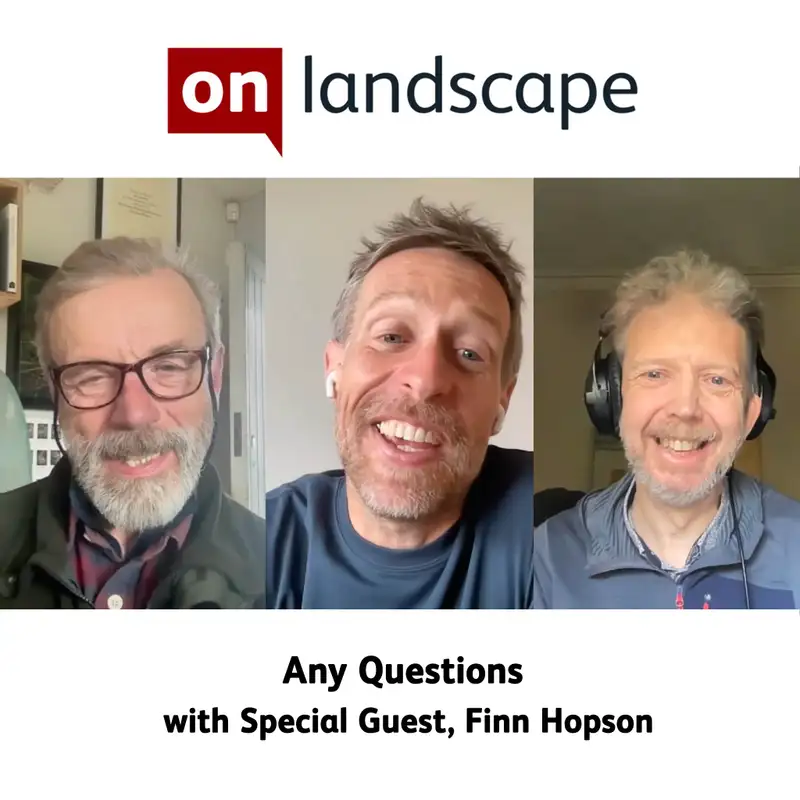
Finn Hopson
Tim Parkin (00:01.537)
Hello and welcome to On Landscape. Any questions? I'm here with our regular co-host, Joe Cornish and our guest, Finn Hobson from Brighton. Not Brighton. From Brighton, yeah. So how are you,
Finn Hopson (00:12.304)
Hello. Yes, well Brighton. Yes, yeah, very much from Brighton. Good. Yes. Thank you for having me on. This is a real pleasure. I've been listening and watching to these for ages. It's kind of funny to see yourself in a nice little Tim and Joe sandwich on the screen there. So thank you very much.
Joe (00:29.462)
I'm
Tim Parkin (00:32.087)
Now, I visited you how many years ago? Is it about 12 years ago?
Finn Hopson (00:36.048)
12 years ago, I think you came down in 2014 when I just opened the gallery on Brighton Beach. we had a huge, yeah, I remember, I mean, looking back now, I can't, it feels like a kind of bizarrely confident move. I had what feels like a very thin collection of work, just enough to fill the walls.
Tim Parkin (00:41.239)
Yeah, quite a big step at the time. We heard a little article about it in the magazine.
Tim Parkin (00:52.471)
Yeah.
Tim Parkin (00:58.507)
Were you, am I right in remembering you were doing like a calendar at the time for a?
Finn Hopson (01:03.728)
There was a kind of crossover. It wasn't specifically related to opening the gallery, but there's a, it's a particular thing in Brighton. There's a calendar that a friend of mine began in 2000. And it's, it is just, it's in a sense, just a photographic calendar, but it was, it was kind of built around kind of street photography in Brighton and kind of capturing something of the spirit of the place, much kind of very, you know, fun and lively and colorful. And it hit a a real kind of popular thing. It sold at its peak.
Tim Parkin (01:08.299)
Yeah.
Tim Parkin (01:29.697)
Yeah.
Finn Hopson (01:31.172)
tens of thousands of copies to people all over the city every Christmas. So within a kind of two month period, he would sell 20,000 of these things. And they went all over the world because Brighton has a huge kind of diaspora of people everywhere who've spent time there at university or family who've traveled. And so at the same time, separately, was opening, I had this opportunity to open a space on the beach. But my friend was also at the time was kind of looking to pass that on as a as a thing to kind of, you know, for me to take on, which helped support the first few years of the gallery, because there was something kind of slightly more.
Tim Parkin (01:32.782)
wow, okay.
Tim Parkin (01:37.612)
Yeah.
Tim Parkin (02:00.009)
I can imagine, yeah.
Finn Hopson (02:00.844)
kind of slightly more guaranteed product each Christmas. Having said that, I only did it for a few years because it turned out that creating something like that had about 50 odd pictures in it every year. And the kind of organizing of that through submissions and taking pictures myself and all that was kind of not quite where I needed to be in order to run the gallery and make the pictures I wanted to make for there. So it was a fun thing to do. And I've never been part of anything quite so huge and sudden and full on.
Tim Parkin (02:04.929)
community.
Tim Parkin (02:19.872)
Yeah.
Tim Parkin (02:27.671)
And at the time when you opened the gallery, you've been going as a photographer for about five or six years. Yeah.
Finn Hopson (02:33.114)
Five or six years, I think, yeah. I mean, I'd been interested in doing it and came from a kind of visual background working in TV and film and things, but not operating a camera, but just around visual people for a long time. So it felt like I had some grounding, but like I say, the opportunity came up. I said yes a lot and I had the keys to a gallery space on the beach and had to kind of make it up as I went along. And I think I've probably been doing that largely ever since.
Joe (03:01.198)
Well, I must say that's great to hear. The idea of making it up as you go along is kind of what we have to do all the time, I think as photographers. But also, know, big kudos to you for making a success of it. Now, I'm sure that you'll tell us it's been difficult, having had a gallery myself, I have a little bit of insight into that and also doing a calendar. I have never sold anywhere near the numbers that you have. So congratulations.
Finn Hopson (03:07.663)
Mm.
Finn Hopson (03:24.302)
No, it's ridiculous that thing. And still going under some different friend stewardship. It's a real, it's almost become a generational thing now. It's the expected gift at Christmas, you know. But no, I think you're right. The gallery, you I know that you know as well, it's not an easy way to make it work, but it's really a tool to keep me going and keep me making the work and have a motivation to keep going, you know, and keep doing my thing. So as long as it supports me.
Tim Parkin (03:52.087)
How's that been going for the last 12 years then?
Finn Hopson (03:54.852)
I've shepherd it through a pandemic, which I wasn't expecting. I think the first three years we were in middle of a building site for the I360 viewing tower on the beach. was on my next door neighbor. So for the first three years I had a huge amount of work going on outside. That was a challenge. There was a few really good years, I think, running into the COVID years. Kind of got better and better and bigger and bigger.
Tim Parkin (03:59.723)
Yeah. Yeah.
Tim Parkin (04:08.331)
Yes.
Tim Parkin (04:19.447)
Was the tower an asset in the end? Because it's right outside.
Finn Hopson (04:24.184)
I don't know if it was. It sounds like it should be to have a huge kind of tourist attraction next door. But I think in a sense, we're in different markets. You know, it does draw people. But as an attraction, it failed to bring in the crowds that the city expected. It wasn't that exciting as a thing. wasn't, you know, I'm a ambivalent about it. But it was, it wanted to do lots of exciting things. And actually, in the end, most people were kind of a bit, well, you know, it's okay.
Tim Parkin (04:27.497)
It does, doesn't it? Yeah.
Tim Parkin (04:32.726)
Yeah.
Tim Parkin (04:41.085)
yeah.
Finn Hopson (04:51.696)
So it was brilliant to have a thing that you can point at and go, there's a thing you can see from 20 miles away. That's where the shop is. it was also, it hasn't been the asset to the whole city, not just me, that I think we all thought it would be. And then around COVID, like a lot of things, hit trouble and has changed hands and is now kind of reinventing itself. I closed for a lot of the time. Actually, the nicest thing, the best, the thing I've...
Tim Parkin (04:55.85)
Yeah. Yeah.
Tim Parkin (05:03.403)
That's a shame, isn't it? Yeah.
Tim Parkin (05:09.431)
So how do you cope with COVID as a gallery then? Because that must have been a real challenge.
Tim Parkin (05:17.152)
Yeah.
Finn Hopson (05:20.112)
held on to and the thing I think was real positive, if I can go that direction. Obviously we were closed a lot and there was, you know, it's very difficult to get an income. The thing that was surprising and lovely was that it, I had a huge amount of support from the kind of local community. I didn't realize that I had so many people who cared that it continued. So as soon as I said, look, we're closing and we're going to have to be shut for an indeterminate amount of time. had lots and lots of people get in touch and say, well, look, I'm going to buy that picture now that I was thinking about. I'm going to come and...
Tim Parkin (05:48.418)
Nice.
Finn Hopson (05:48.624)
order it, know, we'll do the thing and keep you going. So I ended up doing lots of, you know, popping down to the clothes shop, making prints, framing things, and then taking them to people's houses, leaving them in gardens, you know, handing them over at a distance to people, you know, through windows, all sorts of things. But it was a fantastic reminder that the previous few years had built something kind of real and that people did care. And they did want me to survive. And so that was a great motivation to not just kind of give up and go, well, this is all over.
Joe (06:05.038)
Thanks.
Finn Hopson (06:19.088)
And I would argue in a way, and this is a slightly depressing note perhaps, but that the last couple of years with a kind of cost of living crisis and things becoming more expensive and people having less money is harder than COVID because there isn't that, there isn't that kind of, there isn't any kind of, you know, money to kind of support things from the government side. And there's also not, people aren't able to make those kinds of decisions at this point. So I think, yeah, I think that's, this is a harder time now.
Tim Parkin (06:30.209)
Yeah.
Tim Parkin (06:37.687)
Yeah, I think.
I think we've seen that with the competition in the magazine.
Finn Hopson (06:45.872)
oddly, obviously not for society perhaps as general, but in terms of just running a small business I think I've seen so many small shops in Brighton and galleries of varying sizes go out of business and framing suppliers and all these kind of backgrounds, photography related people seem to be struggling. So I think this next couple of years is possibly the most challenging yet. So maybe that's a fun thing to look forward to.
Tim Parkin (07:08.552)
It would make sense, Maybe that people can't travel in aeroplanes anymore because there's no oil going around.
Finn Hopson (07:14.978)
Hmm. Well, yes, I mean that strangely, I mean, that may be a bonus for for a city like Brighton this summer. If it's there was the year after we were kind of allowed outside but not allowed to travel that Brighton was absolutely pumping. And, you know, maybe maybe that will be this year. But it's sad to think that that's how it has to be. Not not ideal. But but, you know, I can't complain too loudly. It's a nice way to make a living when it works. you know, there are far harder jobs out there.
Tim Parkin (07:26.859)
Yeah, likewise up here.
Tim Parkin (07:32.639)
Yeah, it's not a good way, is it?
Joe (07:35.694)
All right.
Joe (07:44.46)
Yeah, it's always hard that just it's such a, mean, I'm no economist, but I always think, you know, it's hard just figuring out that you have to earn more than you spend. That's a kind of secret to life pretty much isn't it? And that, that particularly with businesses can be very difficult, especially when you're in an investment phase. but mean, hopefully you have the sort of stability now where you can try to keep your costs to a minimum and still make sales. think, you know, sometimes a bit of proactive marketing is, is required.
Finn Hopson (07:55.429)
Yeah.
Finn Hopson (08:01.84)
Hmm.
Joe (08:14.252)
You know, I don't know about you, but it never came naturally to me. find that incredibly difficult. But yeah.
Finn Hopson (08:14.384)
Mm.
Finn Hopson (08:18.008)
No, no, think if you could pick a theme that runs through most photographers that I've ever met, it's the lack of marketing skills. It's a common trope.
Tim Parkin (08:19.596)
Yeah.
Joe (08:26.958)
You could probably mark other people. I've much more enjoyed the gallery when I had several other lots of other photographers in there. I was constantly, you know, singing their praises and able to promote them personally, whereas I couldn't do that for myself. And that was the best aspect of our gallery was it became a community in that sense.
Finn Hopson (08:36.08)
Mm.
Finn Hopson (08:41.797)
Mm.
Yeah, it's very hard.
Finn Hopson (08:49.392)
Mm.
Tim Parkin (08:49.859)
Wouldn't it be great if we could just inherit loads of money and open a gallery for a communal, for the community? Yeah. I was chatting about my upbringing to a guest last night. I was in Stoke-on-Trent, and the only place you could go to, the horribles nightclubs everywhere. And a guy just down the road from Stoke found out he was a long lost cousin of J.R.R. Tolkien.
Finn Hopson (08:53.744)
That's the dream, yeah.
Joe (08:54.03)
Some people have done that.
Tim Parkin (09:16.919)
and inherited a quarter of a million pound, which then was a huge amount of money. And instead of doing what a lot of people would do, would get out of Stoke-on-Trent, he said, right, I own a pub. I'm going to put a stage at one end of it and book all the bands that I love and invite my friends down to come and drink and watch the bands. And that was the Bridge Street Blues Center. So I liked the idea.
Finn Hopson (09:36.09)
Wow. mean, that's, yeah. I mean, as a sort of sideways note to this, I won't tell the whole full long story of how I ended up here, it's, I, alongside the gallery, I have a, I've always had a small studio space somewhere in Brighton that I can go that's not public facing. And I've got a bigger printer there and things like that. I kind of need a little escape place that's not my attic. And I moved that at the end of last year to a new place that's been opened in Hove.
Joe (09:39.052)
Yeah, that's great.
Tim Parkin (09:53.973)
Yeah, escape.
Finn Hopson (10:05.168)
that's a community, effectively a kind of community art center for photographers. It's one of the most positive, optimistic moves I've ever seen done by anybody. It was Simon Roberts, the photographer, and another photographer called Nina Emmett, who have put this thing together kind of out of nowhere, you know, a huge amount of kind of fundraising and goodwill found the space and decided that what Brighton needed was one of these places. And it's something everyone has talked about for as long as I can remember, but they actually did it.
Tim Parkin (10:09.751)
So great.
Tim Parkin (10:18.264)
brilliant, yeah.
Finn Hopson (10:34.704)
And I've got small space in there and I'm suddenly finding myself in a room with, you know, 20 other people, all of whom do different types of photography to me, all of whom are different stages of careers, different kind of places they've come from in the world. It's it's and it's been the most kind of enlivening, enlightening, positive experience to kind of suddenly mix with a full kind of community of other artists of various types and hear about what they're up to and hear about these opportunities. And they've started building, you know, there's a gallery space and a studio space and they.
Tim Parkin (10:35.425)
Yeah.
Tim Parkin (10:58.422)
Yeah.
Finn Hopson (11:04.698)
program of talks. And it's just been the most fantastic thing. It's a really good reminder of community and the value of real people in real spaces together.
Tim Parkin (11:14.951)
I saw that in various cities I was living in, in the music scene, the old rehearsal rooms, people who were in bands that used to be successful used to invest in warehouses and split them up into little rehearsal rooms. And that would create a community. And that would create a music scene in a city just from a little space like that. So yeah.
Finn Hopson (11:19.76)
Mmm.
Yeah.
Finn Hopson (11:29.69)
Mmm.
Finn Hopson (11:34.02)
Yeah. And I think, you know, as landscape photographers, as nature photographers, you know, we're sort of naturally often very solitary. And I really, I get a lot from that solitude. I really enjoy that time on my own, but I would go mad if that's all I did. I think I need the social side and I need to talk to people. I need to be taken out of my comfort zone a bit and ask strange questions or, and the gallery provides a certain amount of that with the public, but actually there's a whole nother strand here now as well of people who can ask.
Tim Parkin (11:40.907)
Yes.
Finn Hopson (12:01.434)
pertinent questions from a position of kind of knowledge and you know, kind of wisdom about photography and it just pushes you in different directions and makes you think more about the work and why you're doing it and what you're doing in a way that I just couldn't do on my own. I wouldn't move at all. I wouldn't change at all if I just spent my time just solitary doing my thing without ever speaking to anyone, which would be an easy, comfortable thing to do perhaps.
Tim Parkin (12:24.917)
Yeah, Joe, perhaps we need to go and have a chat with the reg ed center just to talk them into having groups of people again. They decided they didn't want large groups after COVID.
Finn Hopson (12:29.648)
Hmm.
Finn Hopson (12:34.477)
Okay.
Joe (12:34.51)
It would make sense to him, if only because having been there, we know it works. but yeah. And I'm thinking, you know, hearing Finn describe that kind of community side, it really does inspire you to think, yeah, there's something, there's something there and there is a national kind of, opportunity, for it. And I think on landscape, yeah, well, that's, I know it's probably another conversation we need to have, but yeah, let's, let's, let's pick that up later.
Tim Parkin (12:58.689)
We'll give it a try. Yeah.
Joe (13:04.598)
But Finn, just while we have you, what's your background? You mentioned the visual arts. So were you in film, video, TV before?
Finn Hopson (13:07.78)
Mmm.
Finn Hopson (13:15.312)
TV, really? mean, it's a really, with hindsight now, it feels like quite a short period of my life. But I grew up in Brighton and then kind of in a slightly accidental way, chatting to some friends who happen to already be working on TV shows. kind of I got a quick kind of side gig in my early 20s as a runner on a children's TV show and thoroughly enjoyed myself. It's an enjoyable, especially if you're in your 20s. know, it was children's TV. was I think it was called Crush.
Tim Parkin (13:39.735)
Which show? Tell us which one it was.
Tim Parkin (13:44.631)
Alright.
Finn Hopson (13:44.784)
And it was some sort of kids TV show that involved taking a set in a truck to different schools. And my job was to drive, you know, be in the truck, move the set. I was kind of not very clever, but could lift heavy things, end of things. But it was with other other guys in, you know, was a bunch of us in a van driving around the country and having fun and helping then a TV crew set up and film this thing. Very brief, few weeks of my life. But that led to, you know,
Tim Parkin (13:49.525)
Yeah. All right. Okay. Yeah.
Tim Parkin (13:57.345)
Good for networking. Yeah.
Finn Hopson (14:10.64)
those those kind of environments are fantastic because you get to know everybody on a crew and then you say, we're going on to this show. you do you need someone who can make nice tea? You know, you can you can weedle your way in with with people who are all very open to the idea that they, you know, they just need good people. And I ended up working in predominantly in comedy TV comedies in the early 2000s, only for about sort of, it must be about six years or something like that, I think. And I wasn't
doing photography, I wasn't operating a camera, I wasn't part of a camera department, but I was surrounded by people who were experts and, you know, very, very happy to talk. And the lovely thing about being on a TV show is that there's lots of downtime while people are setting up and rehearsing where you can wander over to a guy who's been operating a camera for 30 years and say, tell me about this. How does this work? Or look at, you could sit, one of my jobs along the way was involved sitting next to the monitor and watching as it was filmed so I could manage the extras in the background.
But it was astonishing to me that you could build a set and you could light it in a way that made you say, is daytime, this is evening, this is fake. And I could see that it was fake and I could look at it on a camera and go, wow, that's interesting. And that doesn't track directly to landscape photography, of course, but it does in the sense that it clued me into color temperature or the angles of light and shadow. And I remember watching a director of photography kind of get on a walkie talkie and say, could you just move the sun up a little bit?
You look at the set and suddenly the angles of the shadows would change as a huge light outside moved. You think, wow, this is glorious. So it it sparked something in me. And as a job, it was very intense for short periods and then I would have time off. And I was always interested to get back to Brighton from London. London was great, but it's not for me, it's too big and there's no edge. So I wanted to get back to the coast and this coincided with the kind of the first.
bunch of really kind of affordable digital SLRs appearing. And lots of the people I was working with slightly further up the pay grade were, I had these things and I was able to play with them a bit and borrow them. And I would come back to Brighton and kind of start sort of figuring out what I was doing. Like I said, I made it up as I went along. I didn't learn kind of officially, but I just had access to things and went and followed my interests. And that was often here.
Tim Parkin (16:27.223)
Yeah.
So were many people working in the film, TV community interested in photography? Were there quite a lot of photographers?
Finn Hopson (16:36.944)
Yeah, there were. Yeah, lots of people were doing it on the side. You know, if you talked to them about it, they would happily show you some work. But it was pre Instagram, pre social media. So it wasn't quite that sense that you could go and see their work and you kind of knew, oh, this is what you get up to when you're not working. But they all, you know, so many of the directors, the, you know, the producer I worked with for a while, lots of them just into into photography as an art, either as an appreciator of it or as a practitioner or both. But it was a fantastic
Tim Parkin (16:40.095)
Yeah, so I had a passion for it.
Tim Parkin (16:50.143)
Yeah. Yeah.
Finn Hopson (17:03.984)
incredibly lucky to be surrounded by people who were doing interesting things and thoughtful and could have good conversations about it really.
Tim Parkin (17:10.359)
I'm just interested because with the drum scanning we do, we get quite a lot of work from film crew. We just had some scanning work for David Attenborough for his 100th birthday. So the guy on set who's the cinematographer also has a Hasselblad and two lots of film photographs and all the promo shots with the film photographs of David Attenborough.
Finn Hopson (17:18.255)
wow.
Finn Hopson (17:24.688)
Mmm.
Finn Hopson (17:28.4)
Fantastic.
Finn Hopson (17:32.368)
That's amazing. Yeah. I mean, I used to see those guys to not the, not the people doing specific that, but there was a group of people who would come in and do the onset stills. These guys who I thought had the best job in the world because they just got to float in self-direct for the day, shoot some stuff on their fun cameras and then disappear. thought, wow, that's great. You know, be your own boss. Yeah, exactly. And everyone else has got, you know, someone else bossing them around on a walkie talkie, but those guys seem to have a great time. So maybe that was part of it too. But then just to finish that, I mean, I suppose what happened eventually was I ended up.
Tim Parkin (17:43.767)
Yeah.
Tim Parkin (17:49.361)
everybody else's lighting.
Finn Hopson (18:02.008)
wanting to do less of that work. It's very anti-family is the wrong term, but it's not very compatible with an easy life with a family. And around my kind of early thirties, you we wanted to move to Brighton and have kids and live here. And that I began to try and inch my way out and worked more in sort of post-production, editing, working in London again, short bursts, dark rooms back to Brighton, eke the money out, try and involve, you know, being outside as much as possible.
Tim Parkin (18:15.895)
Yeah.
Finn Hopson (18:31.632)
And around that time, that's when I heard about this opportunity for these new gallery spaces that were new shop spaces that were being built in Brighton and then filled in some forms and made up a business plan on the back of a, actually on the back of a print. made it on the back, I printed it on the back of a print. And I thought if the print is good, they won't read the back. They'll be transfixed by my art. yeah, within about six weeks, I mean, it was a very brief, had, you know, I said, yes, I filled in some forms. I did an interview.
Tim Parkin (18:48.118)
Yeah.
Finn Hopson (18:59.536)
And about six weeks after that, I had the keys in my hand, which was astonishing. I remember the moment of them handing me the keys and going, oh, now I do this. So I have to work out how to do this. But it's a fun challenge. I'm quite keen to push myself occasionally into these slightly uncomfortable places.
Tim Parkin (19:04.64)
Six weeks. Bye.
Joe (19:20.398)
It sounds absolutely idyllic in a way. also I think that the kind of semi accidental way that your career has evolved sounds like a classic kind of adventure of a career. And I'm pretty sure there will be plenty of photographers for whom it will resonate, albeit everyone will have a unique story. But yeah, it's so, I think the key things are to have those have had contact with people who
Finn Hopson (19:32.485)
Mm-hmm.
Finn Hopson (19:40.174)
Mm.
Joe (19:50.35)
give you the kind of inspiration because of their expertise or their ability to translate their imaginations into a reality, whether that be in film or in a print. The photographer I worked for in 1980, Mike Mitchell, and one of first things he said to me is, you can imagine something in photography. And that was a very key kind of concept, is even though I'm a nature photographer and I work in the kind of real world as
far as possible with my own work. think that just knowing that there is a possibility to change the way the world looks by how you see the techniques that you use. Of course, if you have the studio, you can create pretty well anything, but you still got to have the imagination to do that. And then the lessons that you learn about lighting in particular and about form. That's why I think painting is actually such a valuable
background for us as photographers, partly because it's a two-dimensional art form as well. But if you look at the history of painting, obviously there are paintings of nature and landscape from around 1600 onwards, but there have been paintings of people, know, good deal further back than that. And then of course still life and histories, social documentary and impressionism and so on. And it is just such a rich vein of ideas.
and by seeing how lighting is managed and how the ideas of composition emerge from that. think a lot of what we do is still, to an extent, directly evolved from the other arts rather than just emerged purely from photography itself, albeit photography itself has, I think, pioneered ideas of composition which then have been picked up by the other arts too.
Finn Hopson (21:33.978)
Mm.
Finn Hopson (21:45.488)
Yeah, it all crosses over, doesn't it? I think that's the thing. It's being open to all of those things and absorbing as much as you can and letting it kind of sit there and kind of percolate really and play out however it needs to. But I think all of it's just about a kind of attention, isn't it? It's paying attention and it's trying to notice what you're noticing. You know, what is it about this world, this place, this thing in particular that catches my eye?
Joe (21:50.252)
Yeah. Yeah.
Finn Hopson (22:09.934)
And then like you say, of imagining how that may look as an image or, you know, imagining it a different time or a different way. I think that process is fascinating and hard to put your finger on. It's almost a subconscious thing that's going on.
Joe (22:21.134)
I think it is largely subliminal, mean, funnily enough, Tim, you mentioned David Attenborough and Finn, that you maybe had contact with, you know, with some of his work colleagues and, you know, full declaration here. is his birthday today, 100th birthday. And, you know, there's somebody whose work has actually probably influenced all of us, you know, if we're honest about it. It may not have been, again, directly, but subliminally.
Finn Hopson (22:38.562)
Mmm. Yeah.
Tim Parkin (22:38.967)
Bless you.
Finn Hopson (22:47.664)
Mmm.
Joe (22:51.052)
And it was striking. watched a biography about life on earth, the very first series last night and on the BBC, play and he, it was clear that he had a vision of telling a story, which he'd then of course picked up from, you know, Darwin and all sorts of other scientific sources about how life evolved and translating that. And the
Finn Hopson (23:12.24)
Mmm.
Joe (23:20.01)
his team, it just coincided with the arrival of color television and, and new cameras, high speed lenses, new technologies, and the way that he was able to harness the energy of all those people working together to create something that actually you can see now in retrospect was quite unique at the time, although it evolved from somewhere else, but the way they put it together, you know, made it really groundbreaking. And yeah, it's
Finn Hopson (23:47.887)
Hmm.
Joe (23:50.03)
It's just something that I thought was worth mentioning simply because it's an
Finn Hopson (23:55.086)
Yes, absolutely. I think it's another, think there's so umbral about his kind of apparent complete, it's kind of a lack of ego in there. You know, it's not about him. He is the face of it and he's the recognizable part of it, but it's nature is the thing and he just wants to show you and to enlighten you.
Joe (24:04.916)
Absolutely.
Joe (24:11.65)
Well, I'm so glad you mentioned that. honestly think that's perhaps the most important thing of all. For me personally, I find the domination of ego in art is very frustrating. know there are clearly brilliant artists who are very ego-driven, but the art that mostly really, really moves me is that which puts the subject first. I always come back to Peter Don Broskis here, the Tasmanian photographer.
Finn Hopson (24:22.392)
Mm.
Joe (24:40.814)
who seems to me, look at his work and you just feel like you're in it. There's nothing getting in the way, there's no pomposity about it. And you can't put your finger on why that is, but I think it is that deep down there's that love for the subject and humility in the face of the reality of the world, which is that we ultimately are completely dependent on our subject, especially if it's landscape and nature.
And I think that is a mindset. You bring that to the way that you approach the subjects and it usually does show, think.
Tim Parkin (25:15.703)
It's a desire to share your fascination, isn't it? You've got to have your own fascination with subjection, lies, whatever. And then all you need to do beyond that is like, I want to show this to people. I want to see it. I want to spend time with it and then share it. And I think that's probably the core of a lot of.
Finn Hopson (25:15.93)
think so.
Mm.
Yeah.
Finn Hopson (25:27.439)
Yes.
Finn Hopson (25:32.539)
Hmm. But it's also I think there's a mindset, there's a difference in a way between I approach the landscape and I want to dominate it and I want to control it versus a kind of I'm here to respond and I like to feel humbled, perhaps it's too big of a word, but yeah, I like to feel small in the landscape. I like to feel that I'm in it and observing it, but I'm not trying to kind of insert myself onto, put my...
Tim Parkin (25:45.334)
Definitely.
Finn Hopson (25:58.286)
My point of view and my thing, it's not about me. It's about being there and witnessing and kind of responding to what it's giving me, showing me what I'm noticing within it. It's a small shift of mindset in a way, but I hope go out into the world feeling that rather than feeling I want to control this and I'll impose my will and make this all about me, I think is a less satisfying way to go about this kind of thing.
Tim Parkin (26:24.407)
I'm intrigued by the Sussex South Downs Park. I mean, it's not an old park, it? think it's only been, is it 2012 or somewhere around there?
Finn Hopson (26:28.912)
Mmm.
No, it's yeah, it's less, rather nicely. I mean, it coincided. It was formed, I think, officially in 2010. And that was around about the time that I kind of made a decision to say this is my patch. I think before that, I was a bit less focused and I was kind of just trying things. And obviously easy to be distracted by a million landscapes around the country and the world. But it was really nice. It was almost as if someone said, here's where you've lived all your life and we're going to draw a line around it.
Tim Parkin (26:35.103)
South stand, sorry.
Yeah.
Tim Parkin (26:45.749)
Yeah.
Finn Hopson (27:00.878)
and you can just work here now. And obviously it's a very, very big line. Yeah, it did. It was a great moment. mean, the conversation about it being a national park was something I remember as a kid. It had a long time and I always thought that would be a good move. having someone come to, yeah, draw a project for you, here's your work and there's a lifetime and off you go. And it was fantastic because it opened, it partly gave me a boundary, but also it said, by the way, there's a lot more to it than you thought.
Tim Parkin (27:01.181)
Yeah. Did that guide your work then? Do you
Tim Parkin (27:12.62)
Mmm.
Tim Parkin (27:16.096)
Yeah.
Tim Parkin (27:29.451)
Yeah.
Finn Hopson (27:30.094)
It's a huge national park and I live at the very pointy end right down on the far Eastern end. it gets bigger and bigger and bigger the further West you go. I look at it, the national park once gave me a map of it all as one big kind of map. And it's slightly terrifying because it's just, I know that there's a huge bit that I haven't even really spent more time in than a quick bike ride through to go, well, this is nice. So it does feel like there's a lifetime now. And it was a really oddly reassuring to kind of go, this is okay. This is real.
Tim Parkin (27:43.477)
Yeah. okay. Yeah. Yeah.
Finn Hopson (27:59.152)
It's a place and you know it already. So this feels like a natural fit for the work, if you see what I mean. And I didn't have to think any more about other places.
Tim Parkin (28:06.741)
It's strange that it's still rare, or I'd say it's still less common for people to commit themselves to an area than it is for people to travel, to find interesting places away from their own area. And I wonder what, I do like it when people do that because there's a difference between what you see as a first time visitor to a location than what you see when you repeatedly revisit a location.
Finn Hopson (28:16.016)
Mmm.
Finn Hopson (28:20.496)
I think so, yeah.
Finn Hopson (28:29.424)
Mm.
Finn Hopson (28:33.23)
Yes, I mean, you're giving yourself a fourth dimension, aren't you? You're giving yourself time. So you can, I find it quite hard to know a place or to feel that I know a place particularly well, unless I've seen it over time, you know, and that might be, sorry, go on.
Tim Parkin (28:36.609)
Yeah.
Tim Parkin (28:46.359)
Do you think that's that?
Yeah, has that really changed your idea of the transience of the views that you're capturing?
Finn Hopson (28:55.184)
Yeah, absolutely. Yeah, it's changed. I think I hope I've moved from an idea of this is the perfect photo of this place. This is the magic light. This is the perfect season to I'd like to see this five different ways. I'd like to see this next month. I'd like to, you know, there's an enjoyment each time you go back because you start to notice the very small stuff. And it might be that that's not necessarily photographically interesting. You know, it's kind of a here's here's a slight subtle change in the
Tim Parkin (29:10.464)
Yeah.
Finn Hopson (29:22.896)
the color of that field from last week, but there's something very pleasing about noticing it, know, a tiny change in a hedgerow or, you know, it's all the micro seasonal stuff as well, I think, and really tuning into a particular landscape. And I find that hard to do elsewhere just because I don't have the time there.
Joe (29:40.386)
I'd actually think that that idea of the series of viewpoints that you know, and that you found work for you visually because of their shape of them. Having a series, I mean, I've done, I do that. And it's not, it's almost happened by accident. And it's actually really, I think there's something geographically important about it. might only be important to you, but that's still worthwhile. And those
Finn Hopson (29:58.565)
Mmm.
Joe (30:09.838)
those sort of little sequences and series and become really fascinating kind of sub projects within, you know, your overall body of work. And it's actually, I think, really great to have have something very nearby that you can just step step out into. I'm, you know, I think all three of us probably able to do that. So that's a very fortunate position to be in. And not not everybody can. I mean, if you live in the middle of Birmingham or London or something, it might be hard. But having said that, I'm sure there are.
Finn Hopson (30:35.728)
course.
Joe (30:39.618)
things you can do there. But if you want to see nature changing, clearly some open landscape nearby. Finn, can I ask you briefly about the downs because that national park on the face of it is pretty different from many of the other national parks we have in the UK. I many of them are in the north of England, know, the Dales, the Moors, the lakes in particular and Snowdonia and you think well and Dartmoor, Exmoor.
Finn Hopson (30:42.789)
Mm.
Joe (31:08.77)
These national parks are predominantly highland, wildland. Yes, there's some agriculture in the form of sheep grazing, but not a lot of crop. Yeah, there are fields as well. But I would imagine that the Downs is predominantly agricultural. But I also noticed that you said in your introduction to your woodland area that there's more woodland in the Downs than any other national park in the UK. Is that right?
Finn Hopson (31:22.032)
Mm.
Finn Hopson (31:36.346)
think it's in England. Yes, I think it's the most wooded national park in England. But I find that's one of my favorite stats. I like to throw that to people because it feels ludicrous. On the face of it, it's known for big open landscape, you know, with very few hedges and very few trees. And those trees that there are are little stunted sideways hawthorns, you know. And the woods that I knew as a child were local, you know, kind of there's a country park on the edge of town, or there's a place called Friston Forest, which is an old
Tim Parkin (31:44.683)
Yeah.
Joe (31:45.144)
Yeah.
Finn Hopson (32:06.064)
beach plantation, which feels like the typical kind of woodland at this end of the National Park. And when I first began to think about photographing trees, I found I ran out, I felt like I ran out quite quickly, kind of local, local trees, where are my trees? But again, this is my point about the National Park getting larger and larger, the further west you go. It is, as you say, I think it's 70, 70, 75 % agricultural land. So it's very, very agricultural. But there is, yeah, it's yeah.
Tim Parkin (32:30.295)
I've just looked at the map of it. Yeah, it's huge.
Finn Hopson (32:34.256)
And it's, when you go into kind of what so East Sussex is very open, not very much woodland. This is broad strokes. West Sussex is where the woodland really begins. And what we have is we have the chalk ridge, very similar to the Yorkshire walls, know, rolling hills, agricultural, classic kind of quintessential British rolling green landscape. And then just north of that, there's a little green sand ridge, small, smaller hills made up of kind of sandstone. And there's a band of Heathland and woodland that runs across West Sussex.
that's completely different in character. So everything that we have on the tops of the hills, it's much more kind of, you know, varied in the types of trees. There's much more bracken and heather, all sorts of interesting wildlife. And just from someone who grew up with just chalk everywhere, going somewhere where the soil is different feels quite special. So that's an indifferent environment entirely. And like everywhere here, it's very managed and it's very pockety. You know, there are places where you feel lost, but actually you're 300 meters from a lovely pub.
or there's always a road, there's always something, and that's just part of the character of the landscape. having said that, once you get off the beaten track and you move away from the South Downs Way, which is our one long distance trail, you can be completely alone for the entire day. It's incredibly rural and incredibly hard to bother getting to because quite a lot of it's quite dead-endy. it's a magical... The woodland in particular is something that surprised me with the scope and the breadth and the...
interesting stuff you can find. are places that were clearly planted perhaps as plantations and have completely abandoned and never anyone there since. There are places I felt were completely lost and never seen by human eye and then you turn up one day and they're bulldozing it. So, you know, there's a huge variety. But having said that, I think the difference in character as well is that wildness. We don't have that wildness that is present in so many other national parks. And we do have, you know,
great access to the land and it's a very easy landscape to go to day and night and all those things. But there's a bit of me that misses a sense of kind of perhaps jeopardy, know, there's not quite the kind of craggy wildness. You're not probably going to die. You're more likely to just sort of turn up in a pub garden. So, but that's that is a photographer. find that quite reassuring. I do spend a huge amount of time out there at strange times of day and night photography or not. go out, you know, on bike rides at night and all sorts. And I feel quite
Tim Parkin (34:45.335)
Ha
Finn Hopson (34:58.586)
comfortable in the landscape and I think that's part of it being a sort of very safe, a very safe place I suppose.
Tim Parkin (35:04.023)
It's interesting that you say about access because when I lived in the Yorkshire, the bottom end of the Yorkshire Dales, Yorkshire Moors, it was often quite difficult to access areas, especially around the Wolds area that was very restricted in what you could do. Has that changed as it became a park or is that?
Finn Hopson (35:15.81)
Hmm
Finn Hopson (35:20.1)
I suppose. Well, I mean, actually, yes, I what I mean, I suppose I meant by access is more that it's easy to get to the edges of, know, there's lots of ways into it as a national park. I am a huge supporter of the kind of Right to Rome for England campaign, and I feel like our access rights are terrible. One thing the national park is working on hard is improving access through working with all the landowners.
Tim Parkin (35:30.569)
Okay, yeah, yeah, yeah.
Tim Parkin (35:36.929)
Yeah.
Tim Parkin (35:44.065)
Yeah.
Finn Hopson (35:45.924)
But like everywhere in England, we have a huge problem of some areas are very out of bounds. we have, think the South Downs has one of the highest numbers of those little open access islands where there's land areas that are nominally open access, but without public right of way to them. I keep thinking, I'm not going to get around to it, but I keep thinking it would be a fun project to visit each one and take a photograph from each island. But that's a bit of an undertaking because there are so many, you know.
Tim Parkin (35:55.99)
yeah, we could-
Yeah, you can't get two.
Tim Parkin (36:07.371)
Yeah, there's a there was a few of those. There's a few in the walls where me and me and Paul Moon have been threatened as he tried to access these places.
Joe (36:12.782)
Interesting.
Finn Hopson (36:17.344)
Yeah, I've been, I mean, I've been, I tried my best to, I know some farmers and I know some landowners and I turn up on their land often enough that I've made some friends along the way. But I have had some run-ins with people whilst on access land and it's an interesting conversation, you know, it's something that it would be great to try and solve. And it's part of a bigger picture of, you know, how you get people into nature. I want people to go to these places and see them and the National Park here is such a great example of
an easy gateway drug to national parks. But yeah, we do need to solve the access problem.
Joe (36:50.284)
Definitely. The other big strand of your work is coast and sea. And so, you know, just by way of connection here, how much of the National Park of the Downs National Park is coastal?
Finn Hopson (37:05.624)
Actually, not that much. It comes down to a point, kind of at the Seven Sisters, so the very far end. The most photographed part of the National Park, the most well known by far, but actually it doesn't touch the coast until it gets there, I think. I think that's the first place and the only place, I think, where it, because the rest of it kind of goes up north of Brighton and the kind of coastal urban strip and sits and then gets wider and heads up towards Surrey. So actually it's...
Joe (37:12.269)
That's it.
Tim Parkin (37:28.992)
Yeah.
Finn Hopson (37:34.104)
I think as a national park to be in, it feels very coastal. The nicest thing about being on those hills is that you can pretty much always see the sea. So you feel very connected to the water. And the Downs, of course, is a water-formed landscape. It's chalk. It was a seabed. And I think you can still see that shape. It's got a wave to it that's kind of, yeah. But actually, the actual physical connection with the coast is just right at the very far eastern end, where it literally, as you know, kind of just tumbles.
Joe (37:41.134)
to you.
Joe (37:52.312)
Yeah, the way that you have it.
Finn Hopson (38:03.65)
straight into the sea. So it's a very dramatic bit.
Joe (38:07.016)
lovely series of images of the cliffs shot from the water, where you're obviously in the water swimming or in a very small boat, I'm not sure which, but yeah, it's all swimming. And also, yeah, fascinating, sorry, fascinated to know what kind of camera he is.
Finn Hopson (38:11.856)
Mm.
Finn Hopson (38:15.396)
Yeah.
Swimming, yeah, yeah.
Tim Parkin (38:20.833)
How did that all start?
Finn Hopson (38:26.416)
No, no, I'll tell that story in a moment. Swimming was supposed to be a kind of just a thing I did that wasn't about photography. had opened a beach gallery. The gallery literally is 30 or 40 meters from the sea. When the tide's up and there's a big storm, it's a few meters from the sea. It's very close. So the first couple of years down there, I spent
staring at the sea every day. And I grew up in Brighton. I've been to that part of the beach since I was a child. But actually, for various reasons, we never really swam here. We never really went in the sea. And I think as a teenager, I took the beach completely for granted and was bored of the beach. But then I found myself in this space. I went to the beach every day to work and looked at the water. And I thought after a year or two, I should go. I should try this. And the idea was to just go for a swim before work and enjoy swimming. But it's
Utterly compelling to go in visually. It's like nothing else. went in, you know, within a few weeks, I bought a little Olympus waterproof camera as a kind of starter just to see, you know, because, you know, my world is 50 % water. live on the coast and 180 degrees of my view and my world is the sea. it's, but to go into the water and even if you go, you know, 20, 30 meters out and turn around everything you've ever known.
Tim Parkin (39:41.697)
Yeah.
Finn Hopson (39:51.138)
is suddenly rendered completely unworldly. It looks completely different. And you're also completely then immersed and at the mercy of the landscape suddenly. It's a way of kind of going, wow, I'm going to abandon control and not be able to put my tripod down. I have done everything as we all have at some point. had stood right on the strand line, water washing around your feet. I'd done so much at the edge, looking out at the piers and outlets.
at the horizon and watching the memorations of starlings in the winter. But I would always kind of, you know, you get wet feet and think, it's a uncomfortable, a bit strange. And I always felt like there was a sort of barrier there. But there was something about getting in and getting a bit more comfortable in that environment that woke up another way of looking at this. It's a great viewpoint change. It's classic advice, isn't it? You know, change your viewpoint, go look at it differently. And I suddenly, you know, it really captured me. so my not photography activity suddenly became the photography activity. And I
I had to work out a version of doing that that got me a reasonable result. think that it's easy enough to take a small camera into the water and take a picture, but it's not very printable necessarily. And there are lots of challenges around how you get clean enough image. so, I mean, yeah, that's the thing. So camera-wise, mean, at a technical level, eventually, after trying a few not very good and quite leaky products, I ended up buying a full kind of underwater housing for my Canon, for my Canon 5DSR.
Tim Parkin (41:01.505)
Did you end up investing in a proper housing and things?
Tim Parkin (41:18.815)
yeah. Yeah.
Finn Hopson (41:18.936)
So an older, an older camera. I think I was about three years old when I bought it. But camera housings are one of those horrific, very niche, very specific pieces of kit that are mostly made of very cheap plastic, but costs several thousand pounds. You need different, different gearings for different lenses. If you want to use zooms, you have to have different ports, the bit that goes on the front of the housing, according to the length of your lens.
Tim Parkin (41:33.558)
Yeah.
Finn Hopson (41:43.908)
You might have a big glass dome for a very wide lens or a flat port on the front for a slightly longer lens and they give different looks. This is stuff I've all had to work out. I'm sure there's many videos out there to sort of learn from, I kind of figured trying to figure out as I went along, the, what do I want this? How do I want to sort of show this? Is this, is it this kind of look? Is it this kind of feel? how would I sometimes I felt in the first year or two, I was capturing things that felt a little, it was all very accidental. That really worked. Why did that work? What was that? You know, why did the sea look so that, you know,
So from a technical point of view, just kind of experimenting and seeing what worked and what didn't.
Tim Parkin (42:18.081)
I suppose most people would be shooting underwater. So you're out, you are actually doing something fairly novel in terms of, I can only think of.
Finn Hopson (42:21.304)
Hmm. Yeah, not yeah, not using it quite how it was meant to be used. mean, the surf surf photographers have been doing this for a very long time, but they also tend to use much longer lenses from from a distance and sit back and maybe they've got boards around them too. But I've tried going out on a paddleboard and I've tried all sorts of other ways of getting in the sea. But really, it's it's eye level that needs to be there. I think I think I was almost the opposite of a drone beneath sea level. So kind of really.
Tim Parkin (42:27.189)
Yeah, yeah, that's true. Yeah.
Tim Parkin (42:49.548)
Yeah.
Finn Hopson (42:51.108)
go and get as low as possible and then try and understand the...
Tim Parkin (42:55.809)
So you end up using a dome, do you, for that above and below effect, or?
Finn Hopson (42:58.552)
I use, yeah, there's a dome on the front most of the time, but that gives you a particular look. It's something that you can see, effectively the lens sits a little back from the glass inside and so you can see that split. If you've got a very wide lens, you can see above and below. Brighton and the South Coast don't have an awful lot below. There's not much, it's very murky. So it's not ever going to be kind of the wildlife. But there's a color that I like. There's a consistent kind of chalky green that's very of this place at least.
Tim Parkin (43:04.055)
Hmm.
Finn Hopson (43:27.056)
But then if you don't want that, it's quite hard because it's a big dome. If you want to see above the surface and just capture the texture of the water coming towards the camera, the dome is a hindrance because it sits there just dipping in and you just get a little line at the bottom of the frame all the time and it's quite frustrating. So if you want that kind of on the surface a bit more like your eye level with the water and just above, you can use a flat front and the lens sits right up against and you let the water roll just in underneath that and it will just give you a lovely kind of softness.
Tim Parkin (43:55.639)
Is that primes or zooms then for that guessing? Okay.
Finn Hopson (43:57.552)
Both, again, different looks. It's a fun limitation that what the lens you put in that day is the lens you have. You can't change. So I went the other day and I had a very wide lens and I would have loved the 35, would have been perfect. That would have happened. But I either use a 16-35, a very wide, or a 35 Prime, is just pin sharp, glorious, does it very crisp.
Tim Parkin (44:05.801)
Yeah, yeah, yes, yeah.
Tim Parkin (44:23.094)
Yeah.
Finn Hopson (44:24.848)
detail where I need it to be. quite reliable for getting that kind of sharpness for a print. Or 24 to 70, which is a kind of gets me, that's when I'm not quite sure what I'm doing. It's become a whole, yeah, it's become a lot of stuff. But it's been the most, yeah, kind of exciting development. mean, doing it, I think nearly 10 years now, it really is, I think of it as the new thing and the thing that's
Tim Parkin (44:36.545)
So it's a full kit really, but you just have to choose one.
Finn Hopson (44:54.448)
of experimental and strange and I'll work this out soon but I realised my first picture with that Olympus was 2016. So it's been a... they are, I didn't think that they would be. I thought that it would be weird and unusual and people wouldn't get it if they hadn't been in the sea or they didn't understand that but... Well that's, mean, yeah, it's the accidental kind of coincidence of sea swimming becoming a much more of a zeitgeisty thing.
Tim Parkin (45:00.983)
And are they popular? Yeah.
Tim Parkin (45:11.936)
Yeah.
Joe (45:12.942)
Many lots of people have been in the sea though.
Finn Hopson (45:24.622)
particularly during COVID as well, people found the water and that seems to have really continued. I I said, I remember swimming in the winter and Brighton pre-COVID and there'd be maybe two of us. And now there's a consistent waves of people all day in and out of the sea. So I found an audience of people locally, particularly who know what that feels like and they understand that, but they love the idea of a photograph that shows what they do. I mean, there's a cliche about, you how do know someone's a sea swimmer? Well, they've already told you, you know, we like to talk about it a lot.
Tim Parkin (45:26.753)
Yeah.
Tim Parkin (45:40.559)
that's cool. Yes. Yeah. Yeah.
perspective.
Tim Parkin (45:51.666)
Yeah.
Finn Hopson (45:53.488)
So it's, you know, you can find your crowd quite easily. But I think also it's, for example, with the Sussex Coast, with the Seven Sisters and places like that, I don't feel like that's been photographed very widely from that kind of angle before. I feel like I'm hopefully trying something a bit more unusual with a very, very, very photographed place. And that's quite exciting. There are, yeah, yeah, there are some, I mean, it's, think water in general seems to have, as a country, we seem to have kind of grasped.
Tim Parkin (46:12.011)
there aren't quite a few painters working in that genre, there, as well?
Finn Hopson (46:22.69)
open water, whatever that is, while swimming, I don't know, you know, as a thing that we enjoy a bit more now. So perhaps it's, you know, it's fortunate that that's coincided.
Tim Parkin (46:28.577)
Dig it.
Do you get inspired by art, either older art, like people like Ravilius?
Finn Hopson (46:36.046)
Yes, mean, yeah, Eric Revilius is a, you go into the Downs and you see him everywhere, you know, completely understand where he was and what he was seeing. And I think I particularly enjoy a kind of similar kind of color palettes and things, particularly when it's kind of colder, frostier, more muted here, it feels like a Revilius. It's kind of, he's an influence, obviously, but also an unavoidable kind of hero. There he is, that's him, know, it's kind of nice. You don't want to kind of accidentally photograph.
Tim Parkin (46:42.453)
Yeah, yeah.
Tim Parkin (47:02.422)
Yeah.
Finn Hopson (47:06.008)
an exact Ravilius, but it's been really interesting to... Sorry?
Tim Parkin (47:09.431)
It was prolific there, wasn't it? So there's a lot of revilus out there because it was fairly prolific.
Finn Hopson (47:14.948)
Yes, yeah, exactly. Yeah, but actually, really I like his, I really like his slightly more kind of, mean, he's stuff around the wall, but lots of stuff that involves a bit more industry and mechanics and farming equipment and bit more barbed wire and things. And I kind of quite like the idea of trying to include a bit more of that in photos, kind of, maybe I'd like to find ways of kind of getting that into my pictures a bit more perhaps than being less excluding of those things that are in, you know, I kind of frame them out all the time. It's quite nice to try and...
maybe develop a way of showing a bit more of the humanity and the things in the landscape here.
Joe (47:51.56)
That sounds like a good idea and I think probably you'll find it's quite commercial as well. So yeah, it is part of the landscape and is where we are. I think it's funny though, isn't it, how with painting and engraving etching and so on, because it's all like one step removed from the reality, the visceral quality of the kind of
Finn Hopson (47:56.684)
I hope so.
Finn Hopson (48:03.215)
Mm.
Joe (48:20.524)
clutter and man-made objects somehow seem to be more acceptable. But I wonder, maybe you should try that. mean, obviously there's great tradition of documentary photography. What there isn't necessarily is a tradition of landscape photography that embraces those elements more so. I think in my own photography, I try to emphasize the wild nature because that's what I think needs emphasizing because
Finn Hopson (48:26.489)
Hmm.
Finn Hopson (48:30.959)
Mmm.
Finn Hopson (48:39.919)
Mm.
Finn Hopson (48:49.583)
Hmm.
Joe (48:50.318)
you know, we don't see it or appreciate it enough, but actually in terms of recording the landscape that we live in is a constant part of it. You know, it's just farm buildings and sheds and tractors and hedgerows with barbed wires sticking out all over the place. And one of my favorite painters is a friend at the other side of the Moors from here, Len Tabner. Len's paintings often include those elements.
Very different to Ravilius, but they are nevertheless, you know, there's the telegraph pole and the wires and the barbed wire hedges and, you know, all the kind of mess that makes up the nature of our incredibly rich and varied and complex landscape. And they definitely are some of his finest works.
Finn Hopson (49:39.664)
Yeah, think there's an interesting, I'm not sure where this goes, but there's obviously a time of AI. If we can go there briefly. found, I think there is something in a, mean, authenticity is a strange, is a much overused word as well, but there's something perhaps in trying to include slightly less perfect, know, perfect inverted commas elements in a photograph to kind of emphasize the realness and the authenticity of the place.
I think that there is going to be, I think there already is a kind of, think photography has a bit of a kind of problem with believability, you know, has been for a while, but I think I've certainly noticed speaking to the public, you know, every day that the conversation has shifted from a occasional, this is all Photoshopped, isn't it? To a AI conversation. And it's more prolific than the Photoshop conversation ever was. Something perhaps about people,
Tim Parkin (50:17.324)
Yeah.
Tim Parkin (50:35.029)
Hello.
Finn Hopson (50:37.252)
you know, for all the people's knowledge that Photoshop existed, they didn't see news headlines every day that referenced it. And I'm finding more and more people coming in and either very open-mindedly asking about it, you you used AI to make this or how does AI work with, you know, for you as a photographer these days to people dismissing everything that I have on the wall as computer generated. Yeah, really astonishingly rude. Quite challenging.
Tim Parkin (50:37.579)
Yeah.
Tim Parkin (50:41.739)
Yeah.
Tim Parkin (50:50.881)
Yeah.
Really? Wow. Yeah, that is incredible.
Finn Hopson (51:00.164)
But it's worth listening to. The great thing about inviting the public in is you have to kind pay attention to what they're saying. You can't just dismiss it and go, you're all wrong, because they're the people that you hope to engage with the work. And I also think as a kind of slight crossover, I think I look at some of the younger photographers that I know and see their work kind of locally and think they're also kind of embracing a slightly messier aesthetic. It's a bit more, if it's not actually film, then it's perhaps the sort of imperfections of film being kind of brought in in some way, you know, maybe a little bit more blurry, edgy, grainy.
Tim Parkin (51:01.707)
Yeah. Yeah.
Tim Parkin (51:26.582)
Yeah.
Finn Hopson (51:29.996)
slightly different framing, slightly more uncomfortable. It's again, it's sort of almost like they're saying, we want this to feel real. We want this to feel raw and authentic and messy, not perfect. you know, I've always been a bit depressed by the idea that someone would come and see something very beautiful. And their first instinct would be how have you faked this? I've never seen it look like that. And I'm kind of saying, well, I, I, took the photo because I'd never seen it look like that either. And I thought it was worth a picture, but it's, it's, it does feel like
Tim Parkin (51:37.611)
Yeah.
Joe (51:51.854)
you
Tim Parkin (51:56.115)
Yeah, exactly.
Finn Hopson (52:00.174)
to a swathe of the public, least obviously not everyone. And obviously you can do your best to tell the story when you present the work, but it's worth bearing in mind, I think. And I think that crosses over into that discussion about the real, somehow including a bit more, obviously they're real anyway, but including a bit more of the more obvious elements in a photograph that might clue you into the idea that this is a place and it exists and it's just there and you can see it and you should go and...
be in it because it is also beautiful but if there's a pylon or if there's a building actually maybe it's okay to let that be in and leave that in the image and see how that you know conversation goes.
Joe (52:39.018)
I still find it depressing that anybody would take pictures and take panels out. mean, it just seems ridiculous. Yeah, you've made that decision. But I think if it is the landscape has those features in there, then they're know, it's historically much more interesting to leave them there. And if you know, could, the landscape, can still be beautiful with those.
Tim Parkin (52:39.22)
Thank you.
Finn Hopson (52:44.824)
Hmm. Yeah. I mean, I framed them out. I, you know, leave them out, but I wouldn't, yeah, take them out is very strange.
Hmm.
Finn Hopson (52:58.744)
Mm. Yeah.
Tim Parkin (52:58.763)
That's what it is, yeah.
Joe (53:08.184)
features in.
Finn Hopson (53:09.593)
absolutely. We still enjoy being there. It's, you know, I very rarely go to a place with a pylon and think, this is terrible. I can't believe I'm here with this pylon, you know.
Tim Parkin (53:12.471)
Mm.
Joe (53:19.118)
Nobody wants to live without electricity though. And that's the other argument about, know, room farms and battery farms and stuff that we need. It's that how are we going to navigate into that future if we're not prepared to accept that there is a visual impact from, you know, from this infrastructure. just is inevitable, unfortunately, and we have to accept it, at least for now until...
Finn Hopson (53:22.69)
Yeah. Yeah.
Finn Hopson (53:31.908)
Hmm.
Joe (53:44.974)
Some other miraculous technology turns out, but that's not going to happen in our lifetime, so don't think.
Finn Hopson (53:48.54)
Yeah. Well, I was talking to an event recently that the chair of the National Park, South Downs National Park was at as well. I was talking to her for a while about, you know, the kind of priorities of the park and their kind of their big thing at the moment is kind of adapting to climate change. They're kind of trying to stop it at this point. They're just trying to work out how to make the landscape work better for everybody. And her appeal to photographers at this event was you need to be the cheerleaders. You need to be the people showing
Tim Parkin (54:06.977)
Yeah.
Finn Hopson (54:18.124)
world, both the landscape in its most beautiful form, but also how that landscape is working, how it's changing, what's going on in it. Be out there, be the eyes, be the observers. It's not asking us to go and do the work. Specifically, I'm not going to be very good at digging irrigation channels or something, but I can use my small act of hope and progress will be to kind of try and maybe show what's happening in these landscapes. If this river valley is going to have to be flooded in a different way, then
go and embrace that and photograph that and try and show the world what's going on and try and take people with you on a journey. And I thought that was, again, quite a hopeful of message about how photography can be part of that bigger picture of helping along the way.
Tim Parkin (55:00.695)
I've been looking at a photographer called George Washington Wilson, who's a photographer for the Scottish Highlands, well Scotland in general, especially the Highlands, from 1860. And I chatted with Aberdeen University because his work's there and that's where he came from. And they were saying that the photographs are actually used in science quite a lot for references for the landscape. And nobody thinks about what you're photographing now is valuable just for what's.
Finn Hopson (55:23.841)
interesting.
Tim Parkin (55:30.239)
what's there, what it is, and yet it is. And it's also important now that we have non-AI versions because the trust in photography is going to be really difficult historically for this period of time.
Finn Hopson (55:30.498)
Mmm. Yeah.
Finn Hopson (55:41.754)
think so. think you're absolutely right. And it's that, like you were saying, Joe, as well about the idea of a series of observing a place over time that has historical significance that we can't fathom yet. You know, that work will be important to people in different ways in the future. And it may be beyond our lifetimes, but it's still important that we're there and doing that as honestly as possible.
Joe (55:53.195)
Exactly.
Joe (55:58.702)
Well, it's so nice to hear somebody else saying that because I have actually been trying to encourage that idea for a while. you know, there is such a thing as a geographic historic record. if we think what you were just saying, Tim, we think about the historic photography and how much we've benefited by being able to get a direct insight into how our
predecessors and our ancestors did live, okay, literally in black and white for the most part, but it's an incredibly valuable record. And I think there will come a time, we won't be around, but there will come a time when our pictures, they might have such a purpose as well. I just think it's easy to forget that.
Finn Hopson (56:45.782)
I think you're absolutely right, yeah.
Tim Parkin (56:50.359)
Well, thank you very much, that's a good point to finish for today. Have you got anything coming up? Fin. Exhibitions or work or?
Finn Hopson (56:57.776)
Do you know, I don't at the moment. No, that's a very boring answer, isn't it? No, it's just heading into hopefully the busier period of time at the beach. So I kind of, I switch into that mode a bit and just kind of keep the place going is the goal for this year. I think it's quite hard to, I used to do a bit more of kind of, know, exhibitions there and kind of, you know, put shows on by other people, but it has this last year or two has been particularly difficult to take that risk, unfortunately, to kind of say, let's take down the work that's kind of selling.
Tim Parkin (57:23.574)
Yeah.
Finn Hopson (57:26.648)
take a punt on some new stuff and that could be brilliant or it might be a quiet month if you do that. So it's a slightly dicey year I think so my goal is keep going. I am working gently in the background on the water work kind of book of some sort you know that's got to be one. People are very kind reminding me every now and again if someone comes into shop and says we'd like one then I kind of think right okay better get on with that but but that's it as all with these things it's it'll take me years to figure out what shape that's going to be.
Tim Parkin (57:40.246)
Yeah.
Definitely. Yeah.
Tim Parkin (57:47.735)
Gotta be done.
Tim Parkin (57:53.131)
Well, it'd be nice to include some pictures from your potential Waterworks book in the article. So if that's possible, that'd be great.
Finn Hopson (57:58.192)
yes. yeah, I can send over a bunch of pictures that will probably be in a book one day. Yeah, of course. I'd love to. Yeah, it's definitely a, yeah, it's a fun strand of work. It's, I don't know, is it still landscape if I'm floating? I don't touch the land anymore. Yeah, yes. Yeah, there you go. Yes. Yeah. Thank you. Thank you. Real pleasure. Thank you very much.
Tim Parkin (58:05.057)
Fantastic.
Tim Parkin (58:13.623)
Yeah, it's sort of. Nature photography. Yeah. Well, thank you very much, Finn and Joe.
Joe (58:16.268)
Yeah. There it is.
Joe (58:24.014)
Thanks, Finn.