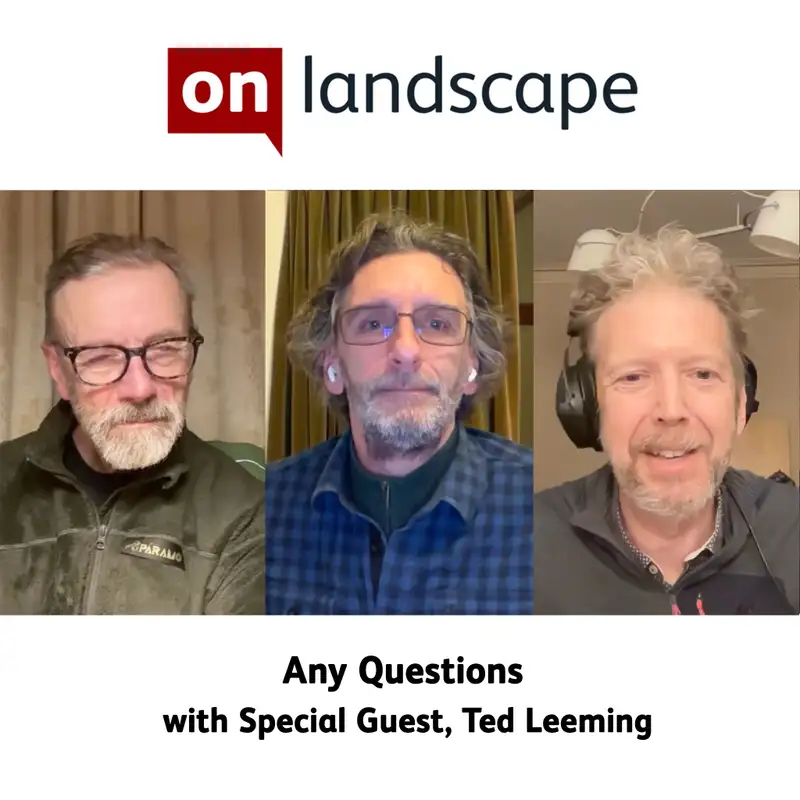
Ted Leeming
Tim Parkin (00:01.304)
Hello and welcome to On Landscape. If any questions, our session where myself and Joe Cornish and sometimes Mark Littlejohn join a guest and we chat about some of our readers' questions and also a lot of our own questions. And our guest for today is Ted Leeming who we're just chatting before now I've known for over a decade on and off. And 10 years ago, you were doing a project at a house in the borders.
called Zero Footprint. So that's pretty much the last thing I've heard of you apart from in passing where you've told me about your project. So what's been happening since the Zero Footprint days?
Ted Leeming (00:43.075)
well, first of all, thank you very much for inviting me on, both of you. So what have I been doing for the last decade? Quite a lot, actually. I think the first thing it's probably worth mentioning is that the Zero Footprint project not only changed my and our Morag Patterson, my wife's practice as photographers, but it also changed our lifestyle.
entirely. I was at that time still managing director at a renewable energy company, which is my other passion, is the environment and climate change. And the Zero Footprint project, which effectively was all about reducing our carbon footprint as landscape photographers by shooting every image from the same location.
It made us rethink our practices as workshop guides and tutors where we were taking people all around Europe and it was fantastic, some amazing locations. But we realized that actually in doing so our own carbon footprint was increasing. And so we made a strategic decision in
I think it was 2016, it might've been into 2017, that we were going to effectively not stop flying, but actually reduce flying to only when we actually needed to. And in doing that, it meant effectively, it curtailed our workshop practice completely. So we still had about three years worth of commitments left in.
workshops and booked clients, which saw us through till 2020. At the same time, 2016, actually a very good friend of ours, our next door neighbor, went into hospital for a routine operation and unfortunately didn't come out. And within 48 hours, I handed in my notice as managing director of the company.
Tim Parkin (03:02.19)
Bye.
Ted Leeming (03:09.715)
on the basis that life's too short and I had too many things that I wanted to do. So effectively, we gave ourselves three years to redefine our practice, which first of all meant for me trying to understand who I actually am as a photographer and my purpose and my aims as a photographer, which was extremely difficult.
And it took me six or seven years to fully realize who I was having been a committed, what I would call a landscape photographer at the time. But through a number of projects and immersive hikes and cycles, I cycled the length of the Danube and did a commute, I called it, from Scotland to Italy on a bike.
and also did the maritime Alps, did a hike along the maritime Alps, 450 odd kilometers. And all of these felt like a second apprenticeship for my practice and how I see myself as a photographer. I basically, having set the aim eventually as everything I shoot has to relate to climate.
people or place and the people and the non-human elements of place.
It allowed me to really focus on projects rather than individual images that I wanted to shoot thereafter. And so what we found ourselves doing is applying to residencies and applying for funding through Creative Scotland and other bodies to do long-term projects where
Ted Leeming (05:15.431)
which involved research on a particular subject and then working very often with communities on understanding their views about place and then delivering a series of outcomes as a result of that in the form of exhibitions, conferences, could be workshops, any number of things. And so having done that for a few years, I think I probably realized that
I was no longer a landscape photographer and in fact defined myself more as a place-based photographer now, a, wherever possible trying to minimize my carbon footprint. Does that?
Tim Parkin (06:00.46)
So that's, yeah, it does. I'm intrigued at that when you say seven years redefine yourself. What do think the biggest learnings were over that period?
Ted Leeming (06:11.963)
Undoubtedly, the biggest learning was that my recognition, I had kept apart various parts of my life. So academically, I'm a geographer and anthropologist by college. I was then a very much a landscape photographer and then a separate part of my life for 30, 40 years has been as an environmentalist and very early days, climate activist.
I even did a juggle in Covent Garden for 24 hours for Greenpeace back in the late 80s. But with the redefinition, what I realized was that I could actually bring all of those elements together into my photography practice. And in responding to briefs set by others and also setting my own briefs, I realized I could create.
the ideal world as a photographer, except for the monetary rewards, which are certainly far less doing the work I do now. But the satisfaction and happiness that I get out of my work has certainly been completely revitalized.
Joe (07:31.891)
That's really fascinating, Ted. I mean, you have obviously thought it through so deeply and you described it so well and so thoroughly as well. Lots of adventures, an incredible number of adventures on the way, all the things that you've managed to cram into your life. mean, any one of which is a major undertaking, especially these physical challenges that you've had. seems, I mean, ideal, I think, if you are able to synthesise
all of your passions and interests in life into one kind of final reality, albeit presumably there was this juggling going on. And I feel as somebody who's really only ever worked as a straight old boring photographer, that it must be quite hard at times to have so many different balls in the air, metaphorically speaking, and to know
which direction to take them. But you do seem to have done that. I mean, we've had lots of conversations over the years, but it feels to me as if the unifying narrative for both of us in our communications has always been about nature and its sustainability and how we can work together, you know, both individually and as communities to see a more prosperous natural world.
and one that is worth believing for children, grandchildren and beyond. And that's something you just touched on. But you obviously have all these other strengths to your bow.
Ted Leeming (09:14.087)
Yeah, I think the important thing that I learned was that I'm actually not trying to provide the answers now. I see myself very much as an observer and through imagery, I think it's possible to reach audiences that can't be reached in other ways. I work a lot on
Identifying the audience for a specific project, because if you're approaching young people, you're not going to invite them to the village hall between seven and nine at night for a talk discussion. identifying an environment of trust that I go into to speak to the various audiences is, and how I do that is very important.
I haven't managed to pick up social media, Joe, like yourself. there are limits to where one will go. But I think that's been a hugely satisfying thing. And with respect to the projects, whilst I have done a wide range of projects since the Zero footprint, I kind of...
and pace myself with respect to each individual project and give it plenty of space. So generally a project will last nowadays three to six months minimum with the current project I'm doing on land use is three years so far and continuing.
Tim Parkin (11:02.03)
I'm intrigued at how your aesthetic might have changed over that period as well, because obviously as a landscape photographer, is a, there's still a lot of priority in beauty, composition and light, et cetera. But I mean, primarily beauty. If you look at the environmental photographers who work in the contemporary scene, it's generally very different. So two questions. One is, has your aesthetic changed when you're doing projects?
And two, if you're just going out somewhere in the back hills, somewhere beautiful, you still get the same buzz out of making the same pictures as you made before? Why has that changed as well?
Ted Leeming (11:43.988)
Great question. Yeah, I think I will always be a romantic at heart. my imagery, I'm not very good at shock and awe and I don't chase that sort of image. There's plenty of people that do that sort of thing much better than me.
Joe (11:46.194)
luck with that.
Tim Parkin (11:48.942)
We've got 50 minutes left.
Ted Leeming (12:14.123)
And I also, from my own perspective, it needs to be done, but everybody finds their niche in the world. But there's only a certain number of polar bears on icebergs that people can look at before they disassociate themselves with the message that's being given. And particularly if people can't
sense a way that they can be part of the change to do something to make a difference to that polar bear, then they tend to switch off and move away. So what I try to do is take images that are accessible to people and perhaps through titles. I tend to use titles a lot more than I used to and try and find some amusement, some link.
to it could be a song or a book or something that gives people an alternative in because everybody has their own journey and everybody looks at the world in a different way. I, for me, and this is part of restless Ted, I guess, if I try and do the same thing all the time, I find myself getting frustrated at myself. So having this variety is very good for.
for my image taking and does allow me to look at things in different ways. The second part of your question, do I get the same excitement when I'm out on the hill? It's heightened, only heightened. And as my physical boundaries with respect to the world with not flying and really trying to...
do most of my photography on a bike or walking and public transport. I actually find I look much more closely at the world around me than I used to. I think you had Morag on a while ago and she was talking about her work in microscopy. And we both, although we're largely
Ted Leeming (14:36.531)
We're still collaborating on some projects, but also working individually. But I think looking down a microscope at the world and seeing that there's a whole cosmos in a square centimeter of soil, that there's more life in a teaspoon of soil than there are people on the planet, is something incredibly exciting. And whilst I don't really go down to
to that same level yet. It's a different way. I did one project called Pollen Makers as a result of No Mo May, which I think was perhaps me being a bit lazy and just thinking I didn't have to mow the lawn for a month or two. I started, it was incredible how quickly nature started coming back onto my lawn.
and I started looking at the fields around, et cetera. But I'm never gonna be a botanical photographer. There's plenty of amazing people doing that. So I tried to take on a different angle and took on the persona of an ant. And so basically got down, right down into the grass and was crawling through. I had an umbrella to shade me as I went. And I might get two meters in two or three hours.
just changing focal lengths, changing apertures. that slowness, and that all came out of the Zero Footprint project as well, really enabled me to be in a different way, which has been fascinating and exciting.
Tim Parkin (16:27.106)
That's interesting because we've got a, I've done some work with a school near us and one of my things was to talk about mountains. And I showed them pictures of their own mountains but on a big screen and zoomed in and panning across so they could look around and they were really intrigued that they're looking at the same mountains they see every day but differently. And one of our friends also does a project where she takes kids out and gets them to look at a square metre of soil for half a day.
Ted Leeming (16:57.043)
I think it's the great Freeman Patson was one of the initial heroes in constraining the photographer on workshops to a small area of space and asking them to really think about what they're shooting. I've tried it on a couple of workshops and
Tim Parkin (16:57.954)
just seeing what they can find.
Tim Parkin (17:04.408)
Yeah.
Tim Parkin (17:12.184)
Definitely.
Ted Leeming (17:25.285)
I think that my presentation was obviously nowhere as good as his because some of the students struggled to concentrate for that amount of time.
Joe (17:37.97)
Yeah, it's asking a lot. It's really, yeah, really fascinating to hear the way that your thinking is going to actually, I find, mean, there's so, you know, we're all different and that's very, very important. One of the things I wanted to go back to though with what you said earlier that I thought was fascinating and forgive me if I get this wrong, but you said you're not trying to provide answers. And I think that's absolutely critical.
Ted Leeming (17:53.398)
Mmm.
Joe (18:06.706)
in many ways in being effective at communicating. It's also, I'm sure, very wise to try to understand your audience and where they're coming from and indeed whether you can have an audience and all of that. find that very, very difficult. I think as a... so... that this is less about photography and more about environmental activity, that one of the great problems with environmental activism is this...
A, that it seems to be contaminated by doom and gloom. And B, it has this sort of preaching kind of element to it. Let's face it, none of us actually knows the answers to what's best. But what I think art can do, photography can do, help to open up the heart and soul to the natural world.
by illustrating its wonder and fascination and beauty and hopefully how people interpret that ultimately is up to them. But I kind of feel that if people care about it, then there's a chance. And if they don't, then there isn't. And ultimately it's that ability to connect what you feel with others, which is why I think it's quite interesting about the titles. Because I think the title, if everything was called
Untitled one, two, three and four and so on. While the pictures might be great, it does become tedious, whereas at least the titles give you a chance to kind of give a flavor or a perspective or a little filter into what you might be thinking, or maybe not what you're necessarily thinking when you look at that picture, but just how your mind works. You know, I think titles are fun and should be embraced actually now. Now that I've been through both sides of thinking on that one.
But yeah, guess the point really is I do think it's so important that we don't know the answers and that we are humble enough to admit that. that includes, you know, when you're a scientist, you know, with your scientific background, having got a son who is a scientist and, you know, whenever I discuss these things with him, he's very often says, it depends, I don't know. He knows a lot, but there's just so much that we don't know. There's still...
Joe (20:33.01)
and you can't tell the future. But I guess it feels to me that the common thread is caring about the future. And if we can do something about it, whether it's reducing our carbon footprint, that, to be honest, seems a bit of a no brainer, doesn't it? I mean, there's a kind of rational thought process behind that. But on the other hand, human beings are also explorers and travelers. And that's a kind of, that's an evolutionary
trait that we've inherited. So it's hard to kind of put a lid on that. But you're still doing it from what you said, cycling, walking, public transport, you can still do it. And it got a little bit of a carbon footprint, but you know, with public transport, but it's a much much smaller one.
Ted Leeming (21:24.787)
The reality is, Joe, that nothing comes for free. And also that everybody is indeed exactly as you say on their own journey. And the worst way that you can encourage someone to join the conversation is to start preaching at them. It's about engaging people in, I think I mentioned it earlier, in...
environments that they feel comfortable in and giving them a potentially a pathway, not through telling them, but inviting them to tell their story to you as to where they sit and can form part of the and be the change. did a COP26
I felt as though I should do something for that. And I actually ended up doing a pack of playing cards where each card, was called COP26 Most Wanted, and it was based around the American soldiers in the Iraq War were given a pack of playing cards of Saddam Hussein's family and generals that they most wanted to capture.
So my thought process took the same concept into the environmental issues that are... There we go Joe, still have a pack. The idea was that each card represented an issue around climate change that needed to be addressed. so one visually it presented that issue, two...
Joe (23:07.058)
going to it.
Ted Leeming (23:21.831)
There was a quote from an authoritative source about that, showing people what the issue was. But on every card, there was a, here's something you can do as an individual to be the change and to make it accessible to people. So you can actually, I've actually put it just recently, put it on my new website.
Exploring.place. So if anybody wants to go and have a look at the cards, I think there's a PDF that you can download them all. It's everything I try and do now where it's not a print for sale, if you like. I try and do open source to make it available to as many people as I can. And certainly the cards were one of them. And actually, at For the Cop, what we did is...
Mostly with Extinction Rebellion, it turned out, but also a little bit of social media. I was funded to produce a number of packs of cards and anybody that wanted a pack anywhere in the world, I would send them one of the packs of cards and for the period of the COP, they took them into galleries and museums close to them.
and stuck them on the walls. It could be in the toilets or... And there was a request that went with it to leave the cards there for the duration of the cop so as many people could see the thing. it was great fun. And there's another element, I think, to all of this is you have to make these things fun. Life's too short to...
Tim Parkin (25:00.48)
Excellent.
Joe (25:11.698)
Thank
Ted Leeming (25:15.668)
to just haul a grindstone around with you. I think that it helps to engage people if you can make it an element of amusement and challenge as well for them and involvement helps.
Tim Parkin (25:35.502)
You asked a question you mentioned earlier about people getting fed up of the polar bear or an iceberg and you see something long enough it becomes you just don't get motivated or reactive by it anymore. What do you think actually works in terms of photographs now in terms of if something went viral on a social media network and a photograph got spread everywhere what sort of photograph do you think actually makes a difference? Is it possible to?
Ted Leeming (25:49.588)
Mm.
Ted Leeming (26:04.818)
think an amazing photograph always makes a difference. They stand for themselves in their own light. Quite a lot of it is luck if you hit the social media button at the right time with an amazing image. It can just be timing.
or a certain individual, an influencer sees it and I don't know what they do, share it or put it on their website. I don't know how it works but I think if something like that happens, can instantly, it can change lives for the photographer I think as well as for people who see those images.
Tim Parkin (26:51.116)
Yeah.
But do you think the beauty is enough to be able to engage people if you show them special places that are more likely to want to preserve those special places?
Ted Leeming (26:59.348)
Mm-mm.
Gosh, gosh, for fear of causing ripples in the on-landscape community, I have a slight concern that people seeing beautiful pictures makes them, if that photographer want to go to that place to photograph it themselves. And I don't blame them. I've done enough of it myself. So don't, I'm not...
Tim Parkin (27:22.68)
Yeah.
Ted Leeming (27:30.046)
telling anybody to not do things. And I would be a huge hypocrite having traveled the world for large proportions of my life taking photos. But yeah, the power of the image. When I was doing my Danube cycle, I think it was in Hungary, I went to the Museum of Terror. And there was a...
a room in the museum that was all about propaganda. And it was the most fascinating part of the museum. So that piqued my interest in the power of photography and titling actually to effect change.
It's been a big part of what I've been trying to message since then is that actually from the top down, there's two ways I see you can bring about change and one that brings about very little. I think you can bring about change from the grassroots up. So people actually doing stuff and that's individuals, it's communities, it's interest groups that are literally getting their hands in the soil.
that are changing the way they tend that garden from a nature perspective. And actually working in communities of interest because those values of community are very important, the intrinsic values, and that spreads.
So a big part of what Morag and I do is work within the community, Morag far more than I do, to try and engage local people in the conversations. And between her and a range of other people doing projects related to land of which the photographic and artistic bit is but a part.
Ted Leeming (29:54.372)
There has been, think over the 20 years that I've been in the Glen Cairns of Dumfries and Galloway, a change in the way that the community sees their community and the respect they have for nature and that is making changes. The other end is, sorry.
Tim Parkin (30:11.106)
Hmm.
No, to say we have a very similar thing happening, which is there's a big split between locals and incomers and also people who are working in the land guillies, et cetera, and people who work in tourism or whatever. we've noticed as we've started talking about water quality and things we've done for water testing, getting those two people just to acknowledge each other has been a massive, massive change for us.
Ted Leeming (30:42.878)
Well, can, after this, can tell me how you managed to achieve it. If we, to get a farmer and a forester in the same room in the Glen Cairns is absolutely impossible. And to get either of them sat with an environmentalist is even more difficult. And yet, if I've been to various workshops where there's been just farmers and...
Tim Parkin (31:00.439)
Yeah.
Ted Leeming (31:11.524)
they suddenly open up and because they're talking to individuals that they trust and they don't fear, the defences come down and they come out of their corners and start looking at proactive solutions because at the end of the day everybody knows what the issues are, everybody has the same fears for their family, for their kids, for their futures.
And it's just how you go about delivering the solutions that's the different difficult things. So I think collaboration at that grassroots level is essential and trying to work and find paths to bring people together without conflict and with respect to each other. And there's ways you can run meetings and where you can run meetings that help that. If you
If you make sure that everybody that sat at the table is involved in the conversation rather than the big voices like mine taking over and overpowering the discussions, I think that that can be very negative and then people tend not to come. So when we do workshops, we try and engage everybody in the room, first of all, by working individually because
That's where you get the most ideas. then allowing once everybody's say written on post it, their thoughts with respect to a particular issue, then engaging as a group, as a small group, small groups of six going around the table, making sure everybody gets to speak and not allowing words like but and no in the conversation, but yes and and.
You very quickly get people becoming less confrontational. then really how you bring together those individual thoughts into a consolidated plan for action is something where you can start by taking small steps and small steps.
Ted Leeming (33:35.463)
lead to larger steps and you create communities. I once worked for a fascinating character called Fred Olson. When I first met him, he was in his 70s. I had supper with him at 97 a year ago and he was still saying it's all about creating, he's a businessman.
Tim Parkin (33:52.078)
.
Ted Leeming (33:59.455)
But everything he said, I remember the very first time I met him and he was trying to buy our company, I asked him what he wanted us to do for him and he banged his hands on the table and said, it's not about what I want you to do, it's about what you want to do. Because if I try and make you do something, you'll just get disenfranchised and move on. So I think making sure that people feel a part of the engagement is extremely important.
Tim Parkin (34:24.11)
you
Ted Leeming (34:29.285)
in all you do. finding, did a, Tim, we were talking the other day about, we got involved, we had a proposal for a national park here in Dumfries and Galloway. And the consultation for that national park was very traditional. It was come to the village hall for a couple of hours, right on a post-it, and then some experts will go away and come back and...
tell you the community what they think you want rather than perhaps what the community wants. And it became very tribal. was either you're either yes for the National Park or no, you're not for the National Park. So we did a creative consultation, did some research on what both sides were saying were the big issues of concern. And it turned out they were literally aside from the National Park.
the concerns that everybody had were identical. It was just that there was a... And they have been set up through PR and to... For a conflict situation. And I think that if we can teach people to recognize those conflict situations and ignore them and say, no, I'm not going to... For this to become a...
a bipartisan argument and we're going to make it a discussion. How do we solve an issue rather than fighting against each other, which achieves very little. Just going back to your other point, so that's the grassroots coming up and an area we're interested in. There's then the top level that I see, what I call the change makers.
Tim Parkin (36:09.998)
Thank much sir.
Ted Leeming (36:23.477)
And that's not only the politicians, but the organizations that have the power to effect change. And so that's the other focus area for myself. And how do we get them to what I was saying about spark imaginations within the people that brings about change? And I think that takes...
really clever thinking, but we've seen brilliant examples of how it can be done overnight. We saw the populace come together over COVID is the obvious example, but stopping the use of plastic bags, the cigarette campaigns, clunk click every trip, where behavioural change campaigns over a long period, you can very easily change how people think towards a better future.
And so one of the things I'm doing at the minute for the next lot of Scottish elections is pulling together a call to action around land and the people that live on the land and how we better look after all users of place and using heads of environmental organisations and other parties to identify a very simple vision or policy that...
any politician should be able to latch onto in a non-partisan manner and deliver in the next parliament is another way that I see that we could start bringing about change through new thinking rather than just patching up old wounds.
Tim Parkin (38:14.658)
Definitely.
Joe (38:16.85)
Wow, that's a lot to take in there. mean, I have to, you know, thinking about the change makers, because, you know, I think the way you've divided, it is very real and relevant. You can see change at grassroots, certainly we do in our area. Most of it fairly positive, I would say. But at the other side at the moment, and I only know about this mainly through
our son who works in the sector. The current US administration in particular is sucking up all the oxygen, which is making life extremely difficult for the companies and for organizations to move forward in, let's say, the energy transition in particular. That's the biggest area of difficulty. I think the...
there's still a lot of positive thinking about environment and, you know, protection for nature. when you have the world's most powerful man saying that climate change is a con, it makes life extremely difficult. And also the way that American corporations have been cowed, at least some of them have, by his policies or by his attitude and his personal kind of
example is making life difficult. So, you we have to hope there will be changes there in due course, sooner rather than later. And also, think I'm resistant to that kind of thinking has to come from grassroots, from voters, first and foremost. yeah, artists can and are, you know, pushing back against that all the time. You know, we see that
especially most notably in the music and acting professions where most of them seem to be proactively willing to stand up for what they believe, which is really very inspiring because they have a voice. We obviously don't have that kind of profile, but I think just being able to declare what you know to be true and to make work around it.
Joe (40:39.814)
that as you say, Ted, it's fun as well and accessible. Hopefully we'll continue to keep the tide moving in the right direction. But it's certainly a very, very tough period at the moment, I would say.
Tim Parkin (40:54.082)
Out of interest, you think people can... Is a goal trying to make people appreciate their local area more? Something I've thought about in terms of seeing the local population where I live in Glencoe and Ballyhoolish is the majority of kids who are growing up here don't really appreciate where they live. In Fort William, was some statistic around 40 % of the population had never been up a hill locally. But they're willing to travel to the Alps or go to America to see.
Joe (41:03.556)
I think it's absolutely,
Tim Parkin (41:23.298)
the equivalent landscape over there. So do think it's possible to get people to appreciate where they live more? Because that is where they can make change, at least.
Ted Leeming (41:33.281)
I think it is essential that we try to engage people in their local environment. For me, is one of the big parts of the jigsaw. Many of the bits fall into that community level at all sorts of different levels through collaboration, as we've said.
I think if you don't need many people in a community to really turn it around, if they put in the hours to get people engaged in the conversations, but it has to be something they feel relates to them in some shape or form. And instead of in Glencoe asking them to do the Anahiga on their first day or Curved Ridge.
Perhaps, know, Lost Valley is a slightly easier or just go and look at the view from the car park is the way that you start and you do it in small incremental steps rather than trying to get to the solution at day one. The dilemma we all have is the urgency with which everything is required, but there's only a certain amount you can do and you can't.
You can't bypass at the grassroots level. What can change is that everybody always talks about the negative tipping points. And I think that there are times when positive tipping points do happen. And with my recent land use project cycling around Scotland, exploring all the different urban and rural land uses and approaches to management of land.
I've seen literally hundreds, if not thousands of quiet voices of individuals, communities and interest groups doing literally amazing stuff from back garden to landscape scale rewilding projects that are making a difference. I do honestly think that we have to just live in
Ted Leeming (44:01.871)
in the hope that those messages just by osmosis filter out to others that are their neighbours and this movement continues. Undoubtedly, I'm sure both of you doing your landscape workshops, what you're seeing in the way of not just rewilding projects, but people managing the land.
Better, not perfectly, but better is growing. still in its infancy, but it is a movement for change.
Tim Parkin (44:40.853)
It's tough to see change on a small scale, isn't it, over a small time scale. You have to look back 10 years, 20 years, 30 years and go, God, things have changed, haven't they, actually?
Ted Leeming (44:46.88)
Meh.
Ted Leeming (44:50.197)
Perfect.
Joe (44:50.354)
They definitely have and having been photographing landscape professionally since the late 1980s for the National Trust amongst others, I've had this sort of focus on, well, I know a lot more, I suppose, now than I did. Now I know how little I know, but there's definitely been changes. And I think the wildlife in particular, there's a lot...
I see in the UK at least more wildlife than I used to in the past. And I'm pretty convinced that most of that is to do with better agricultural practice. there's less widespread use of pesticides in particular than there was at one point. And we have locally, there's a lot going on in our landscape, but just to address a couple of points that came up, because you two live in Scotland, which...
you know, tend to stand out in the UK for obvious reasons, you know, as the most spectacular part of our islands. But North Yorkshire people are tremendously proud and fond of the land. And that was, know, as having had a gallery for 20 years there, we became very aware of how much affection the land is holding.
And bit by bit, the fact that artists are able to start communicating in a kind of visual and with their own storylines, the idea that the wildness is a positive, that does come out, I think. we are seeing change, partly. And yes, there's still far too many neat gardens around, but there's also increasingly ones that look quite wild.
And I certainly think that the wild fringes and the woodlands that we see are managed much better in general now for nature than they were 30 years ago.
Ted Leeming (47:00.822)
I'd have to agree with that. think the dominant force is still driven by a commoditized landscape that seeks to maximize productivity. I think with respect to mentioned pesticides and use of perhaps fertilizers, I think it is being more targeted and people are trying to save costs indeed.
the drivers that come from the top down as I see it and I'm no expert do appear to be still attached to yield and I've spoken to many organic and regenerative farmer that say if they could just switch that from yield to profit and then look at how you bridge the gap in changing your farm from an intensive
system to a less intensive system that considers for all users of place, you will see that change coming forward. there is a gap of about, it seems to be somewhere between four and eight years, where the yield goes down and you're not getting the profits that someone needs to help the farmers with. You can't expect people to
to just drop their productivity by 25 % because they like nature, because they're running on very fine margins. And I think the understanding of all the needs, including those people that are the stewards of the land at the end of the day,
Joe (48:40.528)
That's it. Yeah.
Ted Leeming (48:55.154)
and bringing them with us on the journey is essential, be that farmer, forester and everybody in between.
Joe (49:05.938)
There's so many examples of how these people are kind of pitched against one another in local communities. I had a fascinating example recently. I was involved in a movie about the wash in England. It's that vast tidal estuary between Lincoln and Norfolk, Lincolnshire and Norfolk. And there are many, many locals who
have different interests in the wash. And the whole system, the whole estuary is managed to an extent, but I forget the names of the organizations, but their environmental controls over it. And you also have the cockle fishermen, for example, who every day go out into the wash to farm for cockles, which is a wild harvest, if you like, but they have done it in a sustainable fashion for.
over 200 years. And now they're finding that they're being well, they're being affected by climate change, they're being affected, the markets being affected by Brexit, and they're also being affected by the by the environmental controls, which and and it's so it has been extremely difficult for the guys who do the environmental inspections, and the cockle fishermen. So they're completely in opposition on the face of it. But
partly as a result of this film being made, the filmmaker has actually managed to bring them together in the pub to have convivial discussions and to try to think about a future together. there's a lot, there is a way I think that the creative community can help because that's what we know is needed. That sense of collaboration, ultimately it has to be there for everyone.
balance of interest has to be taken into account. It can't be for one pressure group only. And that's a very difficult trick. But I'm sure there are probably hundreds of examples like that in the way that the land and the sea around our shores are managed, where people's interests are apparently in conflict. But I really don't think they have to be. And I'm sure that with good
Joe (51:31.078)
with good guidance and good governance in the way forward. However, having said that, feel that money is always playing a part in this. Like you said about yields, for example, ultimately, well, that isn't necessarily money, but that's a big part of it. And it has been driven by government policy since the end of Second World War, maximise yields at all costs. But unfortunately, that is at the cost of nature.
and then things start to unravel because the soil quality decreases, water becomes contaminated, becomes more more expensive to do lots of things and to, you know, because more and more cleaning up is required. So there are so many, there are so many issues that have to be taken into account. There's no perfect answer. you know, let's face it, there'll always be tension in these relationships.
but it's how to move forward as much together as we possibly can.
Ted Leeming (52:32.082)
think the siloed mentality you talk about is relevant everywhere and landscapes have become largely specialized and commoditized for individual purposes. I did a little bit of research on this to see where it might have stemmed from and obviously enclosures is one because you've suddenly defined landscapes in a very different way. But more recently,
and perhaps more relevant is the Town and Country Planning Act and subsequent regional and county development plans that were then produced, which effectively zone every element of where we live for a specific purpose. So you have prime agricultural land, you have housing, you have industry that is all being zoned. So it's quite natural.
When you do that, the parties that specialize in those areas will focus on that at the expense of the other users. And that includes nature, which we invented designated areas for nature. And so the public, quite rightly, thinks, nature's been looked after fine. The farmer thinks, well, nature's been... They've designated areas for nature.
And so we can carry on with this in our specialized environment, perfecting what we do with, in essence. Another interesting point just on this is the terminology that's used. If you look at maps and these zones, then class one agriculture and prime agricultural land
make them sound like the best land that we have in the country. And yet our designated areas are called swamps and bogs and mires and negative connotations. And that goes back for hundreds of years. So it becomes the folklore and it's in the genetics of who we are that we should be improving those lands.
Ted Leeming (54:54.868)
because even the terminology suggests we should be doing exactly that. if you start, actually, no, don't start me on generational land use change. I'm very aware that we haven't talked very much about photography in all of this.
Tim Parkin (55:03.118)
you
Joe (55:11.836)
No, no.
Tim Parkin (55:13.326)
Yeah, I'm intrigued. when we got along left, but I've got a question about aesthetics and you talked to a lot of people who were on maybe let's not say the other side of the fence, but people who aren't necessarily enamored of the environmental movement. Does your photography when you show them the photography still engage them in the same way as everybody else gets engaged with beauty and the scene, the landscape?
Ted Leeming (55:42.72)
That would make a great interactive questionnaire on my website, actually, to see... I'm trying to make the website interactive and gather information to see how and what works and what doesn't work. So I haven't done it yet, but I definitely have an aspiration. And when I do exhibitions, I'm now putting QR codes which take people to additional information should they wish to...
Tim Parkin (55:46.87)
Yeah.
Ted Leeming (56:10.488)
to extend their own personal journey. that would be a lovely one to... Yeah, I might plagiarise that and use it, Tim. Thank you.
Tim Parkin (56:13.806)
Hmm.
Tim Parkin (56:21.198)
I say that because I've done a couple of talks locally and we've had a lot of people down who are from all sorts of backgrounds, the guys who put the original forests up and when the forestry act started, the people who put the fences up, people who managed the land, Gillies beforehand, and everybody who saw the photographs all engaged with them positively, but had their own personal take on what they were seeing. They read the land very differently.
Joe (56:46.386)
I must jump in at that point too, because I've got an exhibition in Yorkshire at the moment with Simon Baxter, a woodland photographer. I mean, it's essentially, it's a very, very positive exhibition about woods and forest. But we have a gallery in there that's devoted to, it's called Interference, and it's devoted to the exploitation of woods.
I have a picture now from Glen Etive, Tim, which you've seen. think of what is a, well, essentially it's half the picture is, it shows an industrial forestry site. there's thousands of, of kind of evenly matched, sicker spruce pines sitting like matchsticks on top of one another going up the hillside. In the background, you can see
You can see the remnants of the forest left that haven't yet been cut down and this vast area of clear cut. And then on the right is Larry Garten and the, you know, the Boccalettive moor and Boccalettive bag, I think either side of it. And so you have this signature of Glen Etive on the right and this kind of in a way shocking vision of how we treat nature. Of course, it's harvest timber. I know that.
But there is something shocking about it. I'm very fond of the picture. for a, I wouldn't have thought for a single second anybody would want one. But lo and behold, it's sold. And it actually sold to somebody who's in professional forestry. So they had a very, which I found absolutely, well, I found it quite moving, but also meaningful because it showed how little I know about how work.
is interpreted and appreciated and I know still made the photograph with great deal of intent and intensity and commitment and it was just I assumed it wouldn't be popular maybe it's not popular popular but somebody liked it so
Tim Parkin (59:00.558)
Interesting, lot of people around here who are climbers, et cetera, nearly all started at work at some time in forestry as well. So they've all got that forestry background, even though they're climbers and environmentalists. it's very, I think we never know. Probably the big thing that comes at it for me is we don't know which side is actually 100 % correct, which side has all the facts. You you talk to people from the deer culling or deer husbandry.
Joe (59:12.678)
Yeah. Yeah.
Tim Parkin (59:30.336)
side and they both have very good points and they both have things that are probably going to be proven completely wrong in another 20 years time.
Joe (59:38.13)
And it feels to me a lot of the time that everybody is, it's propaganda on every side, know, environmentalists. You everybody has an agenda and we have to try to see that in a clear-eyed fashion. And I think one of the great things about being a photographer, you know, whether you do it with the level of kind of commitment that Ted has, or if you're just a hobbyist, but the...
Tim Parkin (59:44.674)
The knee jerk reaction, Ravita.
Joe (01:00:06.694)
beauty of it is that you're an observer of the world as it is, as you see it in the reality of that moment. And that is a valuable activity just to be an observer. And how we see in reflection the pictures that we take and how others see them ultimately is for them to judge and perhaps for history to judge in the end if those pictures last. But yeah, I think that that role is an important one.
Ted Leeming (01:00:21.4)
Thank you.
Joe (01:00:35.474)
Well, I have to believe that having done it for the last 40 years.
Ted Leeming (01:00:39.735)
I think everybody sees the, let's call them the opposition as a threat and it's a genuine threat to livelihoods and therefore people tend to, it's only natural for people to be defensive of their positions and also people don't like change, whatever that change is. Status quo is a very comfortable place to be, however bad it might be.
So I think that's important to recognize. think the, on the image side, and it's just something I just wanted to note that the other thing is, everybody shoots, you know, very different types of images. I've gone away from the generally because I'm usually on a bike and have to cycle 70 miles that day. So I don't any longer have the luxury of, of the.
going and doing my research for potentially several days, identifying locations and then going back to them on multiple occasions like I used to for the perfect conditions to be there. And so actually how I shoot now is completely different as well. so, and that engages a different audience as well. It's less a landscape photography audience to be.
to be fair, because they're not the same sort, they don't meet the criteria that we understand as a landscape issue, but a landscape image, but in the traditional sense. But there is a different audience there that engages with those images for different reasons. And that's truly interesting to see that there's always an image for, or always an audience for an image, whatever it might be.
Tim Parkin (01:02:16.338)
Hmm.
Tim Parkin (01:02:37.666)
One of the things we had recently in the natural landscape photography competition was the project winner, whereas I'm not sure if you saw it, was Feli Hansen who did a project on basically rubbish, rubbish on beaches or wherever that looked like landscapes. And it's engaged so many people. So it was a project and it wasn't necessarily landscape as such, but it was well thought out and people loved it. So I was quite...
quite pleased that the majority of people did engage with it in the right way. So it's reassuring.
Ted Leeming (01:03:10.827)
Yeah. And that will, by selecting that one, it will encourage other people to go and shoot that sort of work. I think if I go back 20 years going into camera clubs and being asked to judge, I think there was a very defi... I haven't done too much of it recently. I try to shy away from it. But I think that there was a tendency particularly then to be very...
focused on defining what a photograph is and actually expanding that horizon to allow different perspectives to be looked at. think digital first bought it, allowed people to look at the world in a very different way. But I think increasingly, different styles, the more documentary, it should be embraced.
Tim Parkin (01:03:44.419)
Yeah.
Ted Leeming (01:04:06.679)
rather than technical perfection sometimes. I'm not sure that Kappa ever had some of his best images, some of the least technically perfect if you were to pixel pick them. But the emotive power behind those images is, I guess that's where I'm the route that I'm heading down now to try and get some of.
Tim Parkin (01:04:21.176)
Definitely, yeah.
Ted Leeming (01:04:34.705)
even a fraction of that emotive response. Positive or negative?
Tim Parkin (01:04:40.014)
Perhaps we can do an article about some of your projects being doing and being as we haven't had a chance to discuss too many of those. But I think that has to be visually done as well. So we'll follow up with an article if that if you're interested.
Ted Leeming (01:04:53.245)
I would be delighted to help if I can. Yes, we'll take a chat out of here to discuss what we could do there. And just a little plug, because it only actually went live this week, is if people do have an interest in some of the themes or want to see some of the projects I've been working on, my new website, exploring.place.
Tim Parkin (01:04:56.216)
Fantastic.
Tim Parkin (01:05:01.762)
Well, thank you very much for your time, Ted.
Ted Leeming (01:05:20.955)
is it's still quite crude but it will give people an idea as to perhaps a different way and certainly where I am with respect to my photography it might not be where they are but it might give some ideas to people to help them on their journeys.
Tim Parkin (01:05:20.984)
Okay.
Tim Parkin (01:05:42.434)
Great. Thank you. put a link on that on the article as well at the bottom. So thank you very much, Ted and thank you, Joe.
Ted Leeming (01:05:47.81)
Brilliant. Thank you both very much. Always a pleasure.
Joe (01:05:48.636)
Thanks Tim, thanks Ted.