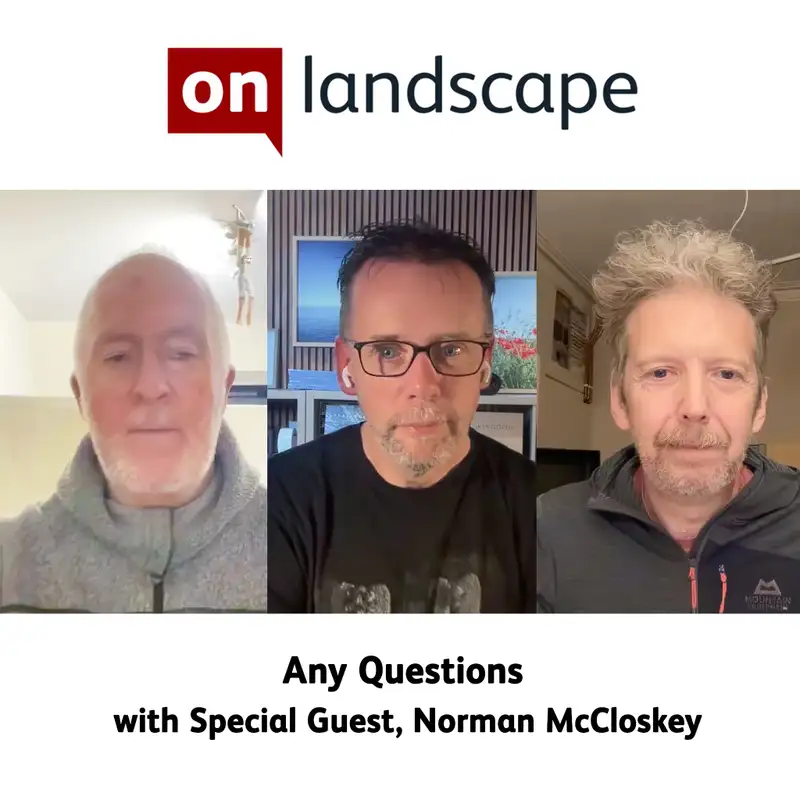
Norman McCloskey
Tim Parkin (00:01.154)
Hello and welcome to On Landscape. It's Any Questions and I'm here with Mark Littlejohn and our special guest Norman McCloskey to answer some of your questions and our questions that crop up. Hello, Norman.
Norman (00:15.346)
Hi guys, how are you?
Tim Parkin (00:17.08)
Very well, very well.
Mark Littlejohn (00:20.429)
I'm not too bad, slightly flustered for being in the wrong place at the wrong time. But lovely to see you.
Norman (00:25.532)
That's all right. That's all right.
Tim Parkin (00:25.622)
Yeah, I mean, as a change, it's everybody else who's late and forgets about things rather than me.
Norman (00:33.222)
Yeah, well, I made it here on time this time, so, yeah.
Tim Parkin (00:33.346)
But we all got here.
Mark Littlejohn (00:36.942)
Yeah, we're all here now. That's all that matters.
Tim Parkin (00:40.258)
So Norman, in case people aren't as familiar with your work, we know you're a photographer from the southern part of Ireland, would that be correct? And I've got a couple of books of yours, now three books of yours because I've just received a new one. Can you tell us a little bit about how you got into photography and where you ended up where you are?
Norman (00:50.0)
Mm-hmm. Yes.
Norman (01:05.522)
Yeah, I'll try and keep it brief because it's a bit of a long tale, but I've been I've been basically photographing the landscape for about 33 years now. I stumbled into photography, picking up a camera when I had moved down to the town I live now. originally grew up in the city in Limerick and it was quite an overwhelming experience moving from, you know, a working class housing estate where everything looked the same to
what I thought was one of the most beautiful parts of the world that I'd ever seen up to that point. And, you know, after a while, the chance came, I picked up a camera and immediately I made the connection with it as a way of, I suppose, making sense of this endless, overwhelming kind of wow moments that I was constantly boring everyone with that.
that had lived here all their lives and just didn't really see the landscape the way I saw it. I thought it was just this magical thing. Everyone else just it was their home. And instead, so, you know, I started photographing it and that was a way of a kind of, I suppose, beginning a conversation and making making sense out of it to me.
self-taught for about the first year. This was pre-internet and YouTube and all of that kind of stuff. So shooting film, Went on to study photography in our college for a couple of years. And that was fantastic. But it was our college who didn't exactly equip you for the real world or a job.
I ended up assisting to a commercial photographer for about a year and that was great fun, but it was a bit sporadic. you know, by now I was, you know, pushing on to being 26. I needed something a bit more kind of reliable. So I took a job in a sports photography agency on working on the picture desk initially. And there was a there was a clear route when you go into that agency to go from the picture desk to being a sports photographer.
Norman (03:09.926)
tried and trusted, everyone did it. It was given to me. was lots of opportunities. I ended up going to games and, you know, being the fourth photographer, the third photographer there. And yeah, it's like, you know, I was at a World Cup qualifier. I took a picture of Dennis Erwin scoring a penalty. It was on the front page of national newspapers the next morning. And you'd kind of think that that's where the story would be. That was where my big break came. But
I mean, to this day, I'd say the look of apathy on my face the next morning just bewildered my boss. And he thought I would be jumping up and down with excitement, but I kind of knew I'd already known the system. It's a very arbitrary thing when you send pictures out to picture desks and, you know, no one's actually saying, God, this guy is amazing. They're just saying this is the moment. And I kind of knew that.
So I knew really early on I wasn't going to be a sports photographer, but there was definitely a career path there for me in the agency. And I began kind of very quickly running it, the picture desk, and then I set up what was to be the commercial department. And it provided me with a fantastic kind of income. And I worked in the world of photography, which I loved. I did love sport as well. And it was a really interesting job.
But it also gave me the time and space to concentrate on my main love, which was landscape photography, which all of my... I had moved to Dublin at this stage. So, you the agency was in Dublin. College was in Dublin as well. And yeah, I just focused my own personal work on that. You know, some years later, I managed to...
Tim Parkin (04:38.518)
Where were you then?
Norman (04:58.839)
self-publish my first book while still having a full-time job and so on. That's where the first kind of cracks in the whole relationship between myself and my boss. At this stage, I had begun working from home and I'd relocated to Kerry, where I was for 11 years of that full-time job. I really had the best of both worlds. I had a fantastic job, good salary, very interesting. I was my own boss and I could basically just put my phone on divert and
bugger off out into the landscape whenever I wanted to. It was ideal. But, you know, eventually all things kind of had to come to an end. There was a bit of a strain with the distance from me being in the office and the dynamic in the company changed. Luckily, around the same time, the opportunity to open my own gallery literally walked in my door and it had been something that I had kind of dreamt about for years, literally lay awake.
Tim Parkin (05:29.218)
Yeah.
Norman (05:56.464)
at night thinking this is what I should be doing, but I felt now my chance is gone. I can't do it. It's too risky. know, mortgage, two kids, bills, all of that kind of stuff. But finally, it seemed that I had kind of, you know, had enough of saying no to myself and the opportunity was too good. The premises was perfect. The rent was ideal. And I had kind of done some very quick calculations while thinking about it and realized that
I was bringing in enough online through book sales and prints. And at that stage, I was doing a few little workshops, which we were talking about before we started recording. So I had more than enough income being generated to cover the rent and the running costs of a business. So there was no excuses left. I kind of had to go for it. And yeah, that was 10 years ago. So I've been a
Tim Parkin (06:44.535)
Yeah.
Tim Parkin (06:50.776)
scary decision.
Norman (06:52.793)
Yeah, like it was, but it wasn't it at some like I make it sound like that. just jumped from a great job into my dream job. I actually was very cautious and I laid the groundwork for a soft landing if it all went wrong. I'd spent a couple of years developing a kind of a part time commercial business. So I was doing I was shooting everything from interiors to PR to, you know, all sorts.
And I actually ended up doing weddings, of all things. And I mean, I never, ever imagined that I would do weddings. I did weddings for five years. So I did them for three years before I started the gallery and I did them for two years while having the gallery. Towards the end, I was doing, you know, 40 weddings a year. I tried to get out of it by putting my prices up.
Tim Parkin (07:23.576)
Yeah.
Tim Parkin (07:29.656)
How long did that last?
Tim Parkin (07:34.229)
Okay.
Norman (07:49.498)
and reducing my hours down. People kept saying yes, I was flummoxed. So I eventually just had to shut it down at the end of 2017 and just concentrate on my work. I don't do any commercial work anymore apart from landscape orientated commissions. And yeah, that's been great. So 10 years in the gallery, it's flown by and...
Tim Parkin (07:49.688)
didn't work.
Norman (08:18.661)
Yeah, it's a kind of a dream, a dream set up really now. And thankfully it's working and I long may that continue for another 10 years, hopefully.
Mark Littlejohn (08:28.63)
It's almost a case of your love of photography and love of the landscape is over time just come together and coincide it and it's no longer a case of, you know, doing the sports photography, doing the weddings, everything's coincided at once and you're making a living from it, which is fairly unique, well not unique in this world, but it's not an easy thing to do.
Norman (08:52.791)
No, yeah, it's and you're right. It just simply comes down to the love of the landscape. I have talked about this before and I could go on about it for hours and I and I don't think, you know, non landscape photographers can understand how profound a thing it is. They probably just see me as man with camera goes off into mountains, takes pictures. But it's so much more than that. And it goes beyond a career for me, to be honest with you. It's it's
the only thing that I've ever felt that I was actually supposed to do in life. I wasn't much good at anything else, to be quite honest with you. And it's provided me with everything from, you know, being a free source of therapy to, you know, a keep fit regime to, you know, a fantastic way to make a living. And you're right in that it is quite unique. mean, I'm
You know, I'm one of only a handful of photographers in the country working as landscape photographers to make a living from it and even fewer that purely just do it from my work. don't do workshops. don't do YouTube or ambassadorships or anything like that. And that's that's kind of rare. Everyone, you know, the obvious path nowadays for landscape photography and doing it as a career is to do tours and workshops. It's very...
Tim Parkin (10:16.045)
I can count on probably one hand the number of people I know who just sell prints and own a gallery.
Mark Littlejohn (10:22.734)
You look at even Joe Cornish's gallery, which was an absolutely superb place and one that landscape photographers all over the UK gravitated to. that, with a successful cafe, could no longer support itself. looking at your prints, it's images that you're, you know, noticed when you're talking about the business head as well, you know, doing landscape photography for a living.
Norman (10:23.149)
Okay, yeah.
Norman (10:29.841)
Mm-hmm, yeah.
Norman (10:39.279)
Yeah, I was surprised when I...
Mark Littlejohn (10:52.814)
but also being able to take the pictures that you want to take that you like and still being successful is a lovely thing. It really is.
Norman (11:02.597)
Yeah, and I think I'm even more unique. mean, look, it is a source of fascination amongst landscape photographers. I've been lucky enough to get to know, you know, quite a few high profile guys and go away on trips with other photographers and people with much, much bigger profiles and following than I do. And there's a common kind of conversation that comes out, which, like everyone kind of secretly admits, well,
You know, I'm not selling any prints, you know, that it's that it's very hard to do. And it's all I do. What one of the kind of the ways I think which I've made it work and managed to avoid the obvious pitfalls of selling out and and just chasing commercialism and chasing what you think will sell is that I have worked around book projects for the last 15 years.
So I've done four books. They'd usually be a period of about three years with a gap in between. And that that means that my main kind of output of photography is is more centered around a project and a book and a narrative. And the way I do it is I I kind of would say I'd be lucky if, you know, if a book had had, say, 100 images, I'd be very lucky if out of that, there would be 10.
images that would then translate to being sellable images in the gallery. And I do just pick from that. I have, of course, over time gone and done once off projects and little little side things which resonated with people and which I enjoyed. But there's there's numerous subjects that I could do. I could do I could go chasing castles and sheep and donkeys and I could sell Prince hand over fist and, you know,
make make a lot of money out of that, but it wouldn't necessarily be me. So I do think every time I go into the gallery and I open the door and kind of look around, I go, this is nuts that this works, you know, and it works for 10 years. But I'm just hugely appreciative and thankful that it does. And I'm very, very careful and cautious then not to change anything, you know, to just kind of
Mark Littlejohn (13:28.941)
Yeah.
Norman (13:28.995)
and keep doing what I do.
Tim Parkin (13:30.52)
Out of interest, what would you say your customer split is between sort of like independent local sales or further abroad or tourists or people who...
Norman (13:46.278)
Yeah, at the start, we were very much reliant on tourists, you know, because it takes a while to build up a domestic customer base. It takes a while for people to appreciate your work and that one will want to come back and buy a second piece. You'll get a regular hit of one off tourists. that's basically I live in a I live in a touristy town. It's population of it. It's very similar to somewhere like Keswick.
But without all the outdoor shops. know, in Kinmair you have galleries and you've a high net spend, is really good. But so at the start it was very much touristy, but thankfully over time I've built up a really, really nice domestic market, Irish buyers. you know, without kind of chasing the notoriety of
Tim Parkin (14:19.074)
Okay.
Norman (14:43.493)
followers and all of that kind of stuff. And my profile still remains quite, quite low. And I'm happy with that. people have people know my work now, or they would even they would just know the gallery. They wouldn't necessarily know who it is, but they know they know the gallery comes from there. So when I do an art fair in Dublin, there's recognition, there's recognition of the work or there's recognition of images. And, you'll find that people have saved photos on their phone and they've
meant to come back in a year's time or something. So at the moment, it's probably about 50-50. I do export a lot. And our obvious main client base is the USA. We did have a really, really good, strong, vibrant business with the UK prior to that wonderful idea of Brexit. And that really hit us for a while. We're clawing it back.
And it's people now finally understand it. And I think UK visitors are finally coming to terms with the fact that, you know, they will pay that on stuff that they import and so on. But it's still a conversation we have to have with everyone. that that does. Whereas US customers just they're used to just going around and they're amazing. Like they will they'll think nothing of picking the biggest print on the wall and saying, yeah, ship that to me framed with glass. And.
Tim Parkin (15:59.948)
Yeah.
Tim Parkin (16:09.336)
Wow.
Norman (16:11.513)
Yeah, they're very comfortable.
Mark Littlejohn (16:12.841)
Do you think it's a bit like you're saying before about the weddings and the more you charged, the more people want to book? Is that a similar sort of thing with the prints? I suppose it's getting that balance reassuringly expensive. Some people won't buy something unless it's got an extra zero on it or just a 50 % more expensive.
Tim Parkin (16:14.113)
is cost.
Norman (16:33.871)
Yeah, I mean, yeah, and that is true. And over time we have put up our prices because it just you had to. But I've never really wanted to have, you know, work that was just out of reach and only for, you know, an elite section of people. The comments that I get all the time and my work is printed and framed to a very high standard.
The comment that we get from a lot of people who know the value of, you know, of who might buy a heart and who might buy princes. These are way too low. You these are and I'm going, well, you mean they're they're good value then they're reasonably priced. And that's what I want, because.
I have young people, you know, their first home and stuff coming in and, know, you can see them there. They love a print and they're always going about buying it. You know, it's still 450 or 500 euros. And I still think that's bonkers. I'd have to think a long time about spending that money on a print myself. But it happens. So.
There is an element of, yeah, you could price yourself for a higher end of the market. And I know artists who do do that. But, you know, I like to just be fair about things, to be honest with you. I really don't want to take the piss. I'm not massively motivated by money. The gallery is successful and I earn a nice living out of it. That's great. But...
I just I get a buzz when people come in and buy their first piece of art for their walls. Yeah, yeah, and and I don't know, there's a sense of fairness that comes into everything in life, I think. you know, you could very quickly lose the run of yourself and.
Tim Parkin (18:07.872)
It's helping people appreciate your work, isn't it? It's really valuable.
Norman (18:25.529)
all of a sudden, you know, find yourself in trouble or find yourself without a customer base. And there's only so many of those type of customers that you can chase. It has happened to me that I have had some very, very wealthy clients who have inquired about my work. And when I sent them the quote, I won one case, I got an email back saying you've sent sent us the wrong prices and they literally were looking for zeros at the end of the price. And
Tim Parkin (18:52.566)
Yeah.
Norman (18:54.705)
They actually didn't go ahead with it. They didn't. They just taught. And I knew. Yeah, yeah, but that's fine. You know, that's fine. That's grander. There's plenty of other people then that I can deal with, you know.
Tim Parkin (18:58.776)
It's not a worth investment for them.
Tim Parkin (19:09.004)
We had, me and my wife, ran an internet consultancy. And we didn't know how to pitch the prices at all. And we had the idea of just on a Friday, we'd double the quote. So anything that came in on a Friday, it doesn't sound very fair on some of the people, and we would be a little bit flexible with it all. But the quote would go out with twice the price. We got more orders from it, which is really weird.
Norman (19:25.775)
Okay, yeah.
Norman (19:31.077)
Yeah.
Norman (19:36.431)
Yeah, yeah, there you go, yeah.
Tim Parkin (19:37.944)
So there is an acceptable price for some people that people think you are too cheap below a certain point. But the fine art market, I think once you start getting over a certain price, you enter that gem southern fine art market, which is a totally different world.
Norman (19:52.656)
Yeah, yeah, like there is a sweet spot and you have to value your work and you can't be afraid. mean, the most common thing that I do see if I was to look at photographers who sell their work online as prints is that they are underpricing it. They're not valuing their own work. And that is that's a very common thing. So there is a bit of a sweet spot, you know.
value your work, price it accordingly, look around, make sure that the person that's buying it sees a value in it as well. Because if you price it too cheaply, you're kind of basically saying to someone, this is all that this is worth. And you shouldn't be afraid to do it. Very often, you know, a photographer will set up a website. It's very easy now to offer prints for sale, know, square space and all that kind of stuff.
And they may or may not sell many prints, but just price them properly and don't be afraid to do that. If you you think your work is good enough, then maybe have a look around at someone who you might know is selling some prints and price them price them in that price range, you know.
Tim Parkin (20:51.938)
Yeah.
Tim Parkin (21:07.286)
good simple starting point is to say it should be at least twice as much as it costs to frame. that's sort of a brainer. And when you look at that, the framing is actually quite expensive. And people are used to spending quite a lot of money for a good, well-framed print.
Norman (21:13.827)
Absolutely,
Yeah.
Norman (21:24.559)
Yeah, yeah, mean, you know, at least that a lot. Most people will sell print onlys and that's fine. And if they're printing them themselves, you know, they'll they'll realize it's quite an economical thing to do. So it kind of might throw them as the starting point, because, you know, this print only cost me, you know, two euros or two pounds. You know, how do I how do I price that? But if you were to get it printed in for a printer, you know, they might charge you hundred and fifty quid for that print if it's a really good print.
And that's your starting point, know, double that or triple it, you know, at least it's it's a very tricky thing. I was very fortunate that I had 18 years of experience selling photography, you know, editorially and for licensing and everything. So I had all of that experience on board when I when I opened up the gallery and.
You know, it was a combination of a lot of things. But the one thing I did know was the value of photography, the value of images.
Tim Parkin (22:25.816)
If look at rights managed work, the cost to buy anything exclusively is enormous. People don't realise that, I don't think that. I want to talk about your books as well though. Which was the first book you published?
Norman (22:32.293)
Yeah, yeah, yeah.
No, no.
Norman (22:42.289)
The first book I published was a book called Parklight. I think he actually reviewed it in in in landscape back in the day. Yeah, I mean, that was the self-published product.
Tim Parkin (22:45.44)
Yes. Yeah. I wonder whether that was the first one or not.
Norman (22:53.371)
project when I initially had a publishing deal with quite a large publisher here in Ireland to photograph Ireland's premier national park. Never been done before. I couldn't really believe it. And I spent three years working on it. And when it came to about the last editorial meeting, I walked into a meeting and I knew the owner, the publisher, quite well. I'd been to Antarctica with him and he kind of looked at me and
book was done and he just said, I don't get it, you know, and I said, what don't you get? And he said, where are all the people? I said, I'm a landscape photographer. This is a landscape photography project. What are you talking about? So we had this big flim flam and we had to tear up the contract and I walked out of there utterly depressed and thought that I just wasted three years of my life and
a friend of mine who knew nothing about photography. I was chatting to him a day later and he said, well, look, sounds to me like you have your book. You just got to figure out how to get it printed. And I thought, actually, yeah, that's that's a good way of looking at it. So I took a punt and I self published it myself. think at the time my print run was probably a thousand copies and it probably cost me about I think about eleven, eleven thousand at the time. And
I basically said, look, I figured I'd make half of it back over time, you know, and I said the rest is worth taking a punt on. But I made all that money back in three weeks. It was phenomenal. yeah, like it sold out and I ended up reprinting it three more times. It's not a it's not a book I probably stand over. It's not a book I'd make today. Put it that way. It was my first book.
Tim Parkin (24:30.616)
Yeah.
Norman (24:46.241)
And, you know, it was all wide angles and all drama and all. But it had to be because it was telling a story of a national park. was, you know, the format was not necessarily it was the form. was OK. mean, I'm still proud of it. But I'd love to go back and probably redo some of that project. I. No, I had a designer.
Tim Parkin (25:06.336)
Yeah, the design and everything.
Norman (25:11.183)
I got I got a designer, but, you know, even then I didn't really know much about design. didn't know that I could express yourself through the design of your books, which I've done very much so on all my subsequent ones. And I think that's a really important thing. And it sets the tone for a book. But yeah, it was a lovely project, lovely project to work on. And it did it. The beauty about that book is it was the stepping stone for me to go on and
Mark Littlejohn (25:28.937)
Yo!
Norman (25:40.978)
do everything else. mean, before I left the sports photography agency, I did my first commercial art fair and all the work on the walls was basically drawn from that project, that book project. And when I opened the gallery, about half of the work that was on display was from that first book project. And I remember looking around and thought, yeah, this is this is actually good enough. You know, I'm not winging it here. So but
You know, the subsequent three books and they were done as a series, as a trilogy to be to basically cover the southwest of Ireland. And there is there is a kind of a very subtle narrative there. There is an approach to photographing the landscape, which was very, very personal, because the beauty of the beauty of run in the gallery and the success I had in the first couple of years was I could see how many books I was selling just
by people coming in. I thought, OK, I don't need a market anymore. I don't need to satisfy a publisher. don't. I have a ready made outlet for my books here. So the next book I did, which was Bera, which was on the Bera Peninsula, I approached it very, very differently, far more personally. I remember the first person I showed it to, she said, God, you're very brave.
And I thought, well, no, I'm this is I'm being authentic here. This is actually the type of book. And the beauty of that was that everyone got it. I mean, it was it was so well received. It was a lovely book. Unfortunately, it's out of print. But and I thought, yeah, OK, this is this is what I want to do now in terms of book projects. So I pushed on with that and kept that same kind of idea of almost ignoring all of the obvious stuff out there.
making a book a better place and, you know, kind of ignoring all these honeypot locations. Or if you had to do it and if you had to, if there was no way around an iconic spot, just try and photograph it differently within the same style and not veering too much off your own personal kind of look in the landscape. And I love, I just loved working on them.
Mark Littlejohn (28:00.363)
Thank
I think that was one of the things that I really liked was just looking at previous things you've said. It wasn't about photographing as many different things and places, now I'm photographing the same things, but in as many different ways as possible. And I think, you you having the courage, because it is courage, at end of the day, you're your, you know, you're spending a bit of money to produce a book and having the courage to produce a book about something that you love and photographing it the way you...
you want to, must be very, very satisfying to see a labour of love succeed really. As opposed to doing something with a view to, this is going to make X number of pounds, this will pay the mortgage for the next 12 months, whatever else. It must be quite a very satisfying thing to photograph the way you're photographing and being successful at it.
Norman (28:54.009)
It is lovely, but I mean, you'll know this, Tim, with producing the the photography awards books. You don't really get to enjoy it at this this space and time. It's, you know, a few months down the road when you're you're when the dust settles on it. And one day you'll pick up the book and you'll look through it and go, actually, yeah, this this is cool. At the moment, I'm you know, I'm
just doing so much in terms of publicizing the book and getting out orders. And I do it all myself. I'm a little mini one man Amazon kind of depot here during the days, constant trips to the post office and trying to figure out what order you missed and send in the book to the wrong person and all that kind of stuff. You know, all that it kind of it doesn't give you the space and time to to enjoy it as much like we had. I launched the book the other night in the gallery. Finally.
got around to having a book launch and that was lovely. But I didn't get to talk to anyone. mean, with the gallery packed, I was told to stand behind that desk, get that pen and don't move. You know, that's all I was doing was signing books and and and selling them to people, which after all, is what a book launch is really about. But so it's funny. It is it is hugely enjoyable. And I do love working on the books and I do.
like picking picking them up. It's kind of almost like having a chat with an old friend, almost leafing through one of your books again. And the process of making them is even more enjoyable to me. It's actually something I need. It's like oxygen, you know. My wife goes nuts every time I finish a book and I'm already talking about the next one. You know, but.
I kind of just have to have that. I have to have the project on the go. It gives me a sense of, you know, literally a sense of purpose. And that way I know I won't stray off to, you know, ooh, there's that nice castle down the road. I took a shot of that, I'd sell loads of them, you know, it keeps me on the straight and narrow that in that respect. But they're lovely. They're lovely things to do. And I'm really proud of
Norman (31:14.981)
this series of books. mean, I don't know where I'm going to go for next. I have a few ideas, but they'll be very, very different.
Tim Parkin (31:21.172)
That's of interest Ed, did you get braver on the number of books you got printed as you've gone on?
Norman (31:26.959)
Yes, that's one of the things that I'm kind of fretting about at the moment. Yeah, I mean, this time I kind of went all out. I would normally print, you know, maybe a thousand or fifteen hundred books and I would sell them and then I would have to reprint it. And that's fine. That's always been the game. But of course, I realized that I wasn't getting the value of the quote because whenever I get it.
Tim Parkin (31:33.784)
It's quite scary when you get that balance right.
Norman (31:55.89)
quote, I'll always say, can you give me a quote for a thousand, know, fifteen hundred and sure, give me a quote for three thousand as well and see. And when you look at the three thousand figure, you kind of go, that's that's pretty tempting. You know, that there is good value in there. Yeah. So this time I went with three thousand. So, you know, it's it's kind of squeaky bum time, you know, it's. Yeah.
Tim Parkin (31:56.076)
you please.
Tim Parkin (32:07.542)
run on cost per book is quite profitable.
Tim Parkin (32:21.426)
offset profit. More profit later, not as much.
Norman (32:24.451)
Yeah, well, that's that's exactly I mean, everyone keeps telling me, I mean, the book is selling well and it's keeping a pace with all the others. just I just I'm the type of mindset that I am. I can kind of concentrate on the negatives at times. So I am thinking about the five pallets of books that are still initially waiting to ship to me instead of instead of the two pallets that I've just sold or, you know, so
Tim Parkin (32:46.744)
Yeah.
Mark Littlejohn (32:47.819)
Yay.
Norman (32:54.299)
There's a bit of that, but it'll be fine. And look, I have I have the gallery as long as that, you know, stays there. You've bought your stock for the next few years and the book, the book will go. It's just that I'm not normally that I wouldn't say confident, but almost presumptive that that these are all going to go. And I do know quite a few photographers that have living rooms with lots of brown boxes.
Tim Parkin (33:15.128)
I don't
Norman (33:23.269)
behind their couch of book projects that didn't necessarily go as well as they thought. And I've always been the one that has had to chase, you know, I've always been the one worrying about stock. So look, it's it is what it is. I made the call. You get good value and the book is done now and I won't have to worry about reprinting it in a year's time, which should be good. yeah, brave or silly, I don't know.
Tim Parkin (33:49.854)
I'm in, Go Mark.
Mark Littlejohn (33:52.287)
Could be worse, you could have done a book on seaweed.
Norman (33:55.153)
I know, that was very fine.
Tim Parkin (33:58.102)
It's not in your lancers. I'm interested with this book. Not having a photograph on the front cover is an interesting choice to make. I know it's not the first time.
Norman (34:08.645)
Yeah, yeah, no, it's a year. I actually I did an interview last week and the chap was remarking on that and I just never thought of it because I work with a local designer and I had I had a concept for the cover of Bera that I wanted to use certain materials and, you know, it it became very
parents earlier on that, well, if you want to use these, you're not talking about using a photograph. You're talking about doing an illustration of some sort. And I thought, you know, that was perfect. And it worked really well in Vera. And when I was printing Vera, I actually picked up the materials in the printers initially in printer Trento that I thought, wow, this is going to be great for my next book. And I literally saw this foil and I thought, yeah, that's what I want to do.
So I came back, showed it to my designer, even before it starts at the book, I says, this is going to be the material we're going to use to cover the next book. And again, that dictated that it was an illustration. I think there's something about that. I love that people don't necessarily know what the book is when they pick it up. But then then it reveals itself. And, you know, the nature of landscape photography, it's hard to
Tim Parkin (35:18.016)
Yeah, that's why I like to bounce it.
Norman (35:30.959)
I suppose to tell people that, this is a different way of looking at the landscape. This isn't a touristy book. This isn't necessarily what you've seen before. I think when you when you put a picture on the cover, you narrow your options there in terms of how you're going to do it. You either go down the kind of more art book route and put a little inset picture on a linen cover. But, you know,
I didn't want to do that. And I love the design process. love the actual physical, the whole process of the books making process. you know, for Bera, we came up with a process that was it was a screen print on Weblin that was debossed and had a foil on it. And the printers were just scratching their heads going, how are we supposed to do this? And
I thought we said, I'm sure you'll figure it out. And again, with Headlands, it's it's we had that metallic ink for the beam and the lighthouse. There's a debossing on it. There's a screen print. And then there's a separate match for the lighthouse itself. there's actually, and there's another for the text. that's that's, know. So, yeah, I love doing that. And I think.
Tim Parkin (36:50.198)
Yeah, I've not spoiled this one yet. Yeah.
Norman (36:56.901)
Yeah, that's all part of it. I love the tactile. I'm sorry.
Tim Parkin (36:58.584)
You're not a jazz fan by any chance are you?
Norman (37:04.497)
I'm a growing one. Yeah, a friend of mine is a jazz journalist and I've learned to appreciate it.
Tim Parkin (37:12.416)
It reminded me a little bit of the sort of like 60s, 70s jazz covers, particularly the inset art.
Norman (37:19.167)
right. OK. Yeah, that's my designers. You know, I kind of I give them the challenge of coming up with a graphical representation of some of the images because I just think it's a nice thing to do. It's it's it breaks up the book. It kind of sets. Yeah, it sets the pace. Yeah, I mean, look, the books are I unfortunately for the first time around.
Tim Parkin (37:21.557)
Nah.
Is this you?
Tim Parkin (37:33.174)
Yeah.
Tim Parkin (37:36.568)
It's kind of like an empty page, isn't it?
Norman (37:46.628)
I managed to choose the most expensive paper in the mill and I fell in love with it and I've stuck with it. So I am very reluctant to have blank white pages in my books. You know, I love that concept of having a facing page. So the book is packed and the most that I will give into is putting those little graphical pieces that stagger through the book. But yet it's all good. It's really interesting part of the process.
Mark Littlejohn (37:49.547)
Thanks.
Mark Littlejohn (38:16.811)
have you always worked with the same designer with the books?
Norman (38:20.369)
For the last three books, yes, he's a local guy. And in fact, my first book that I went to him, he had never designed a book before. But the reason I went to him was because I knew he knew the area. And that was actually more important to me than anything, because I just thought this guy will understand the project. You know, he'll just get it. Now, I do all the sequencing, I do all the editing. So I will lay out the images and I'll do all the pairing and that he does all the graphical.
Mark Littlejohn (38:37.694)
and simply.
Norman (38:50.129)
and the layout of the book in terms of the mechanical stuff. But it's a really, really good partnership. It's kind of almost a collaborative effect. And yeah, it's it kind of takes the pressure off of, you know, thinking that someone's going to take your book and want to do X, Y and Z with it. This time around, Bruce Percy came over here for a couple of days and helped me out with
We did a we just did a sequence where we laid all the I'll always print off everything in five by sevens and we laid it out. We spent a couple of days just looking at sequencing and pairing and his insight was was incredible. It was really, really good. And then I went and changed everything he said, which he actually was delighted about. You know, he was actually really pleased that like I took on board what he was saying. But then I'd go and say, well, no, actually.
Yeah, I see what you're saying, but I think this is there is there's there's a good bit of him in the book. He made some suggestions that stuck, but it's a really nice process to do. So I like working with people on the books and I like getting, you know, a forward from someone who has a bit of a connection with the place or with the work. The last book I asked Paul Wakefield to do a forward for Kingdom because I was aware that
He had worked here, you know, back in the 90s doing the books with John Morris, and he'd actually managed to get to a place that I loved and I have no idea how he found it. And I I sought down his his Ireland book. Unfortunately, the reproduction on it isn't great. And I I I I've badgered him with emails saying, would you please rescan some of these images because they're stunning, but they're
Tim Parkin (40:45.686)
I've offered.
Norman (40:47.203)
Yeah. So, yeah, it's always nice to work with people on the books in different aspects,
Tim Parkin (40:55.414)
when you print a new old book.
Mark Littlejohn (40:55.701)
Let's do rather than Paul Wakefield and Bruce Percy.
Norman (41:00.485)
Sorry.
Mark Littlejohn (41:03.403)
That's two rather good people that work with Paul Wakefield and Bruce Percy. They're both superb.
Norman (41:07.833)
Yeah, absolutely. Yeah. I actually I met Bruce. went to I went to Bolivia with him last year. I was actually paid to go on a tour with him. Place I always wanted to go, the Altiplano and the salt flats up there. And yeah, it was fantastic. And we hit it off with really good fun. I mean, we just laughed all the time. He's he's he's a great sense of humor. Really, really good guy. I told him
probably on the first day, look, I'm not here to make Bruce Percy photographs. And he's you know, that was music to his ears. So we kind of we get out of the car and he got that way and I go that way. And some people would follow him. And, you know, some people wonder why I'm wandering off over there. There's nothing over there type of thing. It was really good. But we stayed in touch. And then I asked him to to would he would he write the forward to the book? And I met Paul, actually.
at the On Landscape conference in Riga at that time. had my first book had somehow managed to get second place in the in the International Photography Awards. I forget what it's actually called. Yeah. And the IPA and polls were the landscape came first. So I sent him an email saying, look, you know, congratulations.
Tim Parkin (42:31.576)
Don't do it again.
Norman (42:33.457)
No, just thought, said, look, what an honor to come second to that book, really, And it was funny, I was standing in between one of your talks and queuing for coffee or something. And he came up and like shook my hand and introduced himself to me. And, you know, we hung out over the weekend and I thought, you know, that was pretty cool. I thought that I was, I thought, I've arrived, you know, hanging out. it was super.
Mark Littlejohn (43:01.963)
That was the first time I met Paul actually, and I thought he was a fascinating man to talk to. His talk was fantastic. I just loved his acerbic dry wit, very sharp. I mean, and I bought Landscape actually at the end of 2014 conference. I think it was there.
Norman (43:06.447)
Absolutely.
Norman (43:19.057)
Yeah, I got it.
Mark Littlejohn (43:21.387)
Yeah.
Norman (43:21.829)
You know, he's fantastic. And that book, think, you know, it just it just comes up so many times, so many recommendations, so many people mention it. You know, is the standard test of time. yeah, stunning work. And he's a he's a real gentleman. I haven't met him in person since we've chatted a bit. And, you know, I love his his India book. was delighted to see him get get that out. It was a really
real passion project. yeah, that's the kind of, it's a nice thing when you make those connections. And for me, it's a great honor that people like that who I really admire would in turn appreciate my work and want to be involved in my projects. It's always nice to do.
Tim Parkin (44:15.992)
Got a question off of a couple of our readers. One is about something that's covered a little bit already, but David Grace says, visited Southern Ireland and admitted to your beautiful gallery and visited at least three more in the area and was really surprised to find so many and all at a very high standard. Why do you think galleries work so well in Ireland when they're very difficult to, they don't appear to be as successful in the UK?
Norman (44:19.546)
Okay, good.
Tim Parkin (44:45.324)
I think there's something about.
Norman (44:47.413)
Yeah, I'm always surprised. I really am. I just don't really understand why there isn't more, because there's you know, thousands of times more landscape photographers in the UK and working, there's hundreds more working at a very, very high level. It's obviously bigger. You have a much bigger population than we do.
But in the area where I am in the southwest of Ireland, there is currently four galleries, just landscape photography galleries. And there's a couple more up the West Coast and there's some popping up all the time now. I met a new lady who was at the art fair first time and she was running a gallery. can see
know, a path there. It's funny, I don't really know. think there's that town I mentioned in Keswick. I came across a gallery or something back then. I thought there'd be more. In fact, as I said, I was bewildered by the events of outdoor shops. you know, maybe it's traditional here. Maybe something to do with our Ireland is very much
reliant on the tourist market. We have a very, very high standard. mean, the days of, you know, kind of just having a cup of soup and.
You know, a red haired Colleen pictured sitting on a donkey. I think that's going to work is our well-gone. The standard for visitors to Ireland is massive now. tourism is huge thing for us. So our products from everything from hospitality to retail is really high standard.
Norman (46:39.025)
And there's a huge element of a service level to go with that. It's a very big part of what we do in the gallery. You spend more time talking to people, getting to know them and talking about their holidays than you do any kind of hard sell. It's not really about that. But yeah, I don't know. sure like there was even now I was in Edinburgh last year and
I was amazed. I couldn't find a photography gallery. There was one and it was shut on, I think, Monday to Thursday or something. And I had to walk for about half an hour to find it.
Mark Littlejohn (47:17.823)
Yeah, there's a couple of smaller ones. I forget his name. triple. William Street, two or three others. There's been others that have opened up really nice galleries, closed down. it makes, but there's plenty of other art galleries. My next door neighbor, she's just come back from an exhibition that Gillan just along the coast from Edinburgh. And it almost seems to be as if perhaps landscape photography.
Norman (47:35.226)
Yeah. Yeah.
Mark Littlejohn (47:45.225)
is more accepted as an art form in Southern Ireland as opposed to across here. If you approach some of the galleries to show work, they're not interested in photographers. In the Lake District, you go through Grasmere, you've still got the Heaton Cooper galleries. You've got, I mean, I've been into two or three in that area, not interested in photography. They still see photography as a lower class in a way. And it's not seen as...
Norman (48:08.827)
Mm-hmm.
Mark Littlejohn (48:13.469)
it's an artistic subject, whereas obviously people in Ireland embrace photography, which is lovely to see.
Norman (48:21.841)
I don't
Tim Parkin (48:23.092)
You do see that in the hospitality around our way when you look in people's and they have paintings more often than not.
Mark Littlejohn (48:30.763)
It's painting, that's the desire as opposed to landscape photography.
Norman (48:36.505)
Yeah, I'm not so I'm not so sure if if that's really true, because I do I do encounter it on a daily basis. People come into my gallery and all the time. And one of the first things we hear them saying to each other is these are all photographs. They're not paintings, you know, and or they come up and ask you, sorry, what are these? You know, there is there is the same kind of prejudice amongst galleries. It is it is pretty tricky. And landscape photography is still pretty much seen as kind of like
you know, these are just pretty pictures type of thing. So there's a bit of snobbery still in the art world. think, I think and I've always felt that putting, you know, two frame photographic prints into a gallery that is full of watercolours or oils is never going to work. it's very, very hard for the context. So one of the reasons why, you know, certainly my gallery
I can only speak for myself works is that there is a consistency. People just kind of get it when they walk in the door and, you know, it's it's it's an understandable kind of thing. My work is, I think, easily relatable. It resonates with people on some certain magic level, which I still don't understand, but I'm not going to question it. But I don't know, maybe there's some.
I would have thought that there is more of a tradition and more of a level of knowledge of landscape photography in the UK. you know, the the, you know, the big competition that Charlie Waite ran for years and featured in the Sunday Times. I mean, you don't have any of the level of exposure to landscape photography in Ireland. still very much misunderstood. But I think, thankfully, if you've got work on the walls or if it's in a place that it's just purely photography.
I think that's the key. really just I really struggle and I talked about this to photographers in the UK. I really struggled to understand why it doesn't work more or why there aren't guys who are doing it. Now it is it is a very difficult thing to do and I am very aware of the fact that you have to have five or six things all slot into place for it to work.
Norman (51:05.137)
You can't just have good work in the wrong place, in the wrong location. You know, you can't have good work in the wrong location, but it's framed poorly or it's not presented right or it's the wrong subject matter. There's quite a few things that need to happen for it to be successful. And I think I wanted to open a gallery in Kinmere for maybe 15 years before I actually did.
Tim Parkin (51:07.862)
Yeah.
Norman (51:33.202)
I spent a long time thinking about it and there were art galleries here and I could see that it was a town that supported that. what I would what I would say is, you know, any town that you go to and I'm sure there are towns in Scotland and in England and Wales that, you know, have a thriving kind of art gallery market. You know, there's there's probably, you know, an opening there for, you know, a good photography gallery to to, you know,
have some space there. I mean, I was really surprised. I think you've interviewed Colin Holmes a few years ago, didn't you? I love his work. absolutely. He's one of my favorite photographers, but he's so modest and humble about his approach to landscape photography. And it looked like he had a beautiful gallery in Edinburgh for a while. But I chatted to him online, you know, about it and, you know, just didn't work for him.
Tim Parkin (52:09.633)
Yes.
Mark Littlejohn (52:24.774)
This is
Norman (52:31.405)
I couldn't understand why it was absolutely, it was class.
Mark Littlejohn (52:35.103)
And it was in a really nice area, surrounded by other galleries. as you say, you're picking an artistic corner. So it was a nice area.
Tim Parkin (52:35.478)
It was.
Norman (52:43.845)
Okay.
Tim Parkin (52:48.268)
And I think it worked it right in the area as well.
Mark Littlejohn (52:51.147)
It was a great place.
Norman (52:51.985)
Yeah, it's funny. And sometimes I've seen it as well. It can just come down to personal circumstances and so on. And life throws something at you where like the first five years, first four or five years of running the gallery for me was was very stressful. And when you're self-employed and when you're doing a job like this, you better love it because you work damn hard. mean, I work pretty much seven days a week from the middle of March up until Christmas. It's very hard to actually
get a day off. I don't complain about it though, because I'm doing what I love. And the reason you're working so hard is because whatever you're doing works and you're successful. It would be worse if I was twiddling my thumbs and had nothing to do. So it's a big commitment. you know, I struggled at the start with adjusting to it. And I could see how, you know, thankfully I kind of
pulled through it. had my wife working with me in the gallery. She kind of snapped me out of it every now and again. And I was beginning to moan too much about it. And you learn, you learn an awful lot. You learn about making your working day easier. You learn about the fact that, you know, saving money on something just so you can actually have to work harder isn't necessarily the right approach. Spend the money on the things that will make your life easier and your business run more smoothly. That was
you know, when I kind of finally realized that, changed everything for me.
Tim Parkin (54:26.424)
might have lost Norman. he's still there. On that point of view, for us to ask you what do you think is the most important aspect? Is it business? Is it photography skill? Is it the right subject? Or is it just working hard in terms of making a Yeah, a gallery.
Norman (54:28.641)
sorry, you froze there for a second.
Any back? Any back?
Norman (54:42.001)
in terms of running a gallery.
Norman (54:47.858)
Tim Parkin (54:50.38)
the balance across all.
Norman (54:50.545)
I think it has to be the work. I really think it has to be the work. After all, that's what people connect with. Like I have a lovely gallery, you know, and I have over 10 years, I'll take it. We close for two months in January and February, and I'll always have a little project and I'll always have something that will make it a nicer space. It is a nice retail space. All of that stuff is important.
Tim Parkin (55:01.996)
Yes.
Norman (55:19.899)
but you could have the swankiest looking place. if people aren't connecting with your work and I realized that quite early on that people were somehow connecting on a level that was enough for them to go, I want that, this speaks to me type of thing. So I think it has to be your work. I would be
I'd have to say that it's not about technical ability. It's not about award winning photography because I am as far away from as an award winning photographer as you can get. I have friends of mine who come in and they'll spot flaws in my photographs. You'll see a bit of, you know, at the edges where the lens has just gone a bit wonky. The print might be the most sharpest print in the world. You could pick out, you know,
areas where the highlights might be a tiny bit blown out or something. All of that is pretty much irrelevant. I do friends who obsess about details and they're the details that only photographers would ever notice. And photographers are not your customers.
Mark Littlejohn (56:35.787)
That's only a certain type of photography, it? It's a society of a being perfect and once it becomes perfect, certainly in my eyes, it becomes sterile, it becomes uninvolving. You what you described, there is something you've seen with the heart that you've captured, that you've put in the wall. But you're right, you you show images and you will get a photographer looking at it from a range of six inches instead of six feet.
Norman (56:40.505)
Yeah.
Norman (56:50.608)
Yeah.
Norman (57:03.761)
Yeah, we can spot them.
Mark Littlejohn (57:06.219)
It's the same as somebody who, you know, we've mentioned jazz before, it's like somebody who loves their music. And instead of listening to the music, they're listening to the changes when they move a cable or when they change the angle of the speaker, they forget why they've got the stuff. It's about what you do, which is a labor of love and you're putting it on the wall. And that obviously comes true because people are still coming through and 10 years on the galleries working great. I I love looking through your images again. I love the quality of the blues and some of the prints and the use of color.
and it's lovely stuff.
Norman (57:36.956)
Thanks. Thanks. So it's a combination of a lot of things, but I think you have to have the basis of that, that what you're actually presenting and what you're about is is good work. I also kind of bang on about this a lot, but.
whether your customers actually understand this or not, but they have to see you in the work. have to. There has to be an artist present. You're not necessarily shouting and screaming saying, how clever I am. But there's a bit of soul in the work. you know, that's quite, that's a kind of an intangible, difficult thing to ever pinpoint and, you know, say,
what fits that category or not. But I know myself from trial and error over the years and every now and again I'll put up an image that I personally love and seeing people respond to it is fantastic. You know, every now and again.
Mark Littlejohn (58:41.515)
It's interesting that we spoke to Paul Kenny a wee while back and I remember talking with Paul 10 years ago and we were discussing about, you know, images you make and he said exactly the same. It's about putting yourself in an image. It's about that image has part of your soul, if you like. And it's intriguing to hear you know, exactly the same. And I think that's just so important. But it's great that you're doing it at the same time, making it work.
Norman (59:07.451)
Yeah.
Mark Littlejohn (59:10.931)
Making it success.
Norman (59:11.247)
Yeah, and it's the one thing I look for when I look at other people's photography. I want to see a thought process. want to see the photographer in the image. I don't necessarily want to see a place or a technique or, you know, composition. I want an image to speak to me about, you know, this person's interesting or I can see what they want to say with this. It's a difficult thing to do.
you know, especially with landscapes and we can all get, you know, kind of waylaid by those wild moments and where suddenly just the scene takes over. But it's funny over the years, I've I've kind of I've I've tuned that out of my work. I often say to people, I spend half my time, more of my time now with my backs to sunrises than actually looking into them and that kind of thing. Looking for just far more subtlety and
I think the key is as well as just being authentic, just being, you know, if you're if your passion is if you're Alex Nail and if you're passionate about mountains and mountain photography, then absolutely. That's what your work should should say. Or if you're, you know, Simon Baxter and you're the woodlands mean everything to you, then of course, that's that's what you should should be doing.
You have to just be authentic about what you're doing, I think, really. it's hard to come from it, especially to run a gallery and have work in there that's going to be varied in different locations and different styles.
Tim Parkin (01:00:55.884)
I've got a question from Kai Thompson on that sort of effect of when you're looking through the viewfinder, or maybe even when you're just planning your book and working out what to do, what is it that grabs your eye? What is it that you're looking for in a picture? Is it a lot of this pre-planned or opportune, or is it when you're composing things that makes you go, yes, that's going to work?
Norman (01:01:18.353)
Norman (01:01:23.697)
Yeah, that's it. Certainly not preplanned. I do very, very little of that. I would be well, I refer to myself as a responsive photographer, and it's purely just about going out there, being present and just, you know, responding to whatever it is that's in front of me. You know, I spend most of my time.
looking around the scene before I take the camera out. The photography is actually can be a quite short part of what I do. I don't know in terms of I don't have a very strong compositional style. I shoot in squares more often than not. So I break all the rules. I put the horizon in the middle. I plunked my subject matter right in the middle of the frame. I've always done that. I guess I'm looking first from without.
you know, from away from the camera to a scene that, know, is I suppose grabbing my attention and speaking to me that I feel something there more often than not, I'm obsessing over silly little details, you know, the light on the grass and, you know, textures of walls and all that kind of stuff. I will then, I suppose, try and construct an image that includes those elements that caught my attention in the first place.
I'm, you know, I'm obviously, you know, I'm a competent photographer, but I'm not the most technical photographer. And I might have it in my arsenal, but it's not something that I'm, you know, consciously working out all of this, these variables when I'm out the camera. It's a far more simple process.
And it's one of the reasons why I wasn't very good at running workshops because I used to tell, you know, used to be talking to guys telling them, know, no, it's not about the camera. Hang on a second. It's about all of this other stuff. Yeah, exactly. telling poor fellas who just spent four grand on a camera to turn off all those menus and all those blinking lights and all that. So it's yeah, it's a hard thing. So when I'm looking through the viewfinder, I suppose I'm looking for a bit of balance.
Tim Parkin (01:03:21.25)
long thing to say.
Norman (01:03:39.09)
There's definitely an innate compositional style that I suppose is now more instinctive than kind of thought out and implemented every time. You know, I'm doing the obvious things like I'm scanning the edges of the frames for distractions. I think and shooting in squares, I find. You know, was.
It was hard a thing to do to find balance in an image, in a frame. So once it's almost like, you know, it's almost like a giant spirit level, you know, you're moving the camera around looking for, and you just I don't know what it is. think it is a very instinctive thing that you just go, OK, that's it. And more often than not, it's a question I always ask myself as well as why did I why did I stop here?
You you walk for 30 minutes into a bug and you just know exactly where you're going to stand and you take out the camera. And for the previous 20 something years, I used prime lenses and I would know exactly, you know, where to stand for whatever lens I was using. And now now I've I've actually I've shoot with a Hasselblad now. So I've invested in some of those nice zooms for the first time ever.
But I'm still kind of shooting at the same focal length pretty much all the time anyway. But it's things like that that are a bit of instinctive, you know, gut feeling. You know, we all have it and it's just that personal side to making an image, I think. But yeah, I mean, it's and very often they're not. I use a cable release and I'm not even looking through the viewfinder.
I like the little screens on the back now for years. didn't, but I'll use that. But it's, I don't know, it's hard to tell what I'm actually looking for. Sometimes I come away from a day thinking, well, I've got nothing there. What have I been doing all day? And, you you'll go and look at them a couple of days later and go, yeah, actually, you know, there's a nice shot there. that's it.
Tim Parkin (01:05:57.793)
Any orders?
Norman (01:06:00.262)
Yeah, and it's that's the beauty of book projects as well is that, you know, it's not about bangers. It's not about, you know, getting these incredible shots all the time. It's about building up a story of a place and a narrative. You can use images in a book that wouldn't necessarily kind of ever make it onto a wall or anything. So, yeah, sorry, a long answer there.
Tim Parkin (01:06:24.472)
Well, that's okay. Well, I've got to say thank you very much for coming on our podcast. And while we're at it, can you remind people whereabouts they can get the new book from?
Norman (01:06:32.817)
That was my pleasure.
Norman (01:06:38.373)
Well, you'll have to come to Ireland. Thankfully, thankfully, there's the Internet. So my current book, Headlands, is available on the website, which is Norman McCloskey dot com. And, yeah, we're shipping it, shipping it to the UK, shipping it everywhere at the moment. There's two versions. There's that there's the nice little one you have, but there's also a lovely limited edition book which comes at a print and all that.
Tim Parkin (01:06:40.397)
Yeah.
Norman (01:07:05.871)
And that's my sales pitch. That's as far as I'll
Tim Parkin (01:07:07.872)
And are any of your other books available at the moment?
Mark Littlejohn (01:07:08.784)
Okay.
Norman (01:07:11.421)
Kingdom is still available. I don't know if you got a copy of Kingdom. That's that's still available. you did you did a nice piece on that, actually. Yeah, that's the available bearers out of print and Parklight is out of print. So, yeah, just just just the two books for now.
Tim Parkin (01:07:14.88)
Isn't it?
Tim Parkin (01:07:27.596)
Great. Thank you very much. It's brilliant. I'm just going to stop it.
Norman (01:07:29.937)
Listen, thanks guys. A pleasure talking to you.
Mark Littlejohn (01:07:31.967)
Thank you. Enjoyed it.
Norman (01:07:33.746)
Cheers, guys. Thanks.